Give Birds a Place to Raise a Family: How to Create Backyard Nesting Habitat
It’s a heart-warming way to help your backyard grow!
You put out the feeders. You added water. Maybe you've planted a few native flowers and started letting one corner of the yard get just a little less tidy.
Then spring arrives.
A chickadee disappears into a hole in an old tree. A Carolina Wren starts carrying twigs toward an impossibly small opening. A pair of bluebirds begins investigating a nest box.
Suddenly, your backyard isn't simply a place where birds stop for breakfast.
It's a place where they might raise a family.
And that may be one of the most rewarding steps you can take when creating a backyard bird sanctuary.
But helping nesting birds involves more than putting up a birdhouse.
Some birds need cavities. Some need dense shrubs. Others build nests high in trees, along sturdy branches, close to the ground or hidden among vines and grasses.
The goal isn't just to fill the yard with nest boxes.
The goal is to create nesting habitat.
And sometimes the best nest box you can provide is actually a tree.
Start With Natural Nesting Habitat
Walk through a natural woodland or along woodland edges and you'll notice something very different from the average suburban yard.
There are layers.
Tall trees tower overhead. Smaller trees grow beneath them. Shrubs form dense patches closer to the ground. Grasses and wildflowers fill sunny openings. Fallen leaves, branches and dead wood remain on the ground.
Birds use virtually all of it.
Cornell's NestWatch recommends creating this kind of layered vegetation because good nesting habitat provides not only potential nest sites, but also the food, shelter and protection birds need to successfully raise young.
That gives us a useful backyard rule:
Before asking where to put a nest box, ask what your yard already provides for nesting birds.
Trees Are More Than Places to Hang Feeders
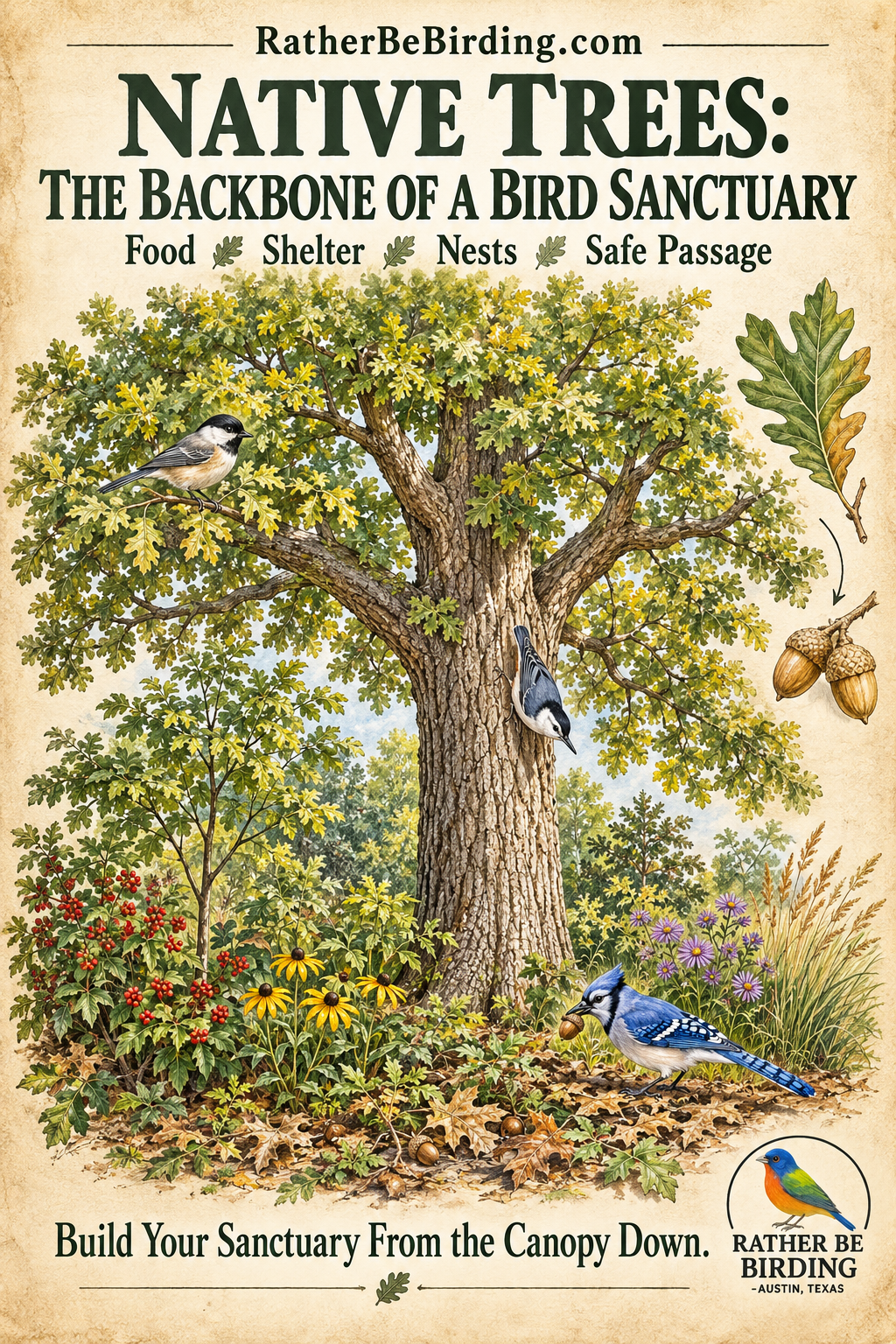
One of the best things you can do for nesting birds is plant—and preserve—trees.
Large native trees can provide:
sturdy branches for open-cup nests
hiding places among foliage
insects for hungry nestlings
protection from weather
roosting locations
eventual natural cavities for cavity-nesting species
Old trees can become especially valuable.
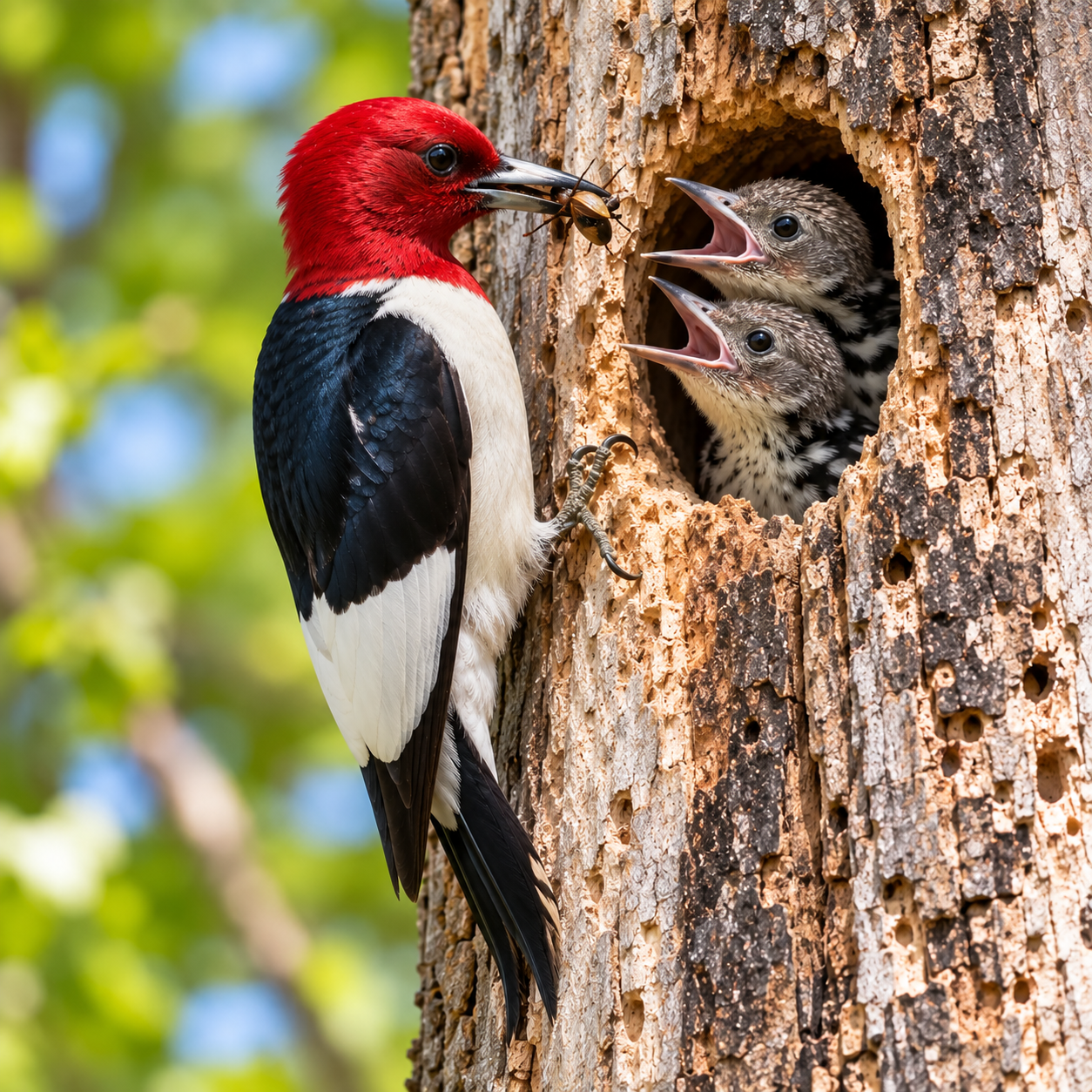
A broken limb or decaying section may eventually create exactly the cavity a woodpecker needs. Later, that same cavity may be occupied by a chickadee, titmouse, nuthatch, owl or another secondary cavity-nesting bird.
That doesn't mean leaving a dangerous dead tree beside your house. Safety comes first. But where a dead or partially dead tree can safely remain, consider keeping it as a wildlife snag rather than automatically removing it.
Native trees also help solve another enormous problem facing nesting birds:
Where does dinner come from?
Baby songbirds need tremendous quantities of insects.
Native trees such as oaks, willows, birches and cherries can support rich communities of native insects. Those caterpillars, spiders and other invertebrates become the food adult birds carry back to their young.
A tree, therefore, isn't simply a possible place for a nest.
It's part nursery, part shelter and part grocery store.
Don't Forget the Middle: Shrubs and Small Trees
We've talked before at Rather Be Birding about the importance of the "middle layer" of a backyard sanctuary.
Nesting season is where that layer really earns its keep.
Dense native shrubs and small trees provide nesting habitat for birds that aren't interested in cavities at all.
Depending on where you live, birds such as Northern Cardinals, Gray Catbirds, Brown Thrashers, towhees and various sparrows may use dense vegetation for nesting or protective cover.
Native dogwoods, serviceberries, viburnums, elderberries and other locally appropriate shrubs can provide combinations of branches, berries, insects and shelter.
[Our Jessamine Vine happily supports our Northern Mockingbird pair and their new brood each year.]
The important word is locally.
A shrub that's wonderful for birds in Maine may not belong in Arizona. Choose species native to your region and appropriate for your soil, rainfall and available space.
And resist the temptation to prune everything into perfect little green meatballs.
A slightly tangled shrub can be much more useful to a bird than a perfectly manicured one.
Build habitat, not just landscaping.
Then Add Nest Boxes
Once you have thought about the habitat, nest boxes become an excellent addition.
They are valuable for cavity-nesting birds—species that naturally nest inside holes rather than constructing exposed nests among branches. Birds aren’t very flexible about nesting. One exception are wrens who often nest in spare tires, garages, broken porch lights, etc. Their requirements are hard-wired and if there are no suitable sites, they simply don’t raise a family that season.
Depending on your location and habitat, nest-box users in the ABA area can include:
Eastern, Western and Mountain Bluebirds
Black-capped and Carolina Chickadees
Mountain Chickadees
Tufted, Oak and Juniper Titmice
Tree Swallows
several wrens
some nuthatches
Wood Ducks
Purple Martins
American Kestrels
several owl species
But here's the important part:
These birds don't all want the same house.
Putting up a generic decorative "birdhouse" and hoping somebody moves in isn't the best strategy.
Start with the bird.
What Bird Are You Trying to Help?
This is the question to answer before buying or building a nest box.
Different species require different:
entrance-hole diameters
floor dimensions
cavity depths
mounting heights
surrounding habitats
spacing from other boxes
An Eastern Bluebird and an American Kestrel are both cavity nesters, but their housing requirements obviously aren't remotely the same.
Even among smaller songbirds, an entrance hole that's appropriate for one species may allow a larger competitor to enter.
Cornell's NestWatch maintains species-specific recommendations for nest-box dimensions and placement. Use those measurements rather than guessing.
Build the box for the bird—not the birdhouse aisle.
Habitat Determines Whether a Box Works
Here's one of the most overlooked lessons about nest boxes:
The box can't compensate for the wrong habitat.
Bluebirds generally prefer relatively open country with low vegetation and available perches.
Chickadees are more closely associated with wooded areas and edges.
Tree Swallows need open habitat, often near water.
American Kestrels use much larger boxes placed in open landscapes such as pastures, fields, meadows and orchards in the country’s northern tier.
You could build a perfectly dimensioned box and still have it remain empty because you put it where your target bird doesn't want to live.
That's why the better question isn't:
Where would this birdhouse look cute?
It's:
Would this bird naturally choose this habitat?
Think like a bird.
Have a question about a specific bird species’ nesting requirements? Email me and I’ll happily help you decide your best options.
Install Nest Boxes Correctly
Once you've chosen the target species and the habitat is right, installation matters.
Small nest boxes are often better mounted on freestanding metal poles or PVC rather than nailed directly to trees. Pole mounting can make boxes easier to monitor and can allow the use of effective predator guards.
Mounting height varies considerably by species, so don't assume every box belongs five feet above the ground.
Orientation may also matter depending on the species and local climate. In particularly hot areas, protecting a box from intense afternoon heat can be important.
Boxes should be sturdy enough to withstand storms and strong winds and should include:
adequate ventilation
drainage holes
a roof that sheds rain
an entrance sized for the intended species
an opening panel for monitoring and cleaning
appropriate predator protection
And skip the perch.
Native cavity-nesting birds don't need one, and a perch can make it easier for predators or competitors to linger at the entrance.
Don't Forget the Predator Guard
If you're investing the effort to provide a nesting site, don't stop six inches short of making it safer.
Snakes, raccoons and other predators can climb poles and reach nests. It also keeps squirrels from chewing a bigger entrance hole and ruining for box investment.
A properly designed pole-mounted predator guard can greatly improve protection.
This is another reason I prefer thinking about the whole nesting system rather than simply purchasing a birdhouse.
The box, mounting pole, predator guard, placement and surrounding habitat all work together.
House Sparrows and European Starlings: The Uninvited Tenants
Two introduced species create a special challenge for people managing nest boxes in much of North America:
House Sparrows and European Starlings.
Both can compete aggressively with native cavity-nesting birds for limited nesting sites.
Proper entrance-hole dimensions can help exclude European Starlings from boxes intended for many smaller species.
House Sparrows can be considerably more difficult because they're small enough to enter many boxes intended for native songbirds.
Habitat selection helps.
House Sparrows are strongly associated with human structures, livestock facilities and developed landscapes. A box placed in suitable bluebird habitat away from buildings may encounter fewer House Sparrows than one mounted beside a busy patio or barn. A box placed in view of the kitchen table or back deck even at a distance can make it easier for you to monitor who is thinking of moving in.
Most importantly, monitor your boxes.
Learn to recognize the nests and eggs of the species likely to use your boxes, and follow current legal and ethical guidance when managing non-native occupants. Native birds, their nests and eggs are generally protected by federal law, so correct identification matters.
Clean Nest Boxes Between Nesting Seasons
Once the young have fledged and the breeding season is finished, your job isn't quite over.
Remove old nesting material and inspect the box.
Wear gloves, particularly when handling old nests and droppings. Remove debris, clean the box as necessary, allow it to dry thoroughly and check for:
cracked wood
loose screws
blocked drainage
damaged roofs
enlarged entrance holes
failed predator guards
Late winter is also a good time for a final inspection before birds begin looking for nest sites again.
Nest Boxes Are Used All Year Long
Some species may use boxes for roosting outside the breeding season. Bluebirds will huddle together to roost overnight on cold winter evenings. Screech Owls will consider their box as their permanent residence. Nest boxes become reliable refuges from winter weather.
Monitor Without Becoming the Nosy Neighbor
One of the pleasures of providing nesting habitat is watching the story unfold.
First comes the inspection.
A bird lands at the entrance.
Looks inside.
Disappears.
Comes back.
Then suddenly someone is carrying nesting material.
Soon you may notice adults making repeated trips carrying caterpillars and insects. Later, you'll hear begging calls. Eventually there comes that wonderful day when young birds appear outside the box.
Watch.
Take photographs from a respectful distance.
Keep a notebook.
Record when nest building began, when adults started carrying food and when young fledged.
If you monitor inside a nest box, follow a recognized nest-monitoring protocol rather than repeatedly opening the box simply because you're curious.
Better yet, consider submitting your observations to a citizen-science nest-monitoring program such as NestWatch.
Your backyard family can become part of something bigger.
Let the Parents Do the Parenting
Once birds are nesting, our instinct is often to help.
Usually the best help is restraint.
Give nesting birds space. Keep cats indoors. Reduce pesticide use. Avoid heavy pruning near active nests. Keep children and pets from repeatedly approaching the nest.
And don't panic when fledglings appear.
A young bird sitting awkwardly on a branch or hopping around the ground may look helpless, but its parents are probably nearby.
This stage is part of becoming a bird.
Sometimes being a good backyard bird steward means knowing when not to interfere.
The Best Nest Box May Be a Better Backyard
Nest boxes are wonderful.
Put them up.
Build them with your grandchildren. Monitor them. Watch bluebirds carry nesting material inside. Listen to chickadees calling from the trees. Celebrate when the first young bird sticks its head through the entrance.
But don't stop with the box.
Plant the native shrub underneath it.
Keep the mature tree at the edge of the property.
Plant an oak if you have the room.
Leave a safe snag where you can.
Grow several layers of vegetation.
Reduce pesticides.
Give fledglings somewhere to hide after they leave the nest.
Provide insects for parents to feed them.
Because the real goal isn't to convince a bird to use a wooden box.
It's to create a place where birds can successfully raise the next generation.
Congratulations—You're Helping Raise the Next Generation
There's something particularly satisfying about seeing birds raise young in a habitat you helped create.
Maybe you planted the serviceberry.
Maybe you stopped trimming one shrub quite so aggressively.
Maybe you preserved an old tree.
Maybe you installed a chickadee box on a pole with the right entrance hole and a predator guard.
None of these actions feels enormous.
But together they create habitat.
So if a pair of birds chooses your backyard this spring, take a moment and enjoy it.
You've done something worthwhile.
You've given them food, shelter, cover or a safe place to nest—and perhaps several of those things at once.
Congratulations. You're contributing to the sustainability of these species, one backyard and one successful nest at a time.
Now pour yourself a cup of coffee, find a comfortable chair and watch.
The birds will take it from here.