

How to Create a Backyard Bird Sanctuary: The Complete Guide
Turn Your Yard into a Refuge for Birds, Butterflies, and Your Own Peace of Mind
Updated 8/19/26
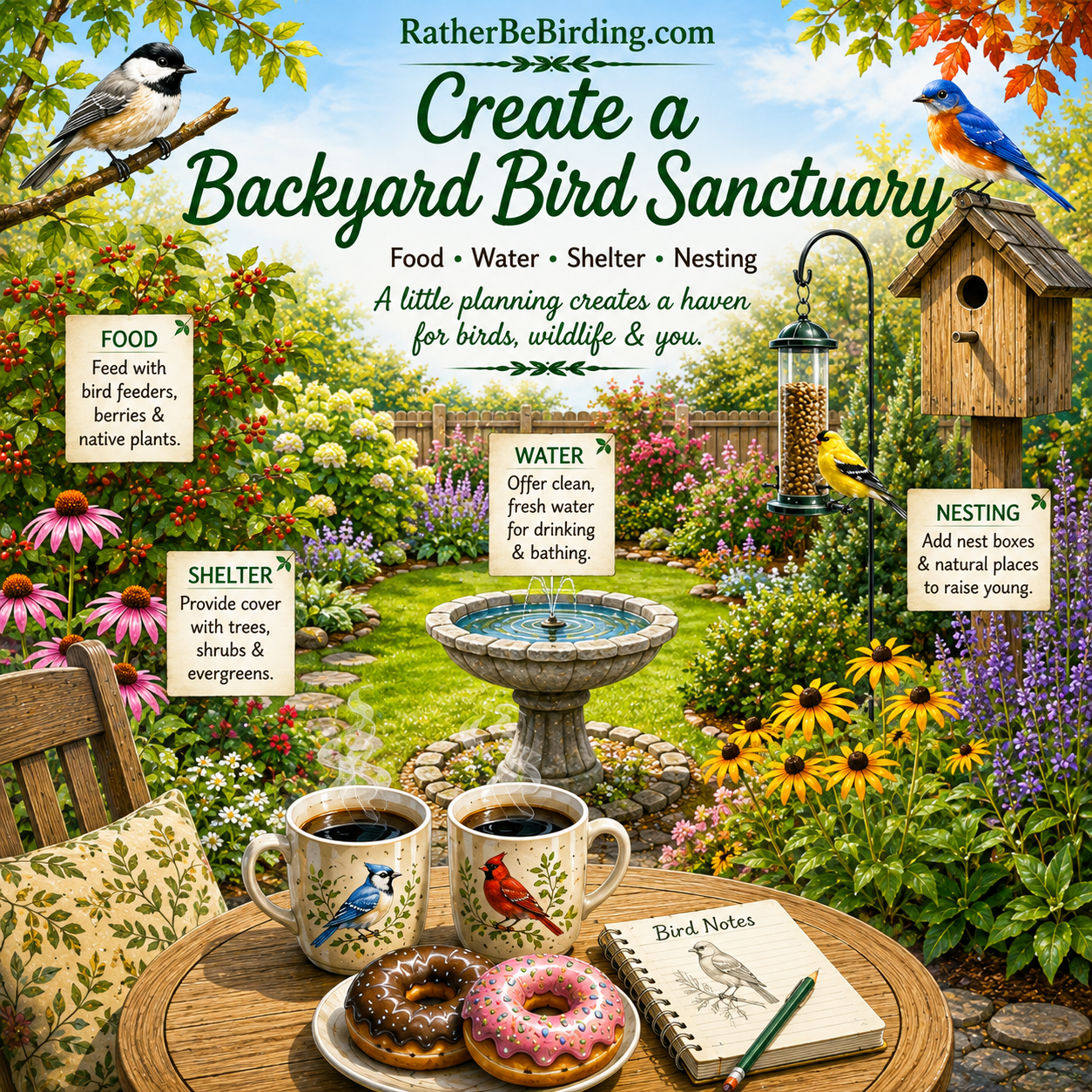
There’s something special about pouring a cup of coffee, stepping outside, and hearing birdsong before the day has really begun.
Maybe a chickadee is calling from the shrubs. A cardinal is waiting near the feeder. A woodpecker is working its way along the trunk of an old tree. Somewhere overhead, a hawk circles past.
A backyard filled with birds can feel wonderfully alive.
And creating one doesn’t require acres of land, an enormous budget, or a perfectly landscaped garden.
What birds really need is habitat.
A successful backyard bird sanctuary provides four basic things:
Food. Water. Shelter. Places to nest.
Once you begin looking at your yard through a bird’s eyes, creating a sanctuary becomes much easier. Instead of asking, What should I buy? you begin asking better questions:
Where can a bird hide?
Where can it find food besides my feeder?
Is there safe water nearby?
Could a bird raise young here?
Is there enough vegetation to move safely through the yard?
Those questions are the beginning of a real backyard bird sanctuary.
And the best part?
You don’t have to create it all at once.
Think Like a Bird Before You Change Your Yard
Before buying a single shrub, feeder, bird bath, or nest box, spend some time simply looking at your yard.
Then imagine that you're a bird.
A beautiful expanse of perfectly mowed lawn may look wonderful to us, but to a chickadee or sparrow it can be little more than an open space that must be crossed.
Birds see a yard differently.
They notice the dense shrub where they can disappear from a Cooper’s Hawk.
They notice the tree filled with caterpillars.
They notice berries ripening along the fence.
They notice seed heads left standing after summer flowers fade.
They notice the shallow puddle beneath the dripping faucet.
They notice the old tree with a cavity.
And yes, they certainly notice your feeders.
But a feeder alone doesn't make a bird sanctuary.
Habitat does.
That is why one of the best things you can do before changing your yard is to make a simple plan.
Start With a Backyard Bird Sanctuary Plan
You don't need landscape-design software.
A piece of graph paper and a pencil work beautifully.
Sketch the approximate shape of your property and mark what is already there:
House, garage, shed and deck
Existing trees and large shrubs
Fences
Sunny and shady areas
Garden beds
Walkways
Utility lines
Bird feeders
Bird baths
Nest boxes
Outdoor seating
Windows where you frequently watch birds
Don't worry about creating a professional drawing. This is a working plan.
Now look for opportunities.
Where could you add a shrub bed?
Could a small tree fill an empty corner?
Is there room for a bird bath near protective vegetation?
Could you enlarge an existing flower bed instead of creating an entirely new one?
Could a section of lawn gradually become native flowers and grasses?
Where would you like to sit and watch the birds? - one of the most important questions for you to ask.
Your sanctuary isn't only something you're creating for wildlife. It should also become a place where you enjoy spending time.
The Four Things Every Backyard Bird Sanctuary Needs
You can make sanctuary planning complicated, but birds themselves make the priorities remarkably simple.
They need:
Food
Feeders can supplement a bird's diet, but natural food is enormously important.
Trees, shrubs, flowers and grasses can provide:
Insects
Caterpillars
Seeds
Nuts
Acorns
Berries
Fruit
Nectar
A good sanctuary provides different foods throughout the year.
Water
Birds need water for drinking and bathing.
A simple bird bath may be enough, although small ponds, fountains, drippers and moving-water features can make a yard even more attractive.
Shelter
Birds need places to escape bad weather and predators.
Dense shrubs, evergreens, brush piles and layered vegetation provide the kind of cover that an open lawn cannot.
Nesting Places
Some birds build nests in trees and shrubs.
Others use cavities.
Some nest near the ground.
A sanctuary with varied vegetation and appropriate nest boxes gives more species opportunities to raise young.
These four elements become the foundation for everything else you do.
Build Your Bird Sanctuary in Layers
One of the most effective ways to make a backyard attractive to birds is to stop thinking only about individual plants and start thinking about layers.
Walk through a healthy woodland and you'll rarely see vegetation growing at just one height.
There may be towering trees overhead, smaller trees beneath them, shrubs closer to the ground, wildflowers and grasses below those, and fallen leaves covering the soil.
Birds use every one of those levels.
We can recreate a simplified version of that structure at home.
Layer One: Tall Trees
Start at the top.
Large trees can become the backbone of a backyard bird sanctuary.
They provide:
Nesting sites
Protective cover
Perches
Insects
Caterpillars
Seeds
Nuts
Fruit
Cavities
Shade
And few trees are more valuable to North American wildlife than native oaks.
Oaks support an extraordinary community of insects, and those insects become food for birds—especially when adults are feeding nestlings.
Mature trees may also eventually provide cavities for woodpeckers, chickadees, nuthatches, owls and other cavity users.
Depending on your region, valuable trees may include native:
Oaks
Maples
Willows
Birches
Pines
Spruces
Firs
Hickories
Hackberries
Serviceberries
Crabapples
Cherries
You don't necessarily need to plant a towering tree tomorrow.
Your most valuable sanctuary tree may already be growing in your yard.
Before removing a mature tree simply because it isn't perfectly shaped, consider what birds might be getting from it.
Layer Two: Small and Mid-Level Trees
Don't forget the middle.
Smaller trees create a bridge between the canopy and shrub layer.
They can provide blossoms in spring, insects during nesting season, fruit or berries later in the year and protected branches where birds can rest.
Depending on where you live, consider native varieties of:
Serviceberry
Dogwood
Hawthorn
Crabapple
Redbud
Elderberry
Mountain ash
Chokecherry
This layer is especially useful in suburban yards where enormous canopy trees may not fit everywhere.
One thoughtfully placed small tree can add an enormous amount of habitat.
Layer Three: Shrubs
If I could convince backyard birders to make one landscaping change, adding more shrubs would be near the top of my list.
Shrubs do a remarkable amount of work.
They can provide food, nesting sites and escape cover all in one plant.
Berry-producing shrubs can be especially valuable.
Depending on your region, possibilities include:
Viburnum
Elderberry
Serviceberry
Native holly
Beautyberry
Chokeberry
Dogwood
Spicebush
Wax myrtle
Manzanita
Currant
Dense shrubs also give small birds someplace to retreat when danger appears.
That matters around feeding stations.
A feeder standing alone in the middle of an enormous lawn may offer plenty of food but very little security.
Nearby vegetation can make birds feel much more comfortable.
Just don't crowd dense cover directly against a feeder where a neighborhood cat could hide and ambush feeding birds.
Layer Four: Flowers, Grasses and Ground Cover
Now look down.
The lowest layer of your sanctuary is easy to overlook, but it can be incredibly productive.
Native flowers attract insects and pollinators.
Those insects feed birds.
Later, flower seed heads may provide food for finches, sparrows and other seed-eating species.
Consider plants such as:
Coneflowers
Black-eyed Susans
Asters
Goldenrod
Bee balm
Blazing star
Coreopsis
Sunflowers
Milkweed
Native salvias
Native grasses can also provide seeds, insects and cover.
And here's one of the easiest sanctuary improvements of all:
Don't clean everything up.
Those brown flower heads that look "finished" to us may still contain seeds.
Leaves beneath shrubs may harbor insects.
A slightly untidy corner can be excellent bird habitat.
A bird sanctuary doesn't need to look abandoned.
But it also doesn't need to look sterile.
Why Native Plants Matter
You don't have to remove every non-native plant from your property.
But when you're adding something new, native plants deserve serious consideration.
Why?
Because native birds, native insects and native plants evolved together.
A shrub isn't valuable only because it produces berries.
Its leaves may support insects.
Its branches may provide nesting structure.
Its flowers may feed pollinators.
Its berries may feed migrating birds.
Its fallen leaves may shelter insects that become food for ground-feeding birds.
One plant can participate in an entire little food web.
That's the real power of native landscaping.
And it is also why a sanctuary filled with plants can support birds in ways that feeders alone never can.
Add Water—One of the Best Bird Magnets in the Yard
People often think first about food when trying to attract birds.
I think water deserves just as much attention.
Birds need water for drinking and bathing, and even species that rarely visit feeders may investigate a good water source.
A basic bird bath works beautifully.
The important word is shallow.
Birds don't need a miniature swimming pool.
If your basin is too deep, add flat stones or rocks that create shallow areas and secure footing.
A gently sloping basin is ideal.
Keep the water fresh and clean the bath regularly. Warm weather can quickly turn standing water into something you wouldn't want a bird drinking.
Location matters, too.
Provide enough nearby vegetation that a wet bird can quickly reach cover, but avoid placing the bath immediately beside dense hiding places that could conceal a cat or other predator.
Want to make your water even more noticeable?
Make it move.
A dripper, bubbler, fountain or small solar water feature can attract attention through both motion and sound.
Create a Feeding Station Instead of Random Feeders
Feeders are wonderful additions to a sanctuary.
But instead of hanging feeders wherever you happen to find an empty hook, think about creating a feeding station.
Different feeders serve different birds.
Tube Feeders
Tube feeders work particularly well for smaller birds such as:
Chickadees
Titmice
Finches
Nuthatches
Fill them with quality seed appropriate for the birds you want to attract.
Platform Feeders
Platform feeders accommodate larger species and birds that prefer a more open feeding surface.
Depending on your region, visitors might include:
Cardinals
Jays
Grosbeaks
Towhees
Sparrows
Suet Feeders
Suet is especially attractive to:
Woodpeckers
Nuthatches
Chickadees
It can be particularly useful during colder weather when birds need calorie-rich foods.
Hummingbird Feeders
Hummingbird feeders can supplement nectar-producing flowers.
Keep the nectar fresh, clean feeders thoroughly and use the standard solution of four parts water to one part plain white granulated sugar.
There's no need for red dye.
A red feeder is enough to get a hummingbird's attention.
Put Feeders Where Birds—and People—Can Use Them Safely
Feeder placement deserves more thought than it often gets.
You want birds to have nearby escape cover.
You also want to reduce window-collision risk.
And ideally, you'd like feeders where you can actually enjoy watching them.
Consider the view from your kitchen table, favorite chair, office or deck.
A sanctuary that you can see becomes a sanctuary you'll notice.
You'll begin recognizing individual behaviors.
You'll notice when migrants arrive.
You'll see parents bringing young birds to the feeders.
You'll know when the goldfinches begin changing plumage.
The backyard itself becomes part of your birding life.
Give Birds Places to Nest
Food gets birds into a yard.
Good habitat may persuade them to stay.
Trees and shrubs provide natural nesting locations for many species.
Dense shrubs can attract birds that prefer protected nest sites, while taller trees provide opportunities for species that nest higher above the ground.
Cavity nesters have different requirements.
Depending on your region and habitat, nest boxes may attract species such as:
Bluebirds
Chickadees
Wrens
Tree Swallows
Nuthatches
But don't install a nest box merely because it's cute.
Entrance-hole diameter, box dimensions, mounting height, habitat and predator protection matter.
The right box in the right place can be wonderful.
The wrong box may remain empty—or create unnecessary risks.
Dead Wood Can Be Very Much Alive
One of the strangest ideas in conventional landscaping is that every dead branch and aging tree must immediately disappear.
From a wildlife perspective, dead wood can be incredibly valuable.
A standing dead tree—or snag—may provide:
Insects for woodpeckers
Perching sites
Nest cavities
Roosting cavities
Food-storage locations
Obviously, safety comes first.
A dead tree that could fall onto your house, sidewalk, driveway or neighbor's property needs professional evaluation.
But when a snag can safely remain, even partially, it may become one of the most valuable habitat features on your property.
Fallen logs and brush piles can provide habitat, too.
Nature wastes very little.
Remember the Butterflies, Bees and Other Wildlife
When you create better bird habitat, something interesting happens.
Other wildlife begins showing up.
Native flowers may attract butterflies.
Milkweed may bring Monarchs.
Pollinators arrive.
Dragonflies patrol around water.
Toads find shelter beneath plants.
Lizards may hunt insects along rocks and garden edges.
Depending on where you live, rabbits, squirrels, chipmunks and other mammals may become regular visitors.
That isn't a distraction from creating a bird sanctuary.
It's part of it.
Birds exist within ecosystems.
A yard filled with insects and plant diversity often provides far more natural food than a yard designed only around feeders.
Backyard Bird Sanctuary Ideas by Region
There is no single perfect plant list for North America.
A sanctuary in Arizona should not look like a sanctuary in Maine.
That's a good thing.
Work with your region rather than trying to create a generic backyard.
Northeast
Think deciduous woodland edges.
Native oaks, maples, birches, serviceberries, dogwoods and berry-producing shrubs can create excellent structure.
Add asters, goldenrod, coneflowers and native grasses at lower levels.
Evergreens can provide valuable winter shelter when deciduous trees are bare.
Southeast
The Southeast offers an extraordinary growing season.
Native oaks, hollies, magnolias, dogwoods and wax myrtle can provide food and shelter.
Beautyberry can add both visual appeal and wildlife value.
Dense vegetation is useful, but avoid creating hidden ambush locations immediately beside feeders.
Water can be particularly valuable during hot weather.
Midwest and Great Plains
Use wind and exposure to your advantage.
Native oaks, hackberries and other regionally appropriate trees can form the upper layer.
Serviceberry, dogwood and native shrubs can provide middle structure.
Prairie flowers and grasses are particularly valuable additions here.
Coneflowers, blazing star, goldenrod, asters and native sunflowers can support both birds and pollinators.
Rocky Mountain States
Water becomes particularly important in many western landscapes.
Native conifers can provide year-round cover, while serviceberries, currants and other regionally appropriate shrubs can supply fruit and structure.
Don't assume your sanctuary needs to resemble an eastern woodland.
Work with altitude, rainfall and the plants naturally suited to your area.
Southwest
A Southwestern bird sanctuary can be spectacular without pretending to be somewhere wetter.
Think drought-tolerant native habitat.
Depending on your location, consider native mesquite, desert willow, hackberry, native salvias, penstemons, agaves and other plants adapted to your climate.
Water can be especially powerful here.
A shallow, reliable water source may attract birds you rarely see at feeders.
West Coast
West Coast gardens vary enormously from the Pacific Northwest to Southern California, so local native-plant knowledge is especially valuable.
Native oaks are extremely important in many areas.
Manzanita, currants, ceanothus and other regional shrubs can provide flowers, fruit and cover.
In drier areas, choose plants adapted to seasonal drought rather than creating a water-hungry landscape.
Your Bird Sanctuary Changes With the Seasons
One of the pleasures of creating habitat is discovering that your backyard never really stays the same.
Spring
Spring is about nesting.
Birds need protein-rich insects, safe nesting habitat, fresh water and plenty of cover.
This is also when you'll discover why those native plants matter.
Watch closely and you may see adult birds carrying caterpillars and insects to hungry nestlings.
Summer
Water becomes increasingly important.
Keep baths clean and filled.
Watch nectar feeders carefully in hot weather and change nectar frequently.
Dense vegetation provides shade and shelter.
This is also a wonderful time to notice fledglings learning how to use your sanctuary.
Fall
Don't be too quick to clean up.
Leave flower seed heads standing.
Let some leaves remain beneath shrubs.
Berry-producing plants may become important food sources for migrants.
Fall is also a wonderful time to evaluate your landscaping and decide where another shrub or tree might improve the habitat.
Winter
Winter reveals whether your sanctuary truly has structure.
Evergreens become valuable shelter.
Seed heads become natural feeders.
Suet can provide concentrated energy.
Open water may become one of the most sought-after resources in the yard.
A heated bird bath—or safe method of keeping water available—can bring remarkable activity during freezing weather.
Avoid These Common Backyard Bird Sanctuary Mistakes
Most sanctuary mistakes begin with good intentions.
Mistake #1: Thinking Feeders Are Enough
Feeders are supplements.
Habitat is the foundation.
Mistake #2: Too Much Open Lawn
You don't have to eliminate your lawn.
But converting even part of it into layered vegetation can dramatically increase habitat value.
Mistake #3: Planting Without Considering Mature Size
That adorable three-foot tree at the nursery may eventually become enormous.
Check mature height and width before planting.
Mistake #4: Making Bird Baths Too Deep
Think shallow water and secure footing.
Add stones when necessary.
Mistake #5: Forgetting About Predators
Avoid placing feeders and baths where cats can easily hide and pounce.
Mistake #6: Over-Cleaning the Landscape
Dead leaves, seed heads and some dead wood have ecological value.
"Tidy" and "healthy habitat" aren't always the same thing.
Mistake #7: Using Pesticides Routinely
If you want birds, you need insects.
A yard devoid of insects isn't necessarily a healthy bird habitat.
Mistake #8: Trying to Finish Everything at Once
This may be the biggest mistake of all.
A sanctuary should evolve.
Plant one shrub.
Add water.
Improve your feeder station.
Plant a tree.
Expand a flower bed.
Watch what happens.
Then make the next decision.
Start Small: Your First Backyard Sanctuary Weekend
If all of this sounds like a lot, don't make a fifty-item project list.
Do four things.
1. Draw your yard.
Use graph paper and mark what you already have.
2. Add or improve water.
Clean the bird bath, make sure it's shallow and consider adding movement.
3. Identify one missing landscaping layer.
Maybe you have mature trees but almost no shrubs.
Start there.
4. Improve one feeding area.
Clean the feeders, use good food and reconsider placement.
That's enough.
You have begun.
Then Watch What Happens
This may be the most important step in the entire guide.
Sit down.
Bring your coffee.
Grab the binoculars if you want them.
Or don't.
Just watch.
Notice which shrubs birds use when they leave the feeder.
Notice whether chickadees investigate your new tree.
Watch goldfinches pick seeds from spent flowers.
Listen for birds you don't immediately recognize.
Notice when the first migrant appears in spring.
Notice when fall migration quietly begins.
Keep a notebook nearby.
Take photographs.
Make a yard list.
Invite someone to sit outside with you.
Your sanctuary isn't a landscaping project you eventually finish.
It's a living place you get to know.
And that may be one of its greatest rewards.
A Backyard Bird Sanctuary Doesn't Have to Be Perfect
You don't need acres.
You don't need an unlimited landscaping budget.
You don't need every native plant recommended for your region.
And you certainly don't need to finish it this year.
Start with what you have.
Protect the mature tree already shading the yard.
Plant one berry-producing shrub.
Let a few flower heads remain through winter.
Add a shallow bird bath.
Hang a feeder where you can enjoy it.
Leave a few leaves beneath the shrubs.
Plant something native.
Then give nature some time.
Birds have an extraordinary ability to discover good habitat.
One morning you may walk outside with your coffee and realize the yard sounds different.
There are chickadees in the shrubs.
A woodpecker is working the tree.
Goldfinches are feeding among the flowers.
A cardinal disappears into the hedge.
And suddenly the backyard doesn't feel like landscaping anymore.
It feels alive.
That's when you know your backyard bird sanctuary is working.
Read How to Create Layers in Your Backyard for More Birds and Designing the Perfect Backyard Feeding Station
