

How to Create Layers in Your Backyard for More Birds
And How to Help Them Thrive
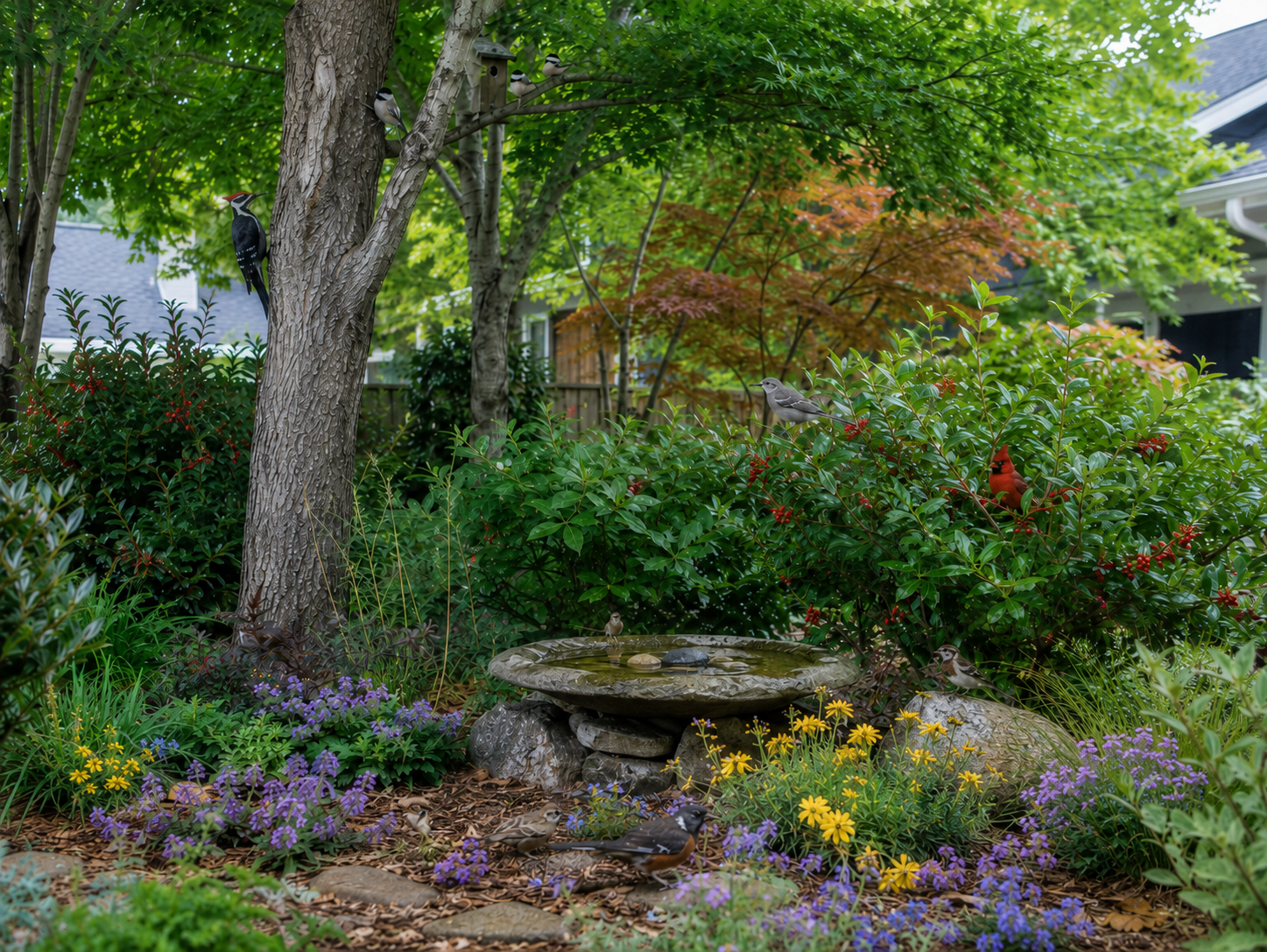
One of the easiest ways to make your yard more attractive to birds is to stop thinking of it as a flat, grassy space.
Most of us look at a backyard and see lawn, fence, patio, flowerbed, maybe a tree or two. Birds see something different. They see height. Cover. Escape routes. Feeding spots. Perches. Nesting choices. Sunny edges. Shady places. Bare patches. Seeds. Insects. Water.
In other words, birds see layers.
A backyard that has only lawn and a few scattered plants may look tidy, but to birds it can feel like a wide-open room with nowhere to hide and not much to eat. A backyard with canopy trees, smaller understory trees, shrubs, ground cover, leaf litter, and water begins to feel more like habitat.
That is the heart of creating a backyard bird sanctuary. As we covered in the Backyard Bird Sanctuary Guide, birds need more than a feeder. Feeders can be helpful, and they are certainly fun, but the real magic happens when your yard begins offering the things birds are already looking for: food, water, shelter, nesting places, and safety.
The National Wildlife Federation describes wildlife habitat as a combination of food, water, cover, and places to raise young, with native plants forming a strong foundation for supporting wildlife. Audubon also emphasizes that locally native plants provide insects, berries, nectar, seeds, and refuge for birds.
Layering is one of the most practical ways to bring all of those pieces together.
What Does It Mean to Create Layers?
In a natural woodland edge, meadow border, creekside, or brushy field, plants do not usually grow in one neat line. They grow at different heights. Large trees rise overhead. Smaller trees fill in the middle. Shrubs create dense cover. Grasses, flowers, ferns, vines, fallen leaves, and low plants cover the ground.
Birds use those layers in different ways.
Some birds spend much of their time high in the treetops. Some prefer the middle branches. Some tuck into shrubs. Others scratch through leaves on the ground. Many move between layers depending on the season, weather, food supply, and whether they are nesting, migrating, hiding, or feeding young.
This is important: the bird examples below are not strict rules. Birds are wonderfully inconvenient that way. A cardinal may feed on the ground, sing from a shrub, and perch in a tree. A warbler may be high in the canopy one day and low in your shrubs during migration. A woodpecker may work the trunk of a tall tree and then drop down to a suet feeder.
But thinking in layers helps you create more opportunities.
Instead of asking, “What one plant should I add for birds?” a better question is, “What layer is missing from my yard?”
The Canopy Layer: The High-Rise Apartment Building
The canopy is the tallest layer in your yard. These are the big trees: oaks, maples, pines, sycamores, cottonwoods, hickories, elms, sweetgums, pecans, or whatever large native trees are appropriate where you live.
If you already have mature trees, congratulations. You have one of the most valuable parts of a bird sanctuary already in place. Mature trees offer perches, nesting cavities, insects, buds, seeds, nuts, shade, and safety. They also create a cooler, more protected microclimate below.
The canopy is often where you may notice birds such as:
Woodpeckers moving along trunks and large limbs.
Nuthatches creeping headfirst down bark.
Chickadees and titmice searching twigs and leaves.
Vireos singing from hidden places in the foliage.
Orioles moving through treetops in spring and summer.
Warblers passing through during migration.
Tanagers, grosbeaks, and flycatchers using high perches.
Owls, hawks, and crows watching from above.
Large native trees are especially valuable because they support insect life, and insects are not a side dish in the bird world. They are often the main course, especially during nesting season. Cornell Lab’s All About Birds notes that native plants create a “wild-foods bonanza” that helps attract more species to a yard.
If your yard is small, you may not have room for a giant tree. That is okay. The goal is not to turn every suburban lot into an old-growth forest. The goal is to add as much vertical structure as your space reasonably allows. A smaller native tree is still a layer. A neighbor’s large tree that overhangs your yard still contributes. Even a narrow yard can benefit from one carefully chosen tree.
Good canopy choices depend heavily on your region, soil, rainfall, and space. In many areas, native oaks are among the most valuable wildlife trees. But the best tree is one that belongs in your local ecosystem, has room to grow safely and will thrive with your typical amount of rainfall.
A practical tip: before planting a canopy tree, imagine it at full size. Not cute little nursery-pot size. Full-grown “hello, I am now a major life decision” size. Think about rooflines, power lines, sidewalks, septic systems, fences, and shade patterns.
Birds love trees. Homeowners love trees more when they are planted in the right place.
The Understory Layer: The Quiet Middle
The understory is the layer beneath the tallest trees but above the shrubs. Think small trees and large, airy shrubs: redbuds, dogwoods, serviceberries, hawthorns, crabapples, elderberries trained as small trees, yaupon holly, mountain laurel, native cherries, or other regional choices.
This is a wonderful layer because it creates movement and shelter between the high canopy and the lower shrubs. Birds do not always want to fly from the ground straight to the top of a tree. Many prefer stepping-stone cover. A small tree gives them a place to pause, watch, feed, preen, sing, or retreat.
The understory may attract birds such as:
Cardinals using branches as singing perches.
Mockingbirds and catbirds feeding on berries.
Thrushes passing through shady areas during migration.
Flycatchers watching for insects from exposed perches.
Wrens exploring tangles and low limbs.
Chickadees, titmice, and warblers gleaning insects.
Cedar Waxwings visiting fruiting trees in flocks.
This layer can be especially helpful for migrating birds. A tired migrant dropping into a neighborhood is often looking for food and cover quickly. A yard with only lawn may not hold it for long. A yard with small native trees, berries, insects, and water may become a little rest stop.
And this is where backyard birding gets quietly thrilling. You may not notice the change all at once. But one spring morning, there is a Black-and-white Warbler working a trunk. Or a Swainson’s Thrush standing silently in the shadows. Or a small flock of waxwings appears because the fruit is just right.
The understory turns your yard from “place birds pass over” into “place birds check out.”
The Shrub Layer: The Safety Net
If the canopy is the high-rise, the shrub layer is the neighborhood café, nursery, storm shelter, and snack bar all rolled into one.
Shrubs are incredibly important for birds because they provide dense cover. That cover matters. Birds need places to hide from predators, escape bad weather, wait their turn at feeders, nest, and move around the yard without feeling exposed.
This is the layer many yards are missing.
We often have lawn, a few tall trees, and then a big empty gap in the middle. To a bird, that gap can feel risky. Shrubs help close that gap.
Good bird-friendly shrubs may offer berries, flowers, seeds, insects, nesting sites, thorns, evergreen cover, or all of the above. Depending on your region, you might consider native viburnums, dogwoods, hollies, beautyberry, spicebush, sumac, elderberry, serviceberry, chokeberry, native roses, wax myrtle, buttonbush, or other local species.
The shrub layer may bring in birds such as:
Northern Cardinals.
Carolina Wrens or Bewick’s Wrens.
Gray Catbirds.
Brown Thrashers.
Song Sparrows, White-throated Sparrows, or other sparrows.
Towhees.
Yellow-rumped Warblers in berry season.
Finches using nearby cover.
Young birds after they leave the nest.
Shrubs near feeders are especially useful, but not too near. Birds like to have cover nearby so they can retreat quickly. But if shrubs are extremely close to a feeder, they may also give outdoor cats or other predators a hiding place. A little distance is helpful. Close enough for birds to escape. Open enough that predators cannot easily ambush.
The shrub layer is also where a yard starts to feel alive in winter. Evergreen shrubs can provide shelter on cold, windy days. Berry-producing shrubs can offer food after flowers and insects are long gone. Brushy cover can hold sparrows and wrens that might otherwise move on.
If your yard feels too exposed, start with shrubs. They are often faster than trees, easier to fit into small spaces, and instantly useful as structure.
The Ground Cover Layer: Where the Quiet Birds Work
The ground layer is easy to overlook because it is not always flashy. But birds absolutely use it.
This layer includes native grasses, sedges, wildflowers, low-growing plants, ferns, leaf litter, fallen branches, mulch, bare soil patches, and natural edges. It also includes what happens when we resist the urge to clean up every leaf, stem, and seed head.
A perfectly bare yard may look neat, but it does not offer much for ground-feeding birds. A more natural ground layer can hold seeds, insects, spiders, beetles, caterpillars, and other small creatures birds depend on.
The ground layer may attract birds such as:
Juncos.
Towhees.
White-throated Sparrows.
Song Sparrows.
Chipping Sparrows.
Mourning Doves.
Robins.
Thrashers.
Quail, where habitat and region allow.
Wrens investigating leaf litter and brush piles.
This layer is also important because many insects overwinter in leaves, stems, or soil. If every leaf is removed and every stem is cut down immediately, some of next season’s bird food disappears with it.
That does not mean your yard has to look abandoned. There is a big difference between “wildlife-friendly” and “the neighbors are forming a committee.” You can use intentional edges. Keep paths clear. Tuck leaves under shrubs. Leave a back corner a little looser. Cut some stems in spring instead of fall. Add native grasses in a defined bed. Use logs or branches as a natural border.
One of the best sanctuary tricks is to make the messy parts look chosen.
Birds do not need perfection. They need function.
Water: The Layer That Pulls Everything Together
If you add only one feature to your yard for birds, water should be at the top of the list.
Birds need water for drinking and bathing. A reliable water source can attract birds that may not care about your feeders at all. In hot weather, dry weather, freezing weather, or during migration, water can become one of the most valuable things in your yard.
A birdbath is enough to begin. It does not have to be fancy. In fact, many birds prefer shallow water. A basin that is too deep may be less inviting, especially for smaller birds. Adding a few stones can give birds a secure place to stand.
Moving water is even better. A dripper, small fountain, mister, or bubbler can catch birds’ attention. Sound matters. Birds may hear water before they see it.
Place water where birds have nearby cover, but also enough visibility to watch for danger. A bird that is bathing is vulnerable. It wants to feel safe. A shrub or small tree nearby can help, especially if the bird can retreat quickly after bathing.
Water may bring in almost any backyard bird, including:
Robins splashing like they own the place.
Goldfinches coming in for careful sips.
Warblers dropping by during migration.
Thrushes visiting quietly at dusk.
Woodpeckers using a sturdy basin.
Sparrows and juncos bathing low.
Hawks occasionally drinking or bathing, which is always a backyard drama.
The most important water rule is cleanliness. Change water often. Scrub the basin. Keep mosquitoes from breeding. In freezing climates, a heated birdbath can be very helpful in winter, but keep cords safe and use outdoor-rated equipment.
Water turns your layered habitat into a destination.
How to Build Layers Without Redoing the Whole Yard
You do not have to transform everything at once. In fact, please do not. That way lies overwhelm, sore knees, and a cart full of plants you later realize have no business living in your soil.
Start by looking at what you already have.
Do you have tall trees? Then ask what is missing underneath them.
Do you have shrubs? Add ground cover and leaf litter below.
Do you have mostly lawn? Begin with one island bed that includes a small tree, shrubs, flowers, and a water source nearby.
Do you have a fence line? Turn it into a habitat edge.
Do you have a bare corner? Make it your sanctuary pocket.
A simple layered planting might look like this:
One small native tree in the back.
Three native shrubs around it.
Native flowers and grasses below.
Leaves left under the shrubs.
A shallow birdbath nearby.
That one little area can become a miniature bird neighborhood.
Over time, you can repeat that pattern in other parts of the yard. Connect beds. Soften corners. Add vines where appropriate. Replace a little lawn at a time. Let your yard become more useful, not just more planted.
Think in Edges, Not Just Beds
Birds love edges. The edge between trees and open space. The edge between shrubs and lawn. The edge near a brush pile. The edge of a patio with nearby cover. Edges give birds choices.
A layered yard creates more edges.
This is one reason a sanctuary yard does not have to be huge. Even a small yard can offer a tree, a shrub, flowers, ground cover, and water. Even a patio can offer container shrubs, native flowers, a small water dish, and vertical structure.
The point is not acreage. The point is variety.
Feeders Still Have a Place
Creating layers does not mean you have to give up feeders. Feeders can be wonderful. They bring birds close, help beginners learn common species, and offer daily joy right outside the window.
But feeders work best when they are part of a larger habitat.
A feeder hanging in the middle of an empty lawn may attract some birds, but a feeder near layered cover can feel safer and more natural. Birds can feed, retreat, perch, wait, and move through the yard more comfortably.
Think of feeders as one restaurant in a larger town. The plants, water, shelter, and layers are the town itself.
The Best Backyard Sanctuary Is Always Becoming
A bird sanctuary is not finished in one weekend. It grows. It fills in. It changes with the seasons. Some plants thrive. Some sulk dramatically and need to be replaced. Birds discover it slowly.
The first year, you may notice more insects and a few extra sparrows.
The second year, the shrubs may hold young cardinals.
The third year, a migrant warbler may stop in the understory.
One winter, juncos may find your leaf litter.
One spring, chickadees may inspect a nest box.
And one morning, coffee in hand, you may look outside and realize your yard is no longer just a yard. It has become habitat.
That is the beauty of creating layers. You are not simply decorating. You are rebuilding little pieces of the natural world birds understand.
Canopy. Understory. Shrubs. Ground cover. Water.
Give birds those layers, and your backyard becomes more than a place they visit. It becomes a place they can use.
Read Backyard Bird Sanctuary Guide next.
If you’re ready to make some choices in a new bird bath (or other water feature) for your backyard, check out the choices for bird baths, solar fountains, bubblers and heaters at the Rather Be Birding Essentials Amazon Store.
