

Purple Martins
From Your Backyard to the Amazon Rainforest
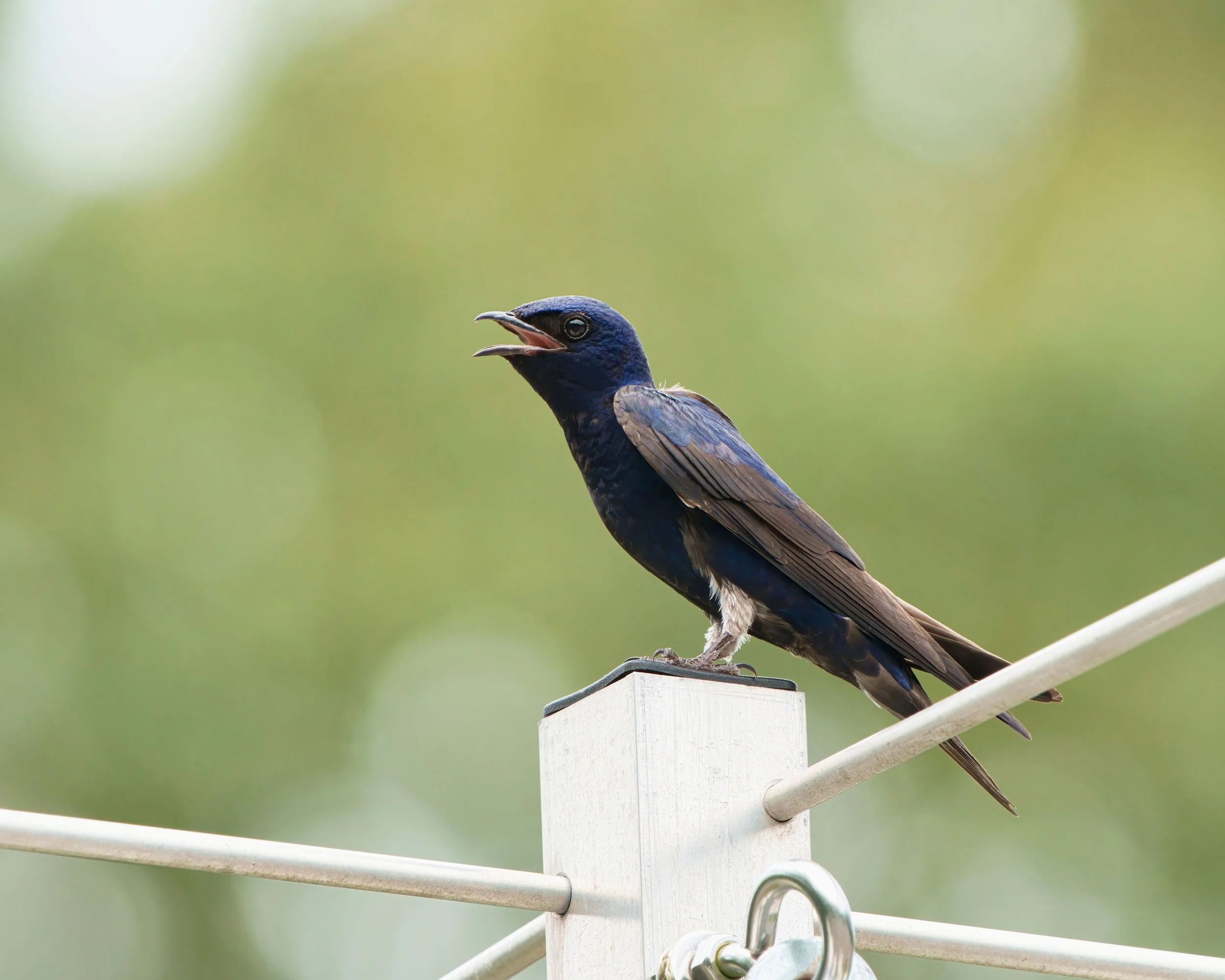
For many bird lovers, the arrival of Purple Martins feels like the true beginning of spring. Their bubbly calls in a non-stop conversation, graceful flight, and constant activity around a martin colony are enough to brighten any backyard.
But there is another side to the Purple Martin story that is even more remarkable.
Unlike most wild birds, Purple Martins east of the Rocky Mountains now depend almost entirely on people for nesting sites. Without generations of bird enthusiasts maintaining martin houses and gourds, these beautiful swallows might look very different today—or be far less common across much of their range.
Then, after spending only a few short months raising young, they begin one of the most incredible migrations in North America. By late July and August, hundreds of thousands of martins gather into enormous flocks before heading south toward South America. Estimates put the number at 9.3 MILLION in 2025.
It is a conservation success story, a migration miracle, and one of the easiest opportunities for birders to witness a truly spectacular natural event.
The Bird That Chose to Live Alongside People
Purple Martins (Progne subis) are the largest swallows in North America. Adult males are a deep, glossy blue-black that often appears purple in bright sunlight. Females and young birds are softer in color, with grayish underparts and darker upperparts.
Long before European settlement, Purple Martins nested in natural tree cavities and abandoned woodpecker holes. Indigenous peoples across parts of eastern North America discovered that martins readily accepted hollowed gourds hung near villages.
The relationship benefited both species.
Martins gained safe nesting locations near human communities, while people enjoyed having insect-eating birds nearby and appreciated their cheerful presence.
Over many generations, this partnership became stronger.
When European settlers arrived, they continued the tradition of providing housing. Over time, Purple Martins increasingly shifted from natural cavities to man-made structures.
Today, east of the Rocky Mountains, Purple Martins nest almost exclusively in human-provided houses and gourds.
Think about that for a moment.
Very few wild birds have become so closely tied to people while remaining completely free-ranging. Purple Martins are not domesticated. They are still wild birds. Yet entire populations now depend on generations of landlords who maintain nesting colonies.
A Conservation Story Hidden in Plain Sight
Many birders don't realize how important this relationship has become.
As forests changed, old cavity-bearing trees disappeared from many areas. Competition from invasive species also increased.
Two introduced birds created major challenges:
House Sparrow
European Starling
Both species aggressively compete for nesting cavities.
House Sparrows frequently take over martin compartments and may destroy eggs or kill nestlings. European Starlings can completely dominate nesting sites if housing is not properly managed.
Because Purple Martins return year after year to the same colony areas, a poorly managed site can quickly become unsuitable.
Fortunately, dedicated martin enthusiasts stepped in.
Throughout the twentieth century, thousands of volunteers installed martin houses, monitored colonies, controlled invasive competitors, and shared knowledge about successful management.
Organizations such as the Purple Martin Conservation Association helped spread research and best practices.
The result is one of North America's most successful citizen-led bird conservation efforts.
Every thriving martin colony you see today represents countless hours donated by people who care deeply about these birds.
Why Martins Love Colony Living
Unlike many backyard birds, Purple Martins are highly social.
A pair of Eastern Bluebirds may happily nest alone. A Carolina Chickadee often prefers a territory of its own.
Martins are different.
They thrive in colonies.
One martin house might contain a dozen nesting pairs. Larger sites can support dozens more. Throughout the breeding season, adults constantly fly back and forth carrying insects to hungry young.
The colony becomes a bustling aerial neighborhood.
Watching a martin colony is a wonderful way to learn bird behavior.
You can observe:
Courtship displays
Nest building
Territorial interactions
Feeding trips
Young birds exercising their wings
Newly fledged juveniles learning to fly
There is always something happening.
Many martin landlords will tell you that what started as a single house eventually became a lifelong passion.
The largest colony of Purple Martins appears to be The Johnson Purple Martin Colony in Rainsville, Alabama - home to 2000 nesting pairs each year.
Built for Life on the Wing
Purple Martins belong to the swallow family, and they are superb flyers.
Their bodies are streamlined for aerial feeding.
Rather than perching on flowers or searching through foliage, martins capture insects while flying.
A martin can spend hours cruising through the sky, grabbing:
Flying beetles
Dragonflies
Moths
Wasps
Winged ants
Various other insects
Contrary to popular myth, martins are not mosquito specialists.
The old claim that a martin eats thousands of mosquitoes every day isn't supported by research.
That doesn't make them any less impressive.
They are still exceptional insect hunters capable of covering enormous distances during daily feeding flights.
Watching a group of martins twisting through the evening sky is like watching a squadron of fighter jets performing an air show.
Everything about them is built for flight.
The Breeding Season Is Surprisingly Short
One of the most amazing facts about Purple Martins is how little time they spend on their breeding grounds.
Many birders assume that birds arrive in spring, remain all summer, and leave in autumn.
Purple Martins operate on a much tighter schedule.
Adult males often arrive across the southern United States as early as January or February.
By spring, colonies are busy with nesting activities.
Eggs are laid.
Young hatch.
Parents work tirelessly feeding growing nestlings.
By early summer, fledglings begin leaving the nest.
Then something surprising happens.
The breeding season ends almost immediately.
Many adult martins begin departing nesting colonies in July.
By late July and August, large numbers have already shifted toward migration staging areas.
Some birds spend only a few months on their breeding grounds before beginning a journey measured in thousands of miles.
The Great Gathering Begins
If you've never witnessed a Purple Martin roost, put it on your birding bucket list.
As nesting concludes, martins from dozens or even hundreds of colonies begin gathering together.
Small groups become larger groups.
Large groups become enormous flocks.
Eventually, tens of thousands—and sometimes hundreds of thousands—of birds may gather in a single communal roost.
These gatherings often occur near:
Wetlands
Rivers
Lakes
Urban areas with suitable trees
Reed beds
The spectacle can be astonishing.
An hour before sunset, martins begin arriving from every direction.
The sky fills with birds.
Groups swirl overhead.
New flocks continue pouring in.
Then, as darkness approaches, the entire mass suddenly drops into roost trees or vegetation.
For a few moments, it feels like watching a living cloud.
Many birders describe their first major martin roost as unforgettable.
Martin Parties: One of Birding's Best-Kept Secrets
Across much of the United States, local organizations host "Martin Parties" during late summer.
These events allow people to gather and watch pre-migration roosts.
Imagine standing with dozens of bird lovers as thousands of martins stream overhead.
Children stare upward.
Experienced birders point out the growing flocks.
People who have never thought much about migration suddenly understand its scale.
The atmosphere is often part festival, part educational event, and part natural wonder.
If you hear about a local martin watch, go.
Bring binoculars.
Bring a lawn chair.
Arrive early.
And prepare to spend much of the evening looking up.
It may become one of your favorite birding memories.
The Journey to South America
After gathering in these enormous flocks, Purple Martins continue south.
Their migration eventually carries them across:
The Gulf Coast
Mexico
Central America
Northern South America
Most Purple Martins spend the non-breeding season in the Amazon Basin and surrounding regions of South America.
For a bird weighing only a couple of ounces, this journey is extraordinary.
A young martin fledged only weeks earlier may soon be crossing international borders and navigating thousands of miles of unfamiliar landscapes.
No parent guides it.
No map exists.
Yet somehow these birds reach wintering grounds they have never seen before.
The more we learn about migration, the more astonishing it becomes.
Purple Martins are among the greatest reminders that even common birds accomplish feats that seem almost impossible.
Why Purple Martins Matter
Purple Martins offer lessons far beyond bird identification.
They remind us that conservation often succeeds through partnerships.
Thousands of ordinary people have helped maintain nesting habitat.
Generations of volunteers have monitored colonies.
Families have introduced children to nature through martin houses.
Entire communities have gathered to celebrate migration.
In a time when many conservation stories feel discouraging, Purple Martins provide an example of what can happen when people become actively involved.
The birds responded.
The relationship endured.
And both species benefited.
How You Can Help Purple Martins
You don't have to become a full-time martin landlord to make a difference.
Here are several ways birders can help.
Learn About Local Colonies
Many communities have active martin colonies maintained by volunteers.
Visit one.
Ask questions.
Observe how successful housing is managed.
You'll likely meet enthusiastic birders eager to share their knowledge.
Attend a Martin Watch
Late summer roost gatherings are powerful conservation experiences.
When people witness thousands of migrating birds together, they often become lifelong supporters of bird conservation.
Provide Proper Housing
If you have suitable open habitat and are willing to commit to ongoing management, consider installing martin housing.
Research carefully before starting.
Successful colonies require monitoring and maintenance.
Control Invasive Competitors
Responsible martin management includes limiting access by House Sparrows and European Starlings.
Doing so greatly improves nesting success.
Support Conservation Organizations
Groups dedicated to martin research and education continue to advance our understanding of migration, nesting success, and habitat needs.
Their work benefits martins across the continent.
Share the Story
Perhaps the most important thing you can do is tell others.
Many people have never heard about the unique partnership between Purple Martins and humans.
Once they learn the story, they rarely forget it.
A Miracle Happening Right Now
As you read this, Purple Martins across North America are preparing for one of the greatest journeys in the bird world.
Some have already finished nesting.
Young birds are strengthening their wings.
Flocks are beginning to gather.
Soon, thousands will stream into evening roosts.
Then hundreds of thousands will begin moving south toward the Amazon.
It is easy to miss because it happens above our heads.
No television cameras follow every flock.
No headlines announce their departure.
Yet every summer, this migration unfolds on a continental scale.
For birders, Purple Martins offer a rare combination of hope, wonder, and participation.
We helped create nesting opportunities.
The birds trusted us.
Now each year they reward that trust with one of nature's most remarkable spectacles.
If you get the chance this July or August, find a local martin roost or attend a Martin Party.
Look up as the sky fills with birds.
Watch the swirling flocks gather before sunset.
And remember that you are witnessing something extraordinary—a conservation success story still being written, one Purple Martin at a time.
It’s not too early to start planning for next year. If you have a big yard with lots of open space, and are located primarily east of the Rockies in the United States and Canada, consider becoming a Purple Martin landlord. Read our post Be a Purple Martin Colony Steward.
