

The Zen of Birding
How Birds Help Us Slow Down, Pay Attention and Reconnect
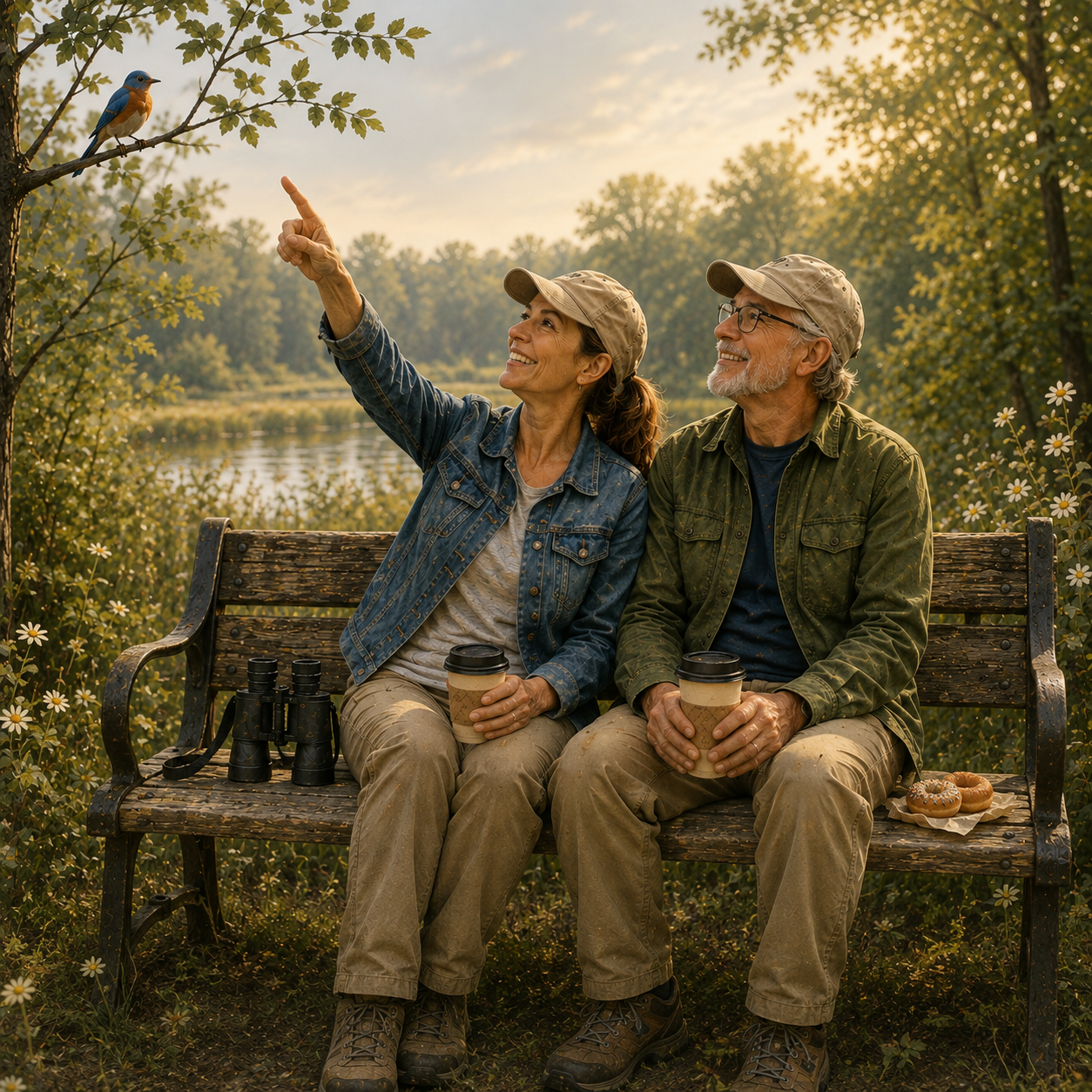
There are days when I go birding and don’t really care how many birds I find.
I know. That sounds a little strange coming from a birder.
Of course I still look. The binoculars come along. I notice the chickadee calling somewhere behind me, stop for the woodpecker working its way up a tree, and automatically look toward the sky when a large shadow passes overhead.
But sometimes the birds themselves aren’t really the point.
Sometimes I go birding because I need to slow down.
I need to get away from screens and schedules and things that supposedly need to be done immediately. I need to walk somewhere where nobody—not even the birds—cares about my to-do list.
And somewhere along the trail, something changes.
Maybe it happens when I stop to listen for a bird I can’t quite locate. Maybe it’s while watching a Great Blue Heron stand motionless at the edge of a pond. Or perhaps it happens when I realize I’ve been sitting on a bench for ten minutes doing absolutely nothing except watching chickadees move through the trees.
The world hasn’t changed.
But somehow, I have.
That, to me, is the Zen of birding.
Birding Operates at a Different Speed
Modern life seems determined to make us go faster.
Messages arrive instantly. News updates continuously. We carry little devices in our pockets that can provide an endless supply of information, entertainment, worries and things we should apparently be doing.
Then you go birding.
Birding does not care about any of that.
You cannot hurry a warbler into coming out from behind a leaf.
You cannot persuade a Bald Eagle to fly because you'd like a better look.
And no amount of impatience will make the owl you know is sitting somewhere in those trees reveal itself.
Birding requires something many of us don't practice nearly enough:
waiting.
At first, waiting can feel unproductive. You find it hard to remain patient.
Then something interesting happens.
You begin noticing things.
A branch moves.
A faint chip comes from the shrubs.
Something small lands near the top of a tree.
You hear water moving over rocks. Wind rattles dry leaves. A squirrel scolds you from somewhere behind the trail.
Instead of waiting for something to happen, you realize that things have been happening around you the entire time.
You were simply moving too fast to notice them. The noise in your head was spinning too loudly for you to hear the important stuff - your breathing and the rhythm of nature.
Birding Teaches Us to Pay Attention Again
One of the wonderful side effects of becoming a birder is that the world gets bigger.
Before birding, a tree may simply be a tree.
After birding?
You notice a Brown Creeper inching upward along its trunk.
You see a tiny Ruby-crowned Kinglet flicking nervously high in the branches.
You notice berries disappearing from a shrub and wonder who has been eating them.
You begin recognizing the places where birds are likely to be before you even see them.
Eventually, this awareness extends beyond birds.
You notice the first buds of spring.
You recognize when insects begin appearing.
You watch water levels rise and fall at the marsh.
You realize the days are getting shorter before you've looked at a calendar.
You start noticing seasons rather than simply passing through them.
That is one of birding's quiet gifts.
It teaches us to look again.
And the more carefully we look, the more there is to see.
Sometimes We Need to Get Out of Our Own Heads
Bird identification requires just enough concentration to occupy the mind without overwhelming it.
You spot movement.
Where?
Halfway up the tree.
Small bird.
Yellow underneath.
Wing bars?
Maybe.
What's the face doing?
And suddenly, for those thirty seconds, that's all you're thinking about.
Not tomorrow.
Not yesterday.
Not something you should have said differently three weeks ago.
Just the bird.
This is one reason I think birding can feel so restorative.
It gives our attention somewhere else to go.
We're not necessarily trying to stop thinking. We're simply directing our thoughts outward.
There is a bird in that tree.
Let's find it.
And sometimes that's enough to interrupt all the noise going on inside our heads.
Nature Has Different Priorities
Spend enough time watching birds and you begin operating, at least temporarily, according to their calendar.
Spring isn't simply March, April and May.
It's migration.
It's courtship.
It's nest building.
Summer becomes fledglings, family groups and long evenings.
Autumn becomes movement again—shorebirds first, then warblers, hawks, sparrows and waterfowl.
Winter brings its own visitors and its own quieter rhythms.
Birds live within seasons rather than schedules.
Watching them reminds us that there is another clock running alongside the one on our phones.
A much older one.
Migration continues.
Leaves fall.
Rain comes.
The sun rises tomorrow whether we finished everything today or not.
There is something enormously comforting about that.
Our problems don't disappear simply because we spend an hour outside.
But they sometimes return to their proper size.
Birding Reminds Us That We Belong Here, Too
There's another subtle change that happens when you've been birding for a while.
You stop feeling as though you're merely visiting nature.
You begin recognizing it.
There's the phoebe that returns to the same nesting spot.
The pair of cardinals that visits the yard every morning.
The first juncos of autumn.
The hummingbirds that suddenly vanish toward the end of summer.
You start anticipating their lives.
And that creates connection.
Consider something as small as a warbler.
You may encounter it for only a few minutes during migration. Yet that tiny bird may have traveled hundreds or thousands of miles before landing in the tree in front of you.
Tomorrow it may be gone.
For a brief moment, your lives intersect.
You don't own the experience.
You simply get to witness it.
I think that's part of what keeps many of us birding for decades.
There's always another season coming.
Always something returning.
Always something leaving.
And we're fortunate enough to be here watching.
You Don't Need a Wilderness
The wonderful thing about this kind of birding is that it doesn't require a trip to some famous hotspot.
You don't need Magee Marsh.
You don't need the Everglades.
You don't need a cabin in the Rocky Mountains.
You can find it in your backyard.
Sit near the feeders with your coffee.
Walk slowly through a neighborhood park.
Spend fifteen minutes beside a pond.
Pull a chair onto your patio.
Stand at the kitchen window.
Then stop trying so hard to accomplish something.
Watch.
Listen.
Let the birds do whatever they're going to do.
Some days you might see fifteen species.
Some days you might watch one chickadee.
Both count.
Try the Five-Minute Birder Reset
Here's a little exercise to try the next time your brain feels as though it has seventeen browser tabs open.
Go somewhere you can see or hear birds.
Put your phone away.
For five minutes, don't make a checklist. Don't open a birding app. Don't worry about identifying anything.
Just sit.
Then ask yourself four questions:
What do I see?
Look at the whole landscape rather than searching immediately for birds.
What do I hear?
Birdsong, wind, water, insects, leaves, distant sounds.
What's moving?
Watch for movement at different heights—from the ground to the tops of trees.
What's changed since the last time I was here?
New flowers? Fewer leaves? More berries? Different birds? Cooler air?
Only after those five minutes should you pick up your binoculars.
You may be surprised how much more you notice.
And without realizing it, you've also practiced one of the most valuable birding skills there is: observation.
Leave the Checklist in Your Pocket Once in a While
I love bird lists.
I love finding a bird I've never seen before.
I love figuring out an identification that initially had me completely stumped.
Those things are part of the fun.
But every once in a while, it's worth going birding without turning the outing into a performance.
You don't have to identify everything.
You don't have to photograph everything.
You don't have to report everything.
And you certainly don't have to see more species than the birder walking fifty yards ahead of you.
Sometimes you can simply watch.
There is an enormous difference between seeing a bird and experiencing a bird.
Spend five minutes watching a nuthatch move headfirst down a tree.
Watch a kingfisher patrol a shoreline.
Follow a flock of Cedar Waxwings as they pass berries back and forth.
Watch shorebirds run with the waves.
Those observations often stay with us longer than another name added to a checklist.
Perhaps This Is Why We Keep Coming Back
Ask birders why they bird and you'll get plenty of answers.
They love birds.
They enjoy the challenge.
They like being outdoors.
They enjoy traveling.
They love learning.
They've made wonderful friends through birding.
All true.
But I suspect there's another reason that's harder to put into words.
Birding makes us feel present.
For a little while, we're exactly where we are.
We're not rushing toward the next thing.
We're listening.
Looking.
Waiting.
Wondering.
And perhaps that's the real Zen of birding.
Not achieving perfect calm.
Not escaping ordinary life.
Just remembering, for a little while, that the world around us is still astonishingly alive.
So grab your binoculars.
Find somewhere quiet.
And don't worry too much about what you might see.
