

25 Common North American Birds Every Beginning Birder Should Know
When you first become interested in birds, it is tempting to begin with the most colorful, unusual, or difficult species in the field guide. Warblers! Shorebirds! Hawks! Surely “real” birders know them all.
But that is a little like learning to play the piano by starting with a concerto.
One of the best things a beginning birder can do is become thoroughly familiar with a small group of common birds. Learn the birds that visit your feeder, walk across the lawn, gather on power lines, circle over the highway, and paddle around the neighborhood pond. These familiar birds give you something every birder needs: a set of reliable comparisons.
Once you know an American Robin well, you have a useful measure of size. Once you recognize a Mourning Dove’s pointed wings, a Northern Flicker’s bouncing flight, and a Turkey Vulture’s shallow V-shaped wing position, you begin identifying birds before you ever see a perfect field mark.
Common birds teach you how birds are built and how they move through the world.
Why Start with Common Birds?
Beginners often assume that bird identification is mostly about color. Find the red patch, the white stripe, or the yellow breast and match it to a picture in the field guide.
Color can help, but it is only one clue—and often not the best one. Light changes color. Young birds may look different from adults. Males and females may not match. Feathers wear and seasonal plumages change.
Common birds let you practice the details that remain useful in almost every identification:
overall size and shape
bill, wing, leg, and tail proportions
posture and movement
feeding behavior
habitat
flight style
calls and songs
flocking habits
Because you see these birds repeatedly, you can study them without pressure. You do not have to identify each one in three frantic seconds. You can watch a robin stop, listen, and pull an earthworm from the soil. You can notice that a dove takes small steps while a sparrow hops. You can hear the difference between a crow’s familiar caw and a jay’s sharper calls.
Eventually, you stop assembling an identification one field mark at a time. You simply know the bird. That instant recognition—what birders sometimes call “jizz” or “GISS”—is built through repetition.
One Continent, Many Neighborhoods
No list of 25 birds can be equally common in Maine, Texas, Arizona, and coastal California. North America is too large and its habitats are too varied.
That is why I favor a two-part approach: begin with a core group of widespread birds, then substitute the common regional birds where you live. A Blue Jay may be an everyday bird in the East, while a California Scrub-Jay, Steller’s Jay, or Black-billed Magpie fills a similar place in a western beginner’s education.
The goal is not to memorize a continent-wide checklist. The goal is to build a useful foundation from birds you can actually find.
Here are 25 excellent birds to begin with.
Familiar Birds Around Homes, Parks, and Towns
1. American Robin
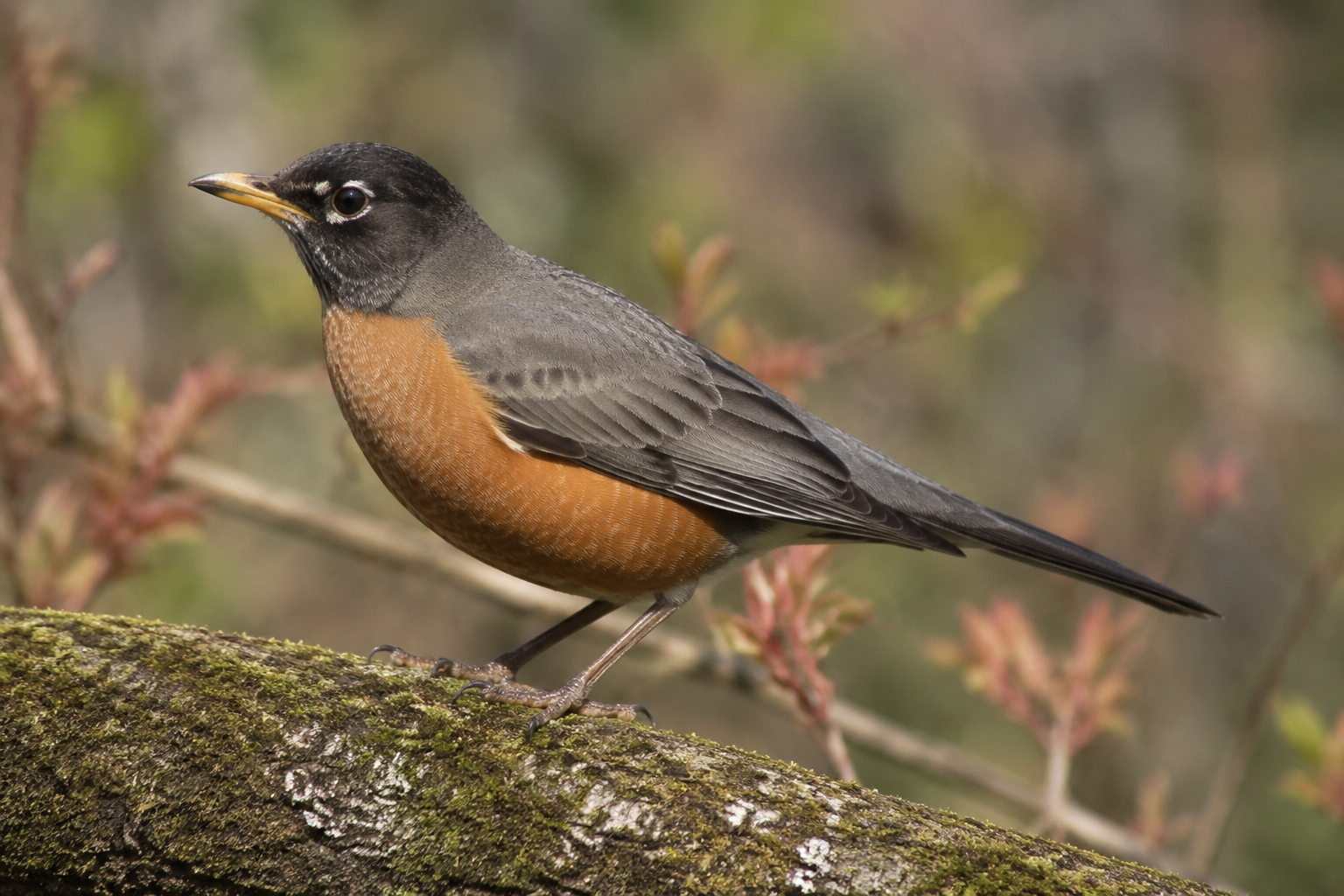
The American Robin is one of our best “measuring-stick” birds. Learn its size, upright posture, fairly long legs, dark back, and warm orange breast. Then notice how it runs across a lawn, stops suddenly, and tips its head as it searches for food. Later, “smaller than a robin” and “about robin-sized” will become genuinely useful descriptions.
2. Mourning Dove
This slim, soft-colored dove teaches shape and flight. Look for the small head, plump body, long pointed tail, and dark spots on the wings. Watch one burst into the air on quick, whistling wings. Its gentle cooing is also a good reminder that identifying birds by sound can begin right outside your window.
3. Rock Pigeon
Do not dismiss city pigeons. Their wide variety of colors makes them a poor bird to identify by plumage alone—and an excellent bird for practicing structure. Notice the heavy chest, small head, broad wings, and fast, powerful flight. You can also watch courtship, flock movement, bathing, and dominance behavior at close range.
4. House Sparrow
House Sparrows are another overlooked teacher. Compare the male’s black bib and gray crown with the female’s plain brown plumage and pale eyebrow. More importantly, learn their chunky bodies, thick seed-cracking bills, busy flock behavior, and constant chirping. This is a useful first step toward sorting out other small brown birds.
5. European Starling
Starlings demonstrate why plumage changes matter. In fresh fall feathers they look spotted; by spring, much of that spotting has worn away and the birds appear dark and glossy. Their triangular wings, short tails, direct flight, and purposeful walk are often easier to recognize than their color. Listen for whistles, rattles, and surprisingly good imitations.
6. American Crow
A crow gives you another valuable size reference. Study its heavy bill, broad wings, fan-shaped tail, steady wingbeats, and intelligent behavior. Watch how crows interact with one another. If several are loudly surrounding a tree, they may be mobbing an owl or hawk—a behavior that can help you find a bird you otherwise would have missed.
7. House Finch
House Finches are widespread around homes and feeders. Males usually show red or orange on the forehead, breast, and rump, while females are brown and heavily streaked. Listen for their cheerful, jumbled song. Comparing House Finches with other finches teaches you to look beyond “small bird with red” and notice streaking, bill shape, and overall pattern.
8. American Goldfinch
American Goldfinches teach both seasonal change and flight pattern. Summer males are bright yellow and black, but winter birds are much duller. In every season, look for the small conical bill, dark wings with pale markings, and deeply undulating flight. Their bouncing flight is often accompanied by a call that sounds like po-ta-to-chip.
9. Black-capped Chickadee
Across much of the northern United States and Canada, the Black-capped Chickadee is a perfect study bird. It is active, curious, and often easy to observe. Learn its black cap and bib, white cheeks, tiny bill, and quick habit of taking one seed at a time. Where it is absent, study your local Carolina, Mountain, Chestnut-backed, or Mexican Chickadee instead.
10. Dark-eyed Junco
Juncos are especially familiar in winter across much of the continent. Their plumage varies by region, making them a wonderful lesson in variation within a single species. Look for a small sparrow with a neat, simple pattern and a pale bill. The flashing white outer tail feathers are especially helpful when a junco flies away.
11. Song Sparrow
Song Sparrows are widespread, but they do not look exactly alike everywhere. Most are brown and streaked, often with a central spot on the breast. Instead of memorizing every plumage variation, watch the bird’s rounded tail, ground-feeding behavior, and preference for brushy edges. Learn its song locally; songs vary, too.
Birds That Teach Habitat and Behavior
12. Red-winged Blackbird
Few birds connect so clearly with a habitat. Red-winged Blackbirds gather around marshes, wet ditches, fields, and agricultural land. Males are black with red-and-yellow shoulder patches; females are brown and heavily streaked. Their ringing conk-la-ree song is one of the easiest landmarks in the spring soundscape.
13. Northern Flicker
This large woodpecker often feeds on the ground, probing for ants. Look for the long bill, brown barred back, spotted underside, black chest crescent, and white rump visible in flight. Eastern birds usually show yellow under the wings and tail; western birds generally show red. One species can teach geography, behavior, and conspicuous flight marks all at once.
14. Downy Woodpecker
The Downy Woodpecker introduces one of birding’s classic comparison problems: Downy versus Hairy. Start with the Downy itself—small body, short bill, white back, black-and-white wings, and a male’s small red patch. When you later meet a Hairy Woodpecker, compare the bill to the head rather than depending on estimated size alone.
15. Northern Mockingbird
Common through much of the southern United States and increasingly familiar farther north, the Northern Mockingbird is a master class in sound and behavior. Its gray color is understated, but its long tail, white wing flashes, confident posture, and habit of singing from exposed perches make it distinctive. Its repeated phrases encourage beginners to listen closely.
16. Killdeer
Killdeer prove that shorebirds do not always live on the shore. Look for them on gravel lots, short grass, rooftops, and open fields. Their two black breast bands, long legs, and loud kill-deer call are memorable. Watch a nesting adult perform its famous broken-wing distraction display, but always give the bird and nest plenty of space.
17. Mallard
Mallards are familiar enough that beginners can concentrate on comparison. Study the male, female, and young birds. Notice the broad bill, sturdy body, and blue wing patch bordered in white. Once Mallards feel easy, begin checking every group carefully. A different bill shape, head profile, or feeding style may reveal another duck among them.
18. Canada Goose
The Canada Goose offers practice with silhouette, voice, and formation flight. Its long black neck, white cheek patch, large body, and loud honking are unmistakable with experience. Watch how geese graze, swim, stand watch, and travel in family groups. Familiarity will also help you spot smaller Cackling Geese where their ranges overlap.
19. Great Blue Heron
A Great Blue Heron teaches proportions. It is tall and long-legged with a dagger-like bill, but in flight it folds its neck back and extends its legs behind. That tucked-neck profile separates herons from cranes, which generally fly with their necks stretched forward. Watch a heron hunt and you will also see the value of patience.
Learning Birds in the Air
20. Turkey Vulture
When a large dark bird circles overhead, look at the wings before worrying about color. Turkey Vultures hold them in a shallow V and often tip gently from side to side with very few wingbeats. Their small heads and long wings create a distinctive silhouette. In the Southeast, compare them with broader-winged Black Vultures.
21. Red-tailed Hawk
The Red-tailed Hawk is one of the most widespread large hawks in North America, but its plumage can vary tremendously. That makes it a good reason to study shape, proportion, and flight. Look for broad rounded wings and a relatively short, wide tail. Adults often—but not always conveniently—show the rusty-red tail that gives the species its name.
22. Ring-billed Gull
Ring-billed Gulls are common around lakes, rivers, parking lots, and landfills across large parts of the continent. Adults have pale gray backs, black wingtips, yellow legs, and a black ring near the end of the yellow bill. Young gulls look different, which teaches an essential lesson: some birds take several years to acquire adult plumage.
Regional Birds Worth Adding to Your List
These final three lean westward on purpose. Many “common bird” lists are so eastern that western beginners are asked to learn birds they seldom see.
23. Black-billed Magpie
Across much of the interior West, the Black-billed Magpie is large, bold, and hard to overlook. Its black-and-white pattern, extremely long tail, and flashes of blue-green iridescence make it an excellent beginner bird. Watch its confident walk, bounding flight, and social behavior. It also provides a useful introduction to the crow and jay family.
24. California Scrub-Jay
Along much of the Pacific Coast, California Scrub-Jays are familiar around oak woodlands, yards, and parks. Their blue head, wings, and tail contrast with a gray-brown back and pale underparts. They lack the crest of a Blue Jay or Steller’s Jay. Inland, Woodhouse’s Scrub-Jay may be the regional bird to learn instead.
25. Anna’s Hummingbird
Anna’s Hummingbirds are now familiar year-round residents in many communities along the Pacific Coast and in parts of the Southwest. Learn their compact shape, straight bill, explosive courtship dives, and the male’s brilliant rose-pink head and throat. Elsewhere, substitute the hummingbird most common where you live—Ruby-throated in the East or Black-chinned across much of the West.
Make the List Fit Your Region
The best beginner list is always local. Keep the widespread birds above that occur near you, then replace the others with regional counterparts.
In the East and Southeast, add birds such as the Blue Jay, Northern Cardinal, Carolina Wren, Tufted Titmouse, and Carolina Chickadee. In the Great Plains, consider the Western Meadowlark, Black-billed Magpie, and Great-tailed Grackle. In the Southwest, Gambel’s Quail, Cactus Wren, Curve-billed Thrasher, Verdin, and Black-chinned Hummingbird may be more useful. In the Northwest and mountain West, Steller’s Jay, Mountain Chickadee, Spotted Towhee, and California Quail belong on many local lists. In the far North, Canada Jay, Common Raven, and Black-billed Magpie may be more familiar than several backyard birds listed here.
Use a regional field guide or the Cornell Lab’s Birds Near Me tool to see what is likely in your location and season. Range matters. Habitat matters. A bird that is common in one region may be completely absent in another.
A Simple 25-Bird Practice Plan
Do not try to memorize all 25 birds from pictures in one afternoon. Choose five that visit your yard, neighborhood, or favorite park. Spend a week with them.
For each bird, notice:
Is it smaller or larger than a robin?
What is its most recognizable shape?
Where does it feed?
Does it walk, hop, climb, swim, hover, or soar?
What sound does it make most often?
Write a few words in a small notebook. You do not need a beautiful drawing or a page of scientific notes. “Robin-sized, long tail, scratches under leaves” is useful. So is “small, bounces through air, calls while flying.” These observations train you to see the whole bird instead of searching desperately for one patch of color.
When those first five feel familiar, add five more. Revisit the birds you already know in different seasons. Look at females, immature birds, molting birds, and birds seen in poor light. The ordinary birds around you will become your living field guide.
Common Birds Build Real Birding Confidence
Knowing common birds does more than make identification easier. It gives you confidence in the field.
When you recognize most of the birds around you, the unfamiliar one stands out. A different shape catches your attention. An unexpected call makes you stop. A small bird moving unlike the chickadees deserves another look. This is how experienced birders often find something unusual: they know what belongs there.
There is also a quieter reward. A bird does not become less interesting because it is common. The more carefully you watch robins, crows, doves, juncos, and gulls, the more individual behavior you begin to see. Familiar birds have courtships, rivalries, family groups, feeding strategies, alarm systems, and seasonal routines. And simply how beautiful they are. They are not background decorations. They are wild lives unfolding around us every day.
Start with 25—or start with five. Learn the birds that share your neighborhood. Notice their shapes, voices, movements, and habits. Before long, the field guide will feel less like an enormous catalog of strangers and more like a gathering of families you are beginning to know.
And that is one of the most satisfying ways to become a better birder.
Consider reading our Birding for Beginners Part 1 next
