

What’s This Bird? Quiz
Master of the Grassland Skies
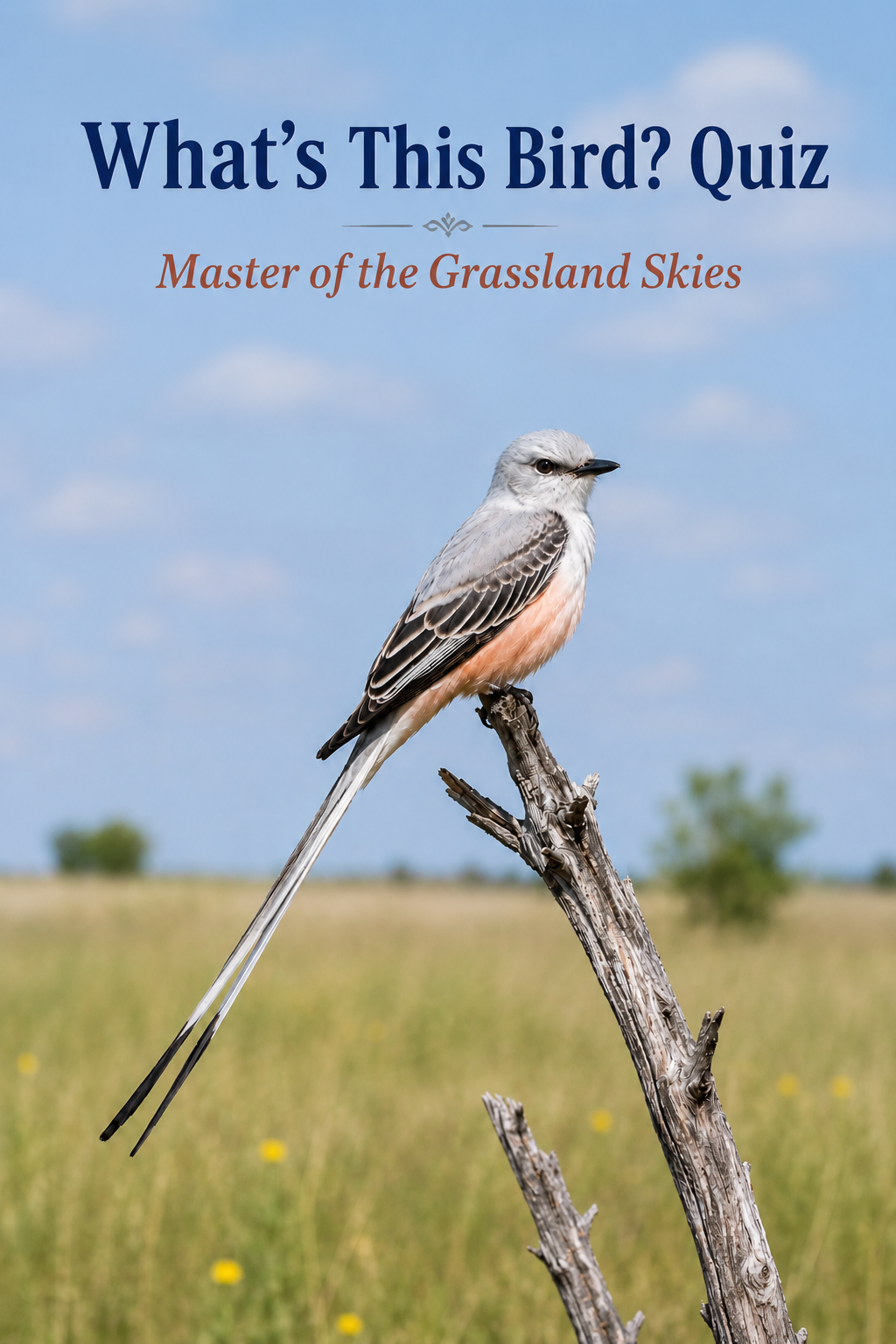
Imagine driving across the open country of Texas, Oklahoma, or Kansas when you notice a pale bird perched upright on a roadside fence, utility wire, or exposed snag. At first glance, it might resemble a Northern Mockingbird—but then you see the tail.
The bird is slim and elegant, with a light pearly-gray head and back, whitish underparts, dark wings neatly edged in white, and a soft wash of salmon-pink along the flanks and beneath the wings. Its most remarkable feature is its extremely long, deeply forked tail. The outer tail feathers may equal or exceed the length of the bird’s body, especially on an adult male. Females also have long tails, although they are generally somewhat shorter, while young birds have much shorter and less deeply forked tails.
When the bird takes flight, that extraordinary tail opens and closes like a pair of scissors. It twists, turns, and changes direction as the bird chases flying insects through the air. The tail is not merely decorative—it helps the bird maneuver during its graceful aerial pursuits. A flying bird may suddenly flash brighter salmon or reddish color from beneath its wings before returning to a prominent perch.
Distribution
This bird is most closely associated with the south-central United States. Its primary breeding range includes much of Texas and Oklahoma and extends into Kansas, Nebraska, Arkansas, Missouri, southeastern Colorado, southeastern New Mexico, and northern Mexico. Oklahoma has even adopted it as the official state bird.
It is a medium-distance migrant. Most individuals leave the United States after the breeding season and spend the winter in Mexico and Central America. During spring and fall migration, these birds sometimes gather in large, noisy flocks. Wandering individuals may also appear far outside their normal range, occasionally turning up almost anywhere in North America.
Habitat
Look for this bird in open country with scattered perches. It favors grasslands, savannas, ranches, pastures, farm fields, roadsides, and brushy areas containing occasional shrubs or small trees. It may also live around parks, golf courses, towns, and other landscaped areas.
The ideal habitat combines open space for hunting with elevated places from which the bird can watch for insects. Fence posts, utility lines, treetops, shrubs, and dead snags all make excellent observation points. Trees and taller shrubs provide nesting sites, while the surrounding open ground gives the bird plenty of room for aerial feeding.
Vocalizations
Despite its spectacular appearance, this bird’s voice is not especially musical. Its calls are sharp, buzzy, chattering, and sometimes rather mechanical. You may hear quick notes rendered as kip, kee-kee, or ka-kee, along with twittering, clucking, and rattling sounds.
The birds can become particularly noisy when defending a nesting territory, confronting a predator, or gathering in groups before migration. Their calls have the bold, insistent quality typical of kingbirds—even though their appearance is far more delicate.
Have you guessed the bird?
It is the Scissor-tailed Flycatcher, one of the most graceful and unmistakable birds of the southern Great Plains.
