

Watch the tail!
This little shorebird seems to bob that taile every second it’s standing still.
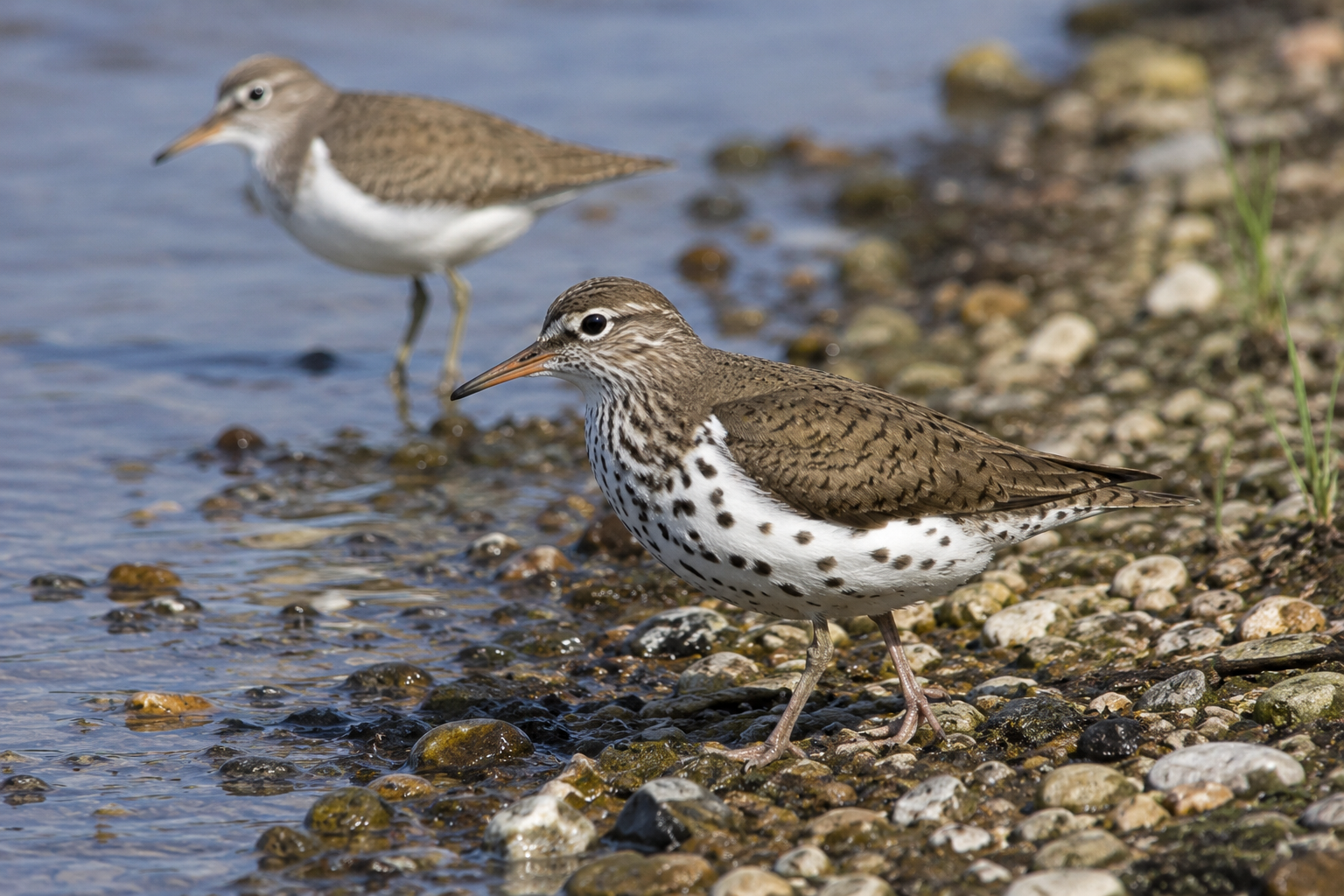
The Spotted Sandpiper (Actitus macularius) is one of North America's most familiar and widespread shorebirds. Even birders who rarely visit beaches often encounter this species along ponds, streams, reservoirs, and muddy shorelines. Small, active, and full of personality, the Spotted Sandpiper is often identified long before you notice its field marks thanks to its distinctive behavior.
Adult breeding birds are easy to recognize. Their upperparts are brownish-gray, while the underparts are bright white covered with bold black spots across the breast and belly. This spotted pattern gives the bird its common name and makes it stand out among North American shorebirds. The bill is relatively short and straight, usually orange or yellowish near the base with a dark tip. Their legs are pale pink to flesh-colored.
During fall and winter, however, the spots disappear. Non-breeding adults have plain white underparts and can look surprisingly different from their summer appearance. Juveniles resemble winter adults but show a distinctive scaly pattern on their upperparts created by buff-edged feathers. Young birds lack the bold spots entirely, making them somewhat trickier for beginners to identify.
One of the best identification clues is the bird's constant bobbing motion. Spotted Sandpipers almost never seem to stand still. They repeatedly bob their tails and rear bodies up and down while walking along shorelines. Once you learn this behavior, you'll often recognize a Spotted Sandpiper even before getting a clear look.
Spotted Sandpipers breed across most of the United States and southern Canada. Their breeding range stretches from Alaska across Canada and south through much of the lower 48 states. As fall arrives, they migrate south to winter throughout the southern United States, Mexico, Central America, the Caribbean, and much of South America.
Unlike many shorebirds that prefer large coastal mudflats, Spotted Sandpipers are highly adaptable. They occur along lakeshores, rivers, ponds, marsh edges, reservoirs, woodland streams, and ocean beaches. They are often seen alone or in pairs rather than in large flocks.
Their feeding behavior is active and entertaining to watch. Spotted Sandpipers walk briskly along shorelines picking insects, small crustaceans, aquatic invertebrates, worms, and other tiny prey from the ground or water's edge. They occasionally make short dashes after prey and may even catch flying insects.
Perhaps the most unusual thing about this species is its breeding system. Female Spotted Sandpipers are often more brightly colored and more aggressive than males. A female may mate with multiple males during a single breeding season, while each male incubates eggs and helps raise the young. This role reversal is uncommon among North American birds and makes the species especially interesting from a behavioral standpoint.
Whether encountered beside a quiet farm pond or along a rocky stream, the Spotted Sandpiper is a delightful bird to watch. Its cheerful teetering, adaptable nature, and distinctive summer plumage make it a favorite shorebird for birders of all experience levels.
