

Beginning Birders
Simple Gear Is All You Need to Get Started
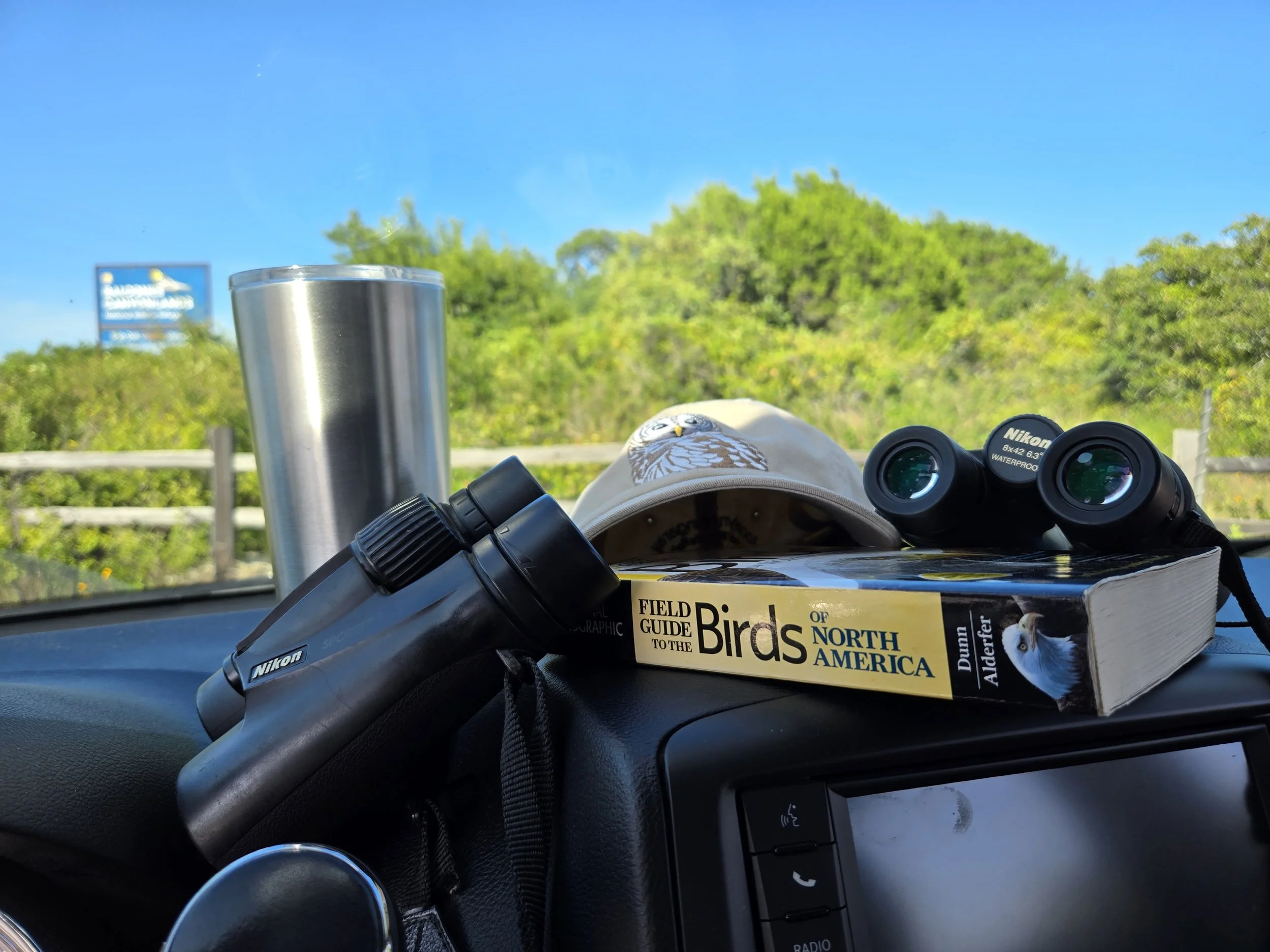
Birding has a wonderfully low barrier to entry.
You do not need a closet full of outdoor clothing, an expensive camera, a powerful spotting scope or a plane ticket to a famous birding destination. You do not even need to leave home.
If you can see outside, you can go birding.
You can watch birds through a kitchen window while you drink your morning coffee. You can notice them from an apartment balcony, a park bench, a hospital room, a sidewalk or your parked car. You can listen for birds while you work in the garden or walk to the mailbox. A short walk around a city pond can provide an experience that makes your day.
Birding can be as simple as looking up and paying attention.
Of course, a few basic pieces of equipment can make birds easier to see and identify. But beginning birders do not need to buy everything at once. Start with what you have, learn what you enjoy and add equipment slowly—if and when it would make birding more comfortable or rewarding.
The most important equipment you bring into the field is not something you can purchase.
It is curiosity.
You May Already Have Everything You Need
Before you shop for binoculars or download another app, try this simple exercise.
Find a place where you can see outside. Sit quietly for five or ten minutes and watch for movement. Look at the edge of a roof, the top of a fence, the branches of a tree and the open sky.
What do you notice?
Perhaps a Northern Cardinal lands in a shrub. A flock of grackles crosses the sky. A hawk circles high above the neighborhood. A House Wren disappears into a tangle of leaves.
You do not have to identify every bird. In fact, you do not have to identify any of them yet.
Notice how the bird moves. Is it hopping or walking? Is it searching the ground or staying high in a tree? Does it sit upright or lean forward? Is its flight smooth, bounding or full of quick turns?
You might find yourself asking, “How can that bright red bird totally disappear among the green leaves?
This is birding.
You have already begun.
The Best First Purchase: Binoculars
Binoculars are the one piece of equipment most birders eventually want. They bring a distant bird close enough for you to see its shape, colors, markings and behavior without disturbing it.
But your first binoculars do not have to be expensive.
If you already own a pair, start with those. Old travel binoculars, compact binoculars from a sporting event or a borrowed pair may be enough to help you discover whether birding appeals to you.
Once you are ready to buy, look for binoculars that feel comfortable in your hands and are easy for you to focus. For many birders, an 8x42 binocular is a good all-around choice.
The first number—8—means the view is magnified eight times. This is powerful enough to see useful details while generally remaining easier to hold steady than binoculars with higher magnification.
The second number—42—refers to the diameter of the objective lenses in millimeters. Larger objective lenses collect more light, which can provide a brighter image in shady woods or during early morning and evening.
That does not mean everyone must purchase 8x42 binoculars. An 8x32 model may be lighter and easier to carry. Compact binoculars can be convenient for travel or short walks. Some birders prefer 10-power binoculars for open country or distant waterbirds, although the narrower view and extra magnification can make them more challenging for a beginner to use.
The best binoculars are the ones you can comfortably hold, focus and carry.
You can buy online by paying attention to customer reviews and checking return policies. The Rather Be Birding Essentials Amazon Store has some great binoculars from entry-level choices to high-end.
When comparing them, ask yourself:
Can I hold these without straining my hands or shoulders?
Can I reach the focus wheel easily?
Can I adjust the eyecups comfortably with or without glasses?
Does the image look bright and clear?
Can I find a bird or another object quickly?
Would I be willing to carry these for an hour?
Do not assume that a higher price automatically makes a particular binocular the right one for you. Optical quality matters, but comfort and ease of use matter too.
Set a budget you can live with. You can always upgrade later if birding becomes an important part of your life.
Practice Before You Go Anywhere
Using binoculars feels awkward at first. Many beginners spot a bird with their eyes, raise their binoculars and then discover that the bird has apparently vanished.
The bird is usually still there. The binoculars simply are not pointed at the same place your eyes were looking.
Practice at home using stationary objects.
Choose a doorknob, flowerpot or particular leaf. Keep looking directly at it. Without moving your head or looking down to find your binoculars, raise the binoculars to your eyes. The object should appear in the center of your view.
Repeat this until the movement becomes natural. Keep your hands on your binoculars at all times so you’re ready to raise them quickly.
Next, practice focusing on objects at different distances. Move from a nearby fence to a distant tree, then back again. Learn which direction to turn the focus wheel for closer or farther objects.
A few minutes of practice can prevent a great deal of frustration when your first bright warbler appears.
A Field Guide Helps You Ask Better Questions
A field guide is another useful piece of beginning birding equipment. It may be a traditional printed book, a regional guide, an app or a combination of these.
I have always had a fondness for paper field guides. A book allows you to browse related species, compare shapes and markings, make notes in the book margins, use stickies and highlighters and gradually become familiar with the bird families in your area. You may begin looking up one bird and discover three others you want to find.
For a beginner, a regional guide can feel less overwhelming than a guide covering every bird in North America. If you live in the East, West, Southwest or another well-defined region, a guide focused on that area reduces the number of possibilities you need to consider. However live in the middle of the country, you can sometimes get birds from East and West and unusual rarities probably won’t be in a regional book at all. If you don’t anticipate traveling to see birds or if you live closer to either coast, regionals guides may be best for you and probably lighter weight.
Illustrated guides and photographic guides each have advantages. Illustrations can emphasize typical field marks and show birds in consistent positions. Photographs show real birds in natural light, including some of the variation you may encounter.
There is no single field guide that every birder must use. Choose one that makes sense to you.
When you look up a bird, do not jump directly to color. Begin with the basics:
Where did you see it?
Do you recognize the family it may belong to?
What type of habitat was it using?
How large was it compared with a familiar bird?
What was its overall shape?
How did it behave?
Where was it feeding?
Was it alone, in a pair or in a flock?
What sounds did you hear?
Color can be helpful, but it changes with distance, lighting, age, sex and season. Shape and behavior are often more dependable starting points.
A field guide is not simply a book of answers. It teaches you which questions to ask.
Birding Apps: Helpful, but Not Required
A phone can be useful birding equipment too.
Bird identification apps can help you narrow the possibilities by location, date, appearance or sound. Digital field guides are convenient when you do not want to carry a book. Birding apps may also show which species are likely in your area or help you record what you have seen.
Merlin Bird ID and eBird are two tools many birders use. Merlin can help with visual and sound identification, while eBird allows birders to record observations and contribute information that can be useful to science and conservation.
These tools can be extremely helpful, but try not to let your phone do all the noticing for you. Some apps request a species name to show it to you - not the best choice if you’re brand new and have no idea what a Verdin is.
Listen to a bird before checking a recording. It’s handy to have the live recording right there when you hear a new bird.
Look at its size, shape and behavior before accepting an identification suggestion. Use technology as a guide—not as a crutch or a substitute for your own growing skills.
You do not need to record every bird you see. You do not need to keep a life list unless that sounds enjoyable. Some people love lists, data and goals. Others prefer to sit quietly and watch chickadees move through the trees.
Both are real birding.
A Simple Notebook Can Change the Way You See Birds
A small notebook and pencil may become some of your favorite birding equipment.
Your notes do not need to be scientific or beautifully written. Record the date, location, weather and the birds you noticed. If you could not identify a bird, write down what you remember.
For example:
Small gray-brown bird on the fence. Long tail held upward. Quick movements. Pale eyebrow. Loud bubbling song from the shrubs.
That description may later lead you to a wren. More importantly, the act of writing it down will help you remember what you saw.
You can also sketch the bird. Artistic ability is not required. Draw a simple outline and mark where you noticed color, stripes, spots or unusual shapes. Add arrows and notes.
The purpose is not to create a perfect picture. The purpose is to look carefully.
Over time, your notebook becomes more than a list of species. It becomes a record of seasons, places and moments: the first hummingbird of spring, a hawk above the grocery store, owls calling after dark or the morning a flock of Cedar Waxwings descended on a berry-filled tree.
What Else Should You Carry?
For a short walk near home, binoculars may be all you need. For a longer outing, bring the same practical items you would take on any outdoor walk.
Depending on the weather and location, that might include:
Water
A hat
Sunscreen
Insect repellent
Comfortable walking shoes
A light jacket or rain layer
A small snack
Any medications or mobility aids you normally need
A phone for safety
A notebook and pencil
A small backpack or crossbody bag can keep your hands free, but you do not need a special birding pack unless you’re planning a long hike or all-day excursion.
Wear comfortable clothing suited to the weather. Neutral colors can help you blend into the surroundings, but you do not need an entirely new wardrobe. Some people will tell you to always wear camo but birds don’t see color like we do so camo is of little concern. Avoid clothing or jewelry that makes a great deal of noise, especially if you are walking through quiet habitat.
Comfort matters more than looking like an experienced birder.
Equipment You Can Wait to Buy
Beginning birders sometimes believe they need a spotting scope, a camera with a long lens, expensive outdoor clothing and shelves full of reference books.
Those things can be useful, but none is required to begin.
A spotting scope is helpful for viewing distant shorebirds, waterfowl and raptors. It can also be expensive, heavy and less convenient than binoculars. Wait until you know you regularly enjoy birding in places where a scope would make a meaningful difference.
The same is true of cameras. Bird photography is a rewarding hobby, but it is a separate skill with its own equipment and learning curve. You do not have to photograph a bird to prove that you saw it or to make the encounter worthwhile. Unless you really enjoy photography (and photographing can be hard and time-consuming), leave the camera equipment home. Once in a while I take a photo with my cell if a bird is very cooperative but I simply don’t have the patience for bird photography and I’m always wondering if I’m missing another bird down the trail.
A quick phone photograph may sometimes help document a bird, even if the picture is blurry. But there is also something wonderful about simply watching.
Let yourself experience the bird before worrying about capturing it.
You Can Go Birding Anywhere
People often picture birding as an expedition to a remote refuge, mountain trail or coastal marsh. Those places can be marvelous, but birds live among us every day.
Look for birds:
Through your kitchen or office window
In your backyard
From an apartment balcony
Around a school or community center
Along a neighborhood sidewalk
In a city park
At a pond or drainage area
Near a shopping-center parking lot
From your car
In trees outside a medical office
On a porch, patio or park bench
Even airports, college campuses, golf courses, cemeteries and industrial areas (and one of my personal favorites - the city’s water treatment plant - may have birds.
You can bird for five minutes or five hours. You can travel hundreds of miles or stay in one chair. You can bird alone, with a friend, with a local club or as part of a guided walk.
Birding adjusts to the life you have today.
If walking is difficult, choose an accessible trail, a paved path or a comfortable place to sit. If you use a wheelchair, walker or cane, look for parks with accessible observation areas. If your energy is limited, watch a feeder or birdbath from indoors.
Birding is not measured by distance.
Birding Gives Your Mind Somewhere Gentle to Rest
Many of us spend our days moving from one demand to another. Our minds race ahead to the next appointment, problem, message or responsibility.
Birding interrupts that cycle.
To see a bird well, you have to pay attention to what is happening now. You listen for a rustle in the leaves. You follow a song to its source. You notice the flick of a tail or a small shape moving through a tree.
For a moment, your thoughts quiet down.
Birding does not make life’s difficulties disappear. But it can give your mind a place to rest. Time outdoors, contact with nature and mindful observation can support a sense of calm and well-being.
Even a brief bird break may help you reset.
Step outside for ten minutes without a goal. Listen for the closest bird, the farthest bird and the loudest bird. Watch the sky. Notice which direction the wind is moving the leaves.
You may return to your day feeling a little steadier and more connected to the world around you.
Birding Keeps the Brain Curious
Birding also gives your brain an enjoyable workout.
Each bird presents a small puzzle. You compare shapes, remember songs, notice patterns and connect a species with its habitat or behavior. You may recall that a certain bird arrived at the same time last year or recognize a call you first heard months ago.
There is always something new to learn.
Seasons change. Plumages change. Young birds appear. Migrants pass through. A familiar bird suddenly does something you have never seen before.
You do not have to memorize hundreds of species to gain these benefits. Learning one backyard bird at a time is enough to exercise attention, observation and memory. But I can tell you it is such a rush when you eventually hear a 2-second melodic phrase and you immediate response is “Hey that’s a Cactus Wren - it’s over there!” or see a flash of orange and instantly recognize that “it’s an oriole I’m sure of it.” Give yourself time, you’ll begin surprising yourself.
The goal is not to know everything.
The goal is to remain curious.
Birding Can Provide Exercise at Your Own Level
Birding can be as physically active—or as restful—as you want it to be.
Some birders hike miles over uneven terrain. Others stroll slowly around a neighborhood pond. Some enjoy birding from a kayak. Others watch from a window or a stationary bench.
A beginning birder might start with a ten-minute walk. Because birds encourage you to keep looking, you may walk farther than you expected without thinking of it as exercise.
You stop to watch a woodpecker, continue to the next stand of trees and then follow the sound of a wren. Movement becomes part of the search.
But there is no minimum distance and no required pace. Rest when you need to. Choose safe, accessible locations. Bring water. Turn around before you are exhausted.
The best birding outing is one that leaves you wanting to go again.
Birding Is More Fun When You Release the Pressure
The secret to enjoying birding is not identifying every bird.
It is noticing more than you noticed yesterday.
Perhaps you learn the difference between a crow and a raven. Perhaps you recognize the “tea-kettle” song of a Carolina Wren before you see it. Perhaps you discover that the “little brown birds” beneath your feeder include two or three different species.
Every small discovery opens another door.
Birding can also be social. A local bird walk gives you an opportunity to learn from others without having to purchase additional equipment. Experienced birders are often delighted to share a view through a spotting scope or help a beginner understand what they are seeing. And most field trip leaders will ask the group to ensure everyone has had a chance to view each bird discovered during the trip. Speak up if you haven’t found the bird & someone will help you locate it.
Do not worry about asking basic questions. Every experienced birder was once a beginner who could not find the bird everyone else was pointing toward.
You may eventually decide to participate in a community bird count, help maintain habitat, volunteer at a nature center or share observations through a citizen-science project. These are wonderful ways to let your enjoyment of birds contribute to something larger—but they are invitations, not requirements.
Begin by enjoying the birds. Caring for them often grows naturally from paying attention to them.
Your Simple Beginning Birding Kit
If you want a practical starting point, keep it simple:
Your eyes and ears
These are the tools you will use most.A comfortable pair of binoculars
Borrow a pair or use what you already own before investing in an upgrade.A field guide or identification app
Choose the format that feels easiest and most inviting.A small notebook and pencil
Record what you notice, including birds you cannot identify.Weather-appropriate clothing and water
Comfort and safety will help you stay outside longer.
That is enough.
You do not need to wait for the right equipment, the right destination or the right season. You do not need to become an expert before you call yourself a birder.
Start Where You Are
Sometime today, look outside.
Find one bird and watch it for a full minute.
Notice its size and shape. Watch how it moves. See where it goes and what it does. Listen for any sound it makes.
Acknowledge and appreciate this tiny, amazing miracle.
If you know its name, wonderful.
If you do not, that may be even better. An unidentified bird gives you a mystery to solve and a reason to look again tomorrow.
Birding can reconnect you with nature, calm a busy mind, keep your curiosity active and encourage you to move at a level that works for your body. It can introduce you to new places, new people and an entire living world that has been around you all along.
Most of all, birding is fun.
And you can begin right now—from exactly where you are.
