

North American Fall Hawk Migration
When the Sky Comes Alive
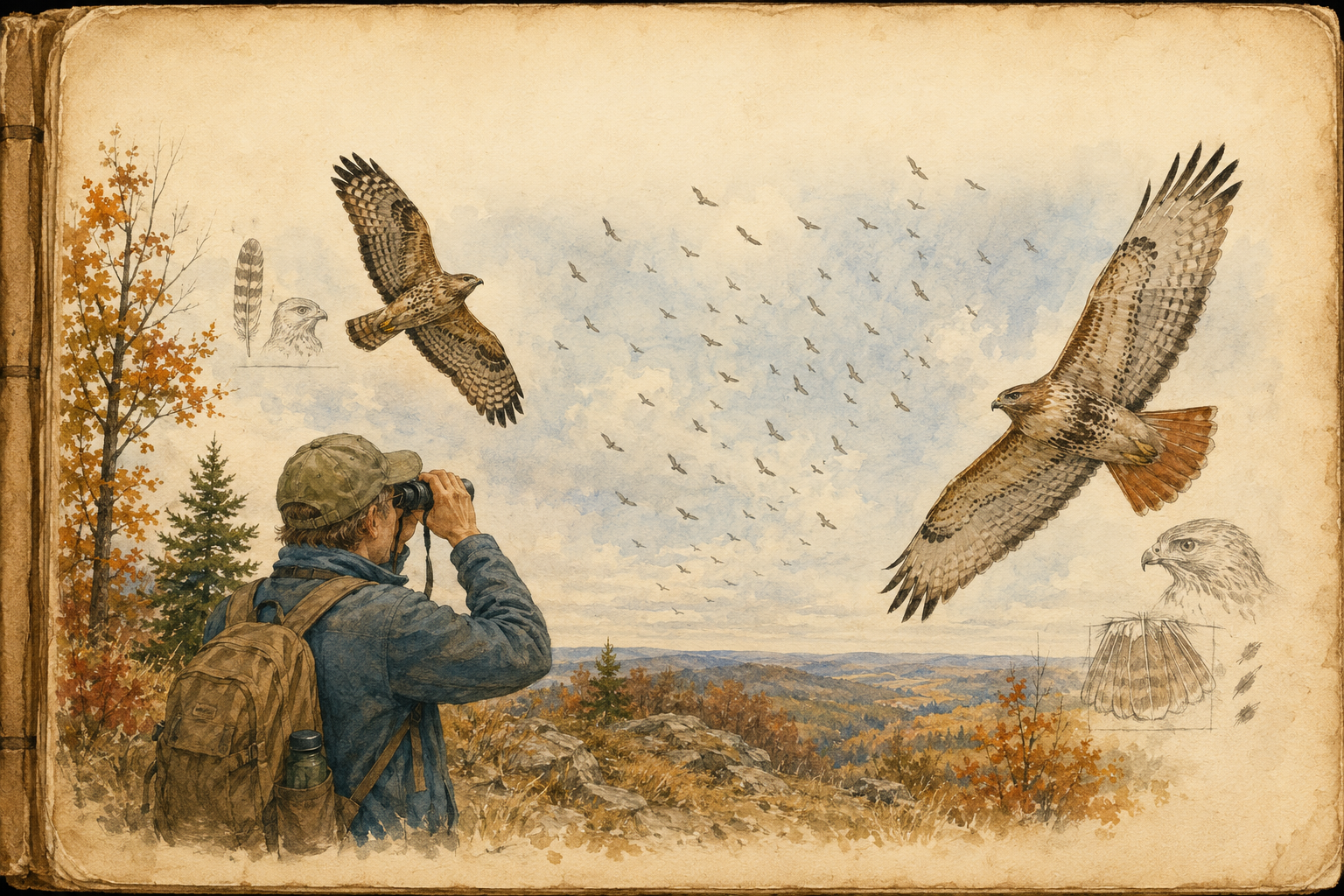
There is a moment each fall when the sky begins to feel different.
The morning air is cooler. The wind has shifted. Puffy clouds move quickly overhead, and the first leaves tumble across the ground. You may step outside expecting to watch the songbirds around your feeders—and instead notice a large, dark shape drifting high above the neighborhood.
Then another appears.
And another.
Before long, you realize those distant birds are not simply circling. They are going somewhere.
Fall hawk migration is one of North America’s greatest natural spectacles, yet it often happens unnoticed above our heads. Millions of hawks, falcons, eagles, vultures and other birds of prey move south every autumn. Some travel only a few hundred miles. Others continue through Mexico and Central America, eventually reaching wintering grounds deep in South America.
Unlike a flock of geese announcing its arrival with loud calls, hawk migration can be quiet and surprisingly subtle. You have to remember to look up.
Once you do, fall skies may never seem empty again.
Fall Migration Does Not Begin All at Once
We sometimes think of fall migration as a single event beginning when the leaves change color. In reality, it is a long, overlapping series of movements that can begin while summer still seems firmly in place.
As we discussed in our North American Fall Migration post, birds do not all migrate at the same time. Each species follows its own schedule based on food, breeding success, daylight, weather and the distance it must travel.
Shorebirds are among the first birds to get moving. Some begin leaving Arctic breeding grounds in June or July, long before most of us are thinking about fall. Our Shorebird Migrationpost explains why sandpipers, plovers and other shorebirds can appear on southern mudflats while backyard gardens are still filled with summer flowers.
Hawk migration follows a more elongated schedule.
Some raptors begin moving in August. Others peak during September or October. Northern species may still be passing through in November or even December. At Hawk Mountain in Pennsylvania, migrating raptors may be observed from mid-August through mid-December.
Fall migration is less like a starting gun and more like a relay race. One group begins moving, another follows, and the cast of birds overhead gradually changes as the season progresses. The travelers may react to an internal clock but also may be influenced by weather conditions and food supply.
Why Do Hawks Migrate?
Hawks do not necessarily migrate because they dislike cold weather. Many are well equipped to survive low temperatures.
The larger issue is food.
As summer ends, insects disappear, reptiles become less active, small mammals are harder to locate beneath snow, and many smaller birds move south. A raptor that depends on these food sources must either adapt to the changing conditions or follow its prey.
Different hawks respond in different ways.
Mississippi Kites, which feed heavily on insects, are among the earlier raptors to leave. Northern Harriers and some larger hawks may remain farther north until colder weather makes hunting increasingly difficult. Weather and seasonal food availability help determine when each species begins moving.
Age can also influence migration timing. Young birds often begin moving before adults. These inexperienced hawks are facing their first winter, and they may be less efficient hunters than older birds. Heading south early may give them more time to find suitable feeding areas.
Not every individual migrates the same distance. A Red-tailed Hawk nesting in Canada may travel hundreds of miles south, while one living in a milder part of the United States may remain in the same general area all year.
That is why the Red-tailed Hawk you see beside the highway in January may not be the same bird you watched there in June. One bird may have departed while another arrived from farther north.
Hawks Know How to Save Energy
Migration requires an enormous amount of energy, and hawks have developed remarkably efficient ways to travel.
Broad-winged Hawks, Swainson’s Hawks, vultures and many other broad-winged raptors use rising columns of warm air called thermals. As sunlight warms the ground, pockets of heated air rise. Hawks circle within that rising air, gaining altitude without constantly flapping their wings.
When they reach the top of a thermal, they glide forward—sometimes for miles—until they find another rising column of air.
A group of hawks circling together in a thermal is called a kettle.
The birds are not circling because they are confused, hunting together or preparing to land. They are riding an invisible elevator into the sky.
Once enough birds begin streaming out of one kettle and gliding toward another, observers may describe the procession as a river of hawks. On an exceptional migration day, that river can continue for hours.
Mountain ridges provide another type of lift. When wind strikes the side of a ridge, it is deflected upward. Hawks can ride this rising air along the mountain with very little effort.
This explains why famous hawk-watching locations are often found on ridges, cliffs, lakeshores or narrow coastal peninsulas. These landscape features concentrate migrating birds into pathways that observers can watch and count.
Large bodies of water also influence migration. Most soaring hawks avoid long flights over open water because thermals are weaker over water than over land. The birds follow shorelines until they reach a suitable place to continue south.
These geographic “leading lines” funnel raptors toward places such as the Appalachian Mountains, the Great Lakes, Cape May, the Texas Gulf Coast and mountain ranges throughout the West.
The Spectacle of Broad-winged Hawk Migration
Broad-winged Hawks create one of the most impressive fall flights.
During most of the breeding season, these woodland hawks can be surprisingly difficult to find. They often remain hidden within forests, where their calls may be more noticeable than the birds themselves.
Then September arrives.
Broad-winged Hawks begin gathering into kettles that may contain hundreds or even thousands of birds. Most pass established migration sites during a relatively concentrated period, sometimes within only a couple of weeks. Large concentrations occur along the Great Lakes and continue through southern Texas, Mexico and Central America.
From the ground, the first birds may look like specks of pepper swirling against a cloud.
Raise your binoculars and those specks become hawks—dozens of them, circling with wings outstretched. As they reach the top of the thermal, they straighten into a long drifting line and disappear toward the horizon.
It is difficult to watch a Broad-winged Hawk kettle without feeling that you have stumbled into one of nature’s great secrets.
Swainson’s Hawks Make an Extraordinary Journey
In western North America, Swainson’s Hawks undertake one of the longest migrations of any North American raptor.
Beginning in late August and September, much of the population leaves the western United States and Canada and travels toward wintering grounds in Argentina. The round trip may exceed 12,000 miles.
Swainson’s Hawks frequently gather over grasslands and agricultural areas, where they may feed on grasshoppers and other insects before or during migration. Large flocks can form enormous kettles, sometimes mingling with Turkey Vultures, Broad-winged Hawks and Mississippi Kites.
A bird we think of as belonging to the open ranchlands of the American West may spend another part of its year thousands of miles away on the grasslands of South America.
Migration connects those distant landscapes. What happens on one end of the route can affect the birds we see on the other.
Not Every Hawk Migrates in a Kettle
Watching a kettle is exciting, but many migrating raptors travel alone or in loose groups.
Sharp-shinned Hawks and Cooper’s Hawks often move along forested ridges and shorelines. Their relatively short wings and long tails help them maneuver through wooded habitats, but they can also use quick bursts of flapping followed by short glides during migration.
Falcons—including American Kestrels, Merlins and Peregrine Falcons—tend to use more direct, powered flight. They may appear to slice through the sky rather than float through it.
Northern Harriers often migrate low over fields, marshes and open country mimicking the pattern Harriers use to hunt for their prey. Their long wings, long tail and slightly buoyant flight can make them look very different from the broad-winged buteos overhead.
Later in fall, Red-tailed Hawks, Rough-legged Hawks and Golden Eagles become more noticeable at northern and mountain hawk watches. At Hawk Ridge near Lake Superior, migration begins in August with species such as American Kestrels, Sharp-shinned Hawks and Broad-winged Hawks, then continues into December with Red-tailed Hawks, Rough-legged Hawks, goshawks and eagles.
The changing species are part of what makes repeated visits to a hawk watch so interesting. The sky in late August is not the same sky you will see in late October.
Some of North America’s Great Hawk-Watching Locations
You do not have to visit an official hawk watch to see migrating raptors, but established sites can greatly improve your chances. Experienced counters and volunteers are often available to point out distant birds and explain what they are seeing.
Hawk Mountain Sanctuary in Pennsylvania is one of the best-known raptor migration sites in North America. Its Appalachian ridges concentrate southbound hawks, especially following the passage of fall cold fronts.
Hawk Ridge in Duluth, Minnesota overlooks the western end of Lake Superior. Raptors moving south are reluctant to cross the enormous lake, so they follow its shoreline and concentrate near the ridge. October can bring larger northern raptors, including eagles, goshawks and Rough-legged Hawks.
Cape May, New Jersey sits at the end of a peninsula bordered by Delaware Bay and the Atlantic Ocean. Migrating birds following the coastline become concentrated near the point before continuing south.
Corpus Christi HawkWatch in Texas can produce astonishing numbers. Depending on the year, annual counts have ranged from roughly 445,000 to more than one million migrating raptors, with Broad-winged Hawks making up most of the flight.
Hawk Hill in the Marin Headlands of California is a major Pacific Coast migration site. Its hills create useful updrafts, while the surrounding geography funnels raptors toward the Golden Gate area. The annual count generally runs from mid-August into early December.
Mountain sites in Utah, Nevada, Arizona, New Mexico and Wyoming also provide excellent opportunities to watch Golden Eagles, Red-tailed Hawks, Sharp-shinned Hawks, Cooper’s Hawks, kestrels and other western raptors.
Watch the Weather Before You Go
A beautiful, calm fall day may feel perfect for birding, but it is not always the best day for hawk migration.
Cold fronts frequently trigger movement. In eastern North America, a day with north or northwest winds following a cold front can push southbound hawks toward mountain ridges and observation points. At Hawk Mountain, some of the best flights occur one or two days after a cold front on northwesterly winds.
Rain usually reduces raptor movement, but the period immediately before or after a storm can be productive.
Thermals strengthen after the ground begins warming, so soaring hawks may become more active by midmorning. On cool mornings, migration can start slowly and improve as the sun climbs higher.
Check the forecast, but remember that hawk watching requires patience. You may wait half an hour with little activity and then suddenly find birds appearing from every direction.
How to Identify Migrating Hawks
Trying to identify a distant hawk can be humbling.
Plumage details that are obvious in a field guide may be invisible when the bird is a dark silhouette hundreds of feet overhead. Instead of searching for color, begin with the bird’s overall shape and behavior.
Look at:
The length and shape of the wings
The length of the tail
Whether the wings are held flat, raised or slightly bowed
Whether the bird flaps frequently or mostly glides
Whether it circles in thermals or flies in a straight line
Whether it travels alone or with other birds
Its apparent size compared with nearby raptors
A Broad-winged Hawk looks compact, with broad wings and a relatively short tail. An accipiter usually has shorter, rounded wings and a long tail. A falcon often has pointed wings and fast, purposeful flight. A Northern Harrier has long wings, a long tail and a lightweight, buoyant appearance.
You will not identify every bird—and that is perfectly fine.
Hawk watching teaches us to become comfortable with partial clues. Sometimes “large buteo,” “accipiter” or even “unidentified raptor” is the most honest answer.
Every mystery bird gives you another opportunity to study shape, movement and behavior.
Good Binoculars Make Hawk Watching More Enjoyable
You can find many migrating hawks with your unaided eyes, especially when they are circling in large kettles. Binoculars, however, reveal the details that turn a distant speck into a living bird.
A good pair of binoculars can help you see a hawk’s wing shape, tail pattern, flight style and subtle changes in direction. They also reduce eyestrain during a long morning of scanning the sky.
Begin by locating the bird without binoculars. Keep your eyes on it, bring the binoculars smoothly to your face and then focus. Trying to search a huge empty sky through binoculars can feel like looking for one pepper flake on a blue dinner plate.
Most birders will be comfortable with either 8-power or 10-power binoculars. An 8x model generally provides a wider field of view, which can make it easier to locate moving birds. A 10x model provides a little more magnification for distant raptors but may be slightly harder to hold steady.
You can find some of our favorite beginner-friendly binoculars and birding equipment in the Rather Be Birding Essential Amazon Store. Good optics cannot identify the bird for you, but they can make every minute spent beneath the migration sky more rewarding.
What to Bring to a Hawk Watch
Hawk-watching locations are often exposed to wind, rapidly changing temperatures and bright sunlight. Bring layers, a hat, sunscreen, water and something comfortable to sit on.
A small notebook can be useful for recording the date, weather, wind direction and species observed. You may begin noticing patterns after only a few visits.
A field guide or bird identification app is helpful, but spend plenty of time actually watching the birds. Notice how they hold their wings, how often they flap and how they react to the wind.
And bring patience.
Hawk watching is not always fast-paced birding. Some of its pleasure comes from settling into the landscape, talking with other birders and waiting to see what the wind delivers.
Hawk Migration Counts Matter
Official hawk watches do more than provide exciting birding opportunities.
Observers count migrating raptors using standardized methods year after year. Because birds of prey sit near the top of food chains and respond to changes in prey, habitat and environmental conditions, long-term migration counts can help scientists track population trends.
HawkWatch International operates a network of migration sites where researchers, staff members and volunteers gather long-term information about raptor populations. Hawk Mountain has maintained migration data for decades, creating a valuable record of changes over time.
The people standing on those windy ridges are not merely watching birds. They are contributing to a much larger conservation story.
Remember to Look Up
Fall birding often keeps our attention close to the ground.
We search mudflats for shorebirds, shrubs for sparrows and woodland edges for migrating warblers. We watch our feeders for the return of winter visitors.
But there is another migration happening high above all of it.
Thinking of upgrading your equipment to enjoy fall migration to the max? Check out some great options for binoculars and more.
A single hawk drifting over your backyard may have come from Canada. A kettle disappearing toward the southern horizon may eventually pass through Texas, Mexico or Central America. A Swainson’s Hawk sailing above a western grassland may be beginning a journey that will end in Argentina.
You do not have to identify every bird to appreciate what you are seeing.
Step outside after the next cold front. Find a comfortable place with an open view of the sky. Bring your binoculars, give yourself a little time and start looking.
At first, the sky may seem empty.
Then one of those distant specks will tilt its wings, catch the wind and become a hawk.
And suddenly, the whole season will be moving above you.
