

Building Confidence as a Beginning Birder
Simple Skills That Help You at Home in the Field
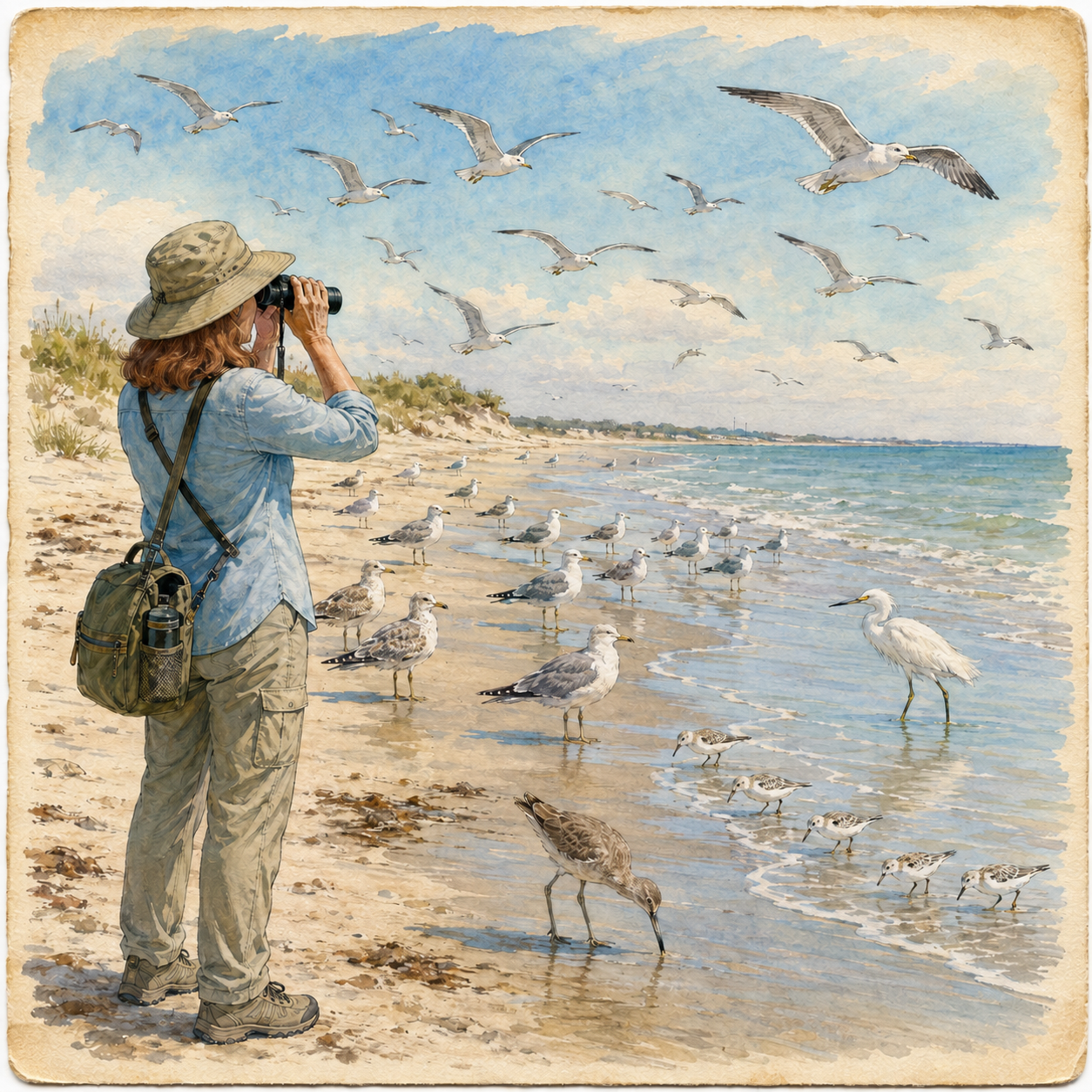
Every experienced birder was once the person who could not find the bird everyone else seemed to be looking at.
They have all raised their binoculars and found nothing but leaves. They have confidently identified a bird—only to discover that it was something else entirely. They have stood quietly in a group, wondering whether their question was too basic to ask.
If any of this sounds familiar, you are not failing at birding. You are learning it.
Confidence in birding does not come from memorizing every species in a field guide. It grows through small, repeated successes: getting a bird into your binoculars quickly, noticing one useful field mark, recognizing a familiar call or explaining where you saw a bird so someone else can find it.
Those skills make birding more enjoyable when you are alone. They also help you feel much more comfortable on a guided walk, at a birding festival or with a local bird club.
The goal is not to become the person with every answer. The goal is to become a curious, observant birder who knows how to keep looking until they can put a name to a bird.
Why Beginning Birders Often Feel Intimidated
Birding groups can appear to move at lightning speed. Someone calls out a name. Binoculars go up—and before you have located the right tree, the bird is gone. Experienced birders may identify birds from a quick glimpse, a single note or a flicker of movement. It can seem like a private club whose members know a secret language. It’s repetition and recall. And you’ll gain the skills faster than you expect.
They do know a language, but it is one you can learn. More important, experienced birders are usually not processing every possible detail. They are using a few dependable shortcuts: habitat, size, shape, behavior, sound and bird family.
You do not need to know as much as they do to join in. You only need a few basic tools and permission to be a beginner.
Start With Birds You Already Know
One of the best ways to build confidence is to stop judging your progress by the number of new birds you identify.
Common birds are excellent teachers. American Robins, Northern Cardinals, Blue Jays, chickadees and Mourning Doves give you repeated opportunities to observe without pressure. Because you know what they are, you can concentrate on how you know.
Choose one familiar bird and ask:
What is its overall shape?
Is it larger or smaller than a robin?
How does it move on the ground or through a tree?
Where does it usually feed?
Does it sit upright, cling to bark, hover or pump its tail?
What sound does it make before you see it?
This exercise turns an automatic identification into a set of transferable skills. The next unfamiliar bird may share the same shape, behavior or feeding style, helping you narrow the possibilities much faster.
Try the Five-Minute Bird Study
Pick one common bird and watch it for five uninterrupted minutes. Do not worry about taking a perfect photograph or finding another species. Write down five things you notice.
Careful observation is the foundation of confident identification.
Practice Finding Birds With Your Binoculars
Many beginners assume they have trouble identifying birds when the real challenge is getting the bird into view. Fortunately, binocular coordination improves quickly with practice.
With your unaided eyes, choose a stationary object such as a pinecone, leaf cluster or distant sign. Keep looking at it while raising your binoculars directly to your eyes. The object should appear in the center—or close to it. Resist the temptation to look down at your binoculars before you lift them. In that instant it takes to glance down at your binoculars, your bird may be gone to parts unknown.
Repeat this ten times. Then practice on a perched bird. Eventually, try following a bird moving through open branches.
This may be the single most useful exercise you can do before joining a group walk. When someone points out a bird that may stay only a few seconds, being able to get on it quickly makes the entire experience feel easier.
Learn to Describe Where the Bird Is
Finding a bird for yourself is satisfying. Helping someone else find it is one of the moments when you begin to feel like part of a birding group. It’s like giving a perfect gift.
Start with the largest obvious landmark—the tallest tree, bare snag or left edge of the pond—then narrow the location.
For example:
“In the tallest oak, about halfway up, on the first bare branch off to the right.”
Birders also use an imaginary clock face. Twelve o’clock is straight up, three is right, six is down and nine is left.
You might say, “The bird is at two o’clock, just inside the outer edge of the tree.”
Practice describing the location of a feeder bird, garden ornament or leaf cluster—even when no one else is present. Clear directions are a learnable skill, and you will appreciate them just as much when another birder is helping you.
Focus on Bird Families Before Species
Trying to compare an unknown bird with every bird in North America is overwhelming. Deciding that it is probably a woodpecker, sparrow, hawk, duck or warbler gives you a much smaller puzzle.
Begin with broad questions:
Is it shaped like a duck, heron, hawk, woodpecker or songbird?
Is the bill thick, thin, hooked, long or chisel-like?
Does it walk, hop, swim, soar or cling?
Is it feeding on the ground, probing bark or catching insects in the air?
You do not have to identify the exact species for an observation to be useful. “I think it was a sparrow because it was small, brown, streaked and feeding on the ground” is good birding.
Try a One-Family Week
Choose one family you see regularly and focus on it for a week. Study ducks at a pond or compare the sparrows in your yard. Learn the family’s general shape and behavior, then two or three likely species. A little organized knowledge is more useful than a long list of disconnected facts.
Use the Three-Clue Rule
Color attracts attention, but it can be surprisingly unreliable. Light, distance, wear and shadows can all change the way a bird looks. Instead of making an identification from one bright patch, try to collect three clues.
Your clues might include:
Size and overall shape
Bill shape or a distinctive field mark
Behavior, habitat or sound
Suppose you see a black-and-white bird moving headfirst down a tree trunk. Its compact shape, short tail and climbing behavior point toward a nuthatch even before you study the head pattern.
The three-clue rule gives you a repeatable process and makes it easier to reconsider an identification without treating a mistake as failure.
Say What You Notice Before Naming the Bird
In a group, you do not have to wait until you know the species before speaking.
Try saying:
“There is a small bird flicking its tail low in the shrubs.”
“I have a large pale hawk circling above the ridge.”
“I’m hearing a repeated two-note call from the trees behind us.”
These observations may help someone locate and identify the bird. You are participating in exactly the right way: by paying attention.
When someone supplies the identification, ask what clue helped most. A question such as “Was it the wing bars or the behavior that made that a kinglet?” often teaches you more than simply hearing the bird’s name.
Practice Birding Alone Without Making It a Test
Solo birding gives you the freedom to linger. No one is waiting for you to make an identification or move along the trail.
Choose a familiar, comfortable location and set one small goal. You might spend 20 minutes watching a single feeder, walk one short loop at a park or look for three species you expect based on the habitat.
Try the Three Bird Challenge before you go:
Predict three birds you are likely to find.
Write down why each one should be there.
Look and listen for those birds before chasing anything unexpected.
Predicting birds teaches you to read habitat and season as well as the value of preparation. Finding even one of your three creates a meaningful success. If you find none of them, you still learn something about conditions, timing or habitat.
Keep brief field notes, but do not turn every outing into homework. Record the date, place, a few species and one question. Your notes will reveal progress that is easy to overlook.
If you find a bird you just can’t identify, field notes can help you take a second pass at IDing when you get back home. Pull out that field guide and track down the flock of large “sparrows” with the thin beak and white outer tail feathers you saw in the pasture that turns out to be American Pipits after more deliberation.
Prepare for a Group Bird Walk
A little preparation removes much of the uncertainty from group birding.
Before the walk, check the terrain and a recent bird list if one is available (ebird, local sources or even the maps in the field guide). Choose five likely birds to review; you do not need to study every possibility.
Bring adjusted binoculars, water, suitable shoes and a field guide or app you know how to use. Arrive early and introduce yourself to the leader. “I’m fairly new and still practicing getting on birds quickly” gives the leader useful information and makes it easier to ask for help.
You’ll quickly “identify” the 2 main types of birders - the ego-centered birder who wants everyone to know how proficient they are (they often run ahead of the group so the can find birds first) and the birders who are there for a pleasant walk and social interaction and, oh yeah, the birds too. You’ll learn from both types but the social birder is often a more patient helper and a better source for educational tips.
Stay near the leader or a birder who gives clear directions. If you lose the bird, say so. “Could you start again from the trunk?” is more useful than pretending you saw it. Your question may help other beginners too.
Field trip leaders often ask at the outset “who are our novice birders today?” or something similar. This is not to single you out or shame you. The leader may say “Newbies stay close to me” or “OK we’ll pair you up with some of these seasoned birders.” That’s a great leader. Get his/her schedule of upcoming trips and attend them.
A good field trip leader also makes sure everyone in their group has a chance to see every bird before moving on. “Everyone get eyes on the Brown Creeper?” That’s your cue to speak up if you haven’t seen it.
An organized field trip with a quality leader can advance your birding skills (and your life list) faster than a dozen trips on your own - more eyes find more birds and experienced feedback can be a godsend.
Use Comfortable Group-Birding Language
A few phrases make joining the conversation easier:
“What field mark are you using?”
“Could you point me to the trunk first?”
“I’m not sure, but the shape made me think it was a wren.”
“What would help separate those two species?”
None of these requires you to sound certain. Good birders regularly say probably, possibly and I’m not sure. Honest uncertainty is careful observation.
Let Mistakes Become Part of Your Field Guide
You will misidentify birds. Everyone does.
The useful question is not “How could I get that wrong?” It is “What clue would help me get it right next time?”
Perhaps you relied too heavily on color, overlooked the bill or chose a species unlikely in that season. Correcting an identification creates a stronger memory than passively reading the right answer.
If someone corrects you, try responding with curiosity: “Thank you—what should I look for?” Most experienced birders will be delighted to explain.
Experts disagree, birds appear in unexpected places and some views are too brief for certainty. “Bird species unknown” is accurate when the evidence is incomplete.
Species can look too similar even for experienced birders to identify accurately. The Couch’s and the Tropical Kingbird are nearly impossible until you hear their song and don’t get me started on the empids (the Empidonax group of flycatchers that are so similar identity often boils down habitat and season).
Measure Progress Differently
A longer life list is exciting, but it is not the only sign of improvement.
You are making progress when you:
Raise your binoculars and find the bird more quickly.
Notice behavior before reaching for a field guide.
Recognize a familiar bird by sound.
Narrow an unknown bird to a family.
Give directions that help someone else see it.
Ask a specific question instead of apologizing for not knowing.
Enjoy an outing even when you identify only a few birds.
You begin helping a newbie find the “new to them” species.
These skills accumulate quietly.
Confidence Comes From Returning
You do not need to feel confident before attending a bird walk, exploring a new trail or calling attention to a bird. Confidence usually arrives afterward—because you went and discovered that you could participate.
Start small. Learn the birds close to home. Practice raising your binoculars. Study one family at a time. Describe what you see before worrying about a name. Then take those skills into a group where other birders can help you build on them.
Birding is not a performance, and the woods are not giving a test. There will always be another bird you do not know. That is not a reason to feel behind. It is one of the reasons birding remains interesting for a lifetime.
The most confident birder is not always the one who recognizes the most species. Often, it is the one who is comfortable saying, “I don’t know yet—but let’s take another look.”
When I knew I had arrived (or at least my ego had). Years ago I was birding along the eastern coast (Cape May I think) and I stood at the edge of the salt grass and tried to identify gulls. I hate gulls. First, most of 3-4 years of plumage changes before reaching adult plumage and second, let’s be frank, they all look alike.
So I’m standing there looking at the one gull that seemed different than the 100+ there. A man had been birding near me walked up, “What do you think that one is?” looking at my gull. In my best field trip leader confident voice “I believe it’s a ____ gull (I’ve blocked which) but since I’m not from around here, I’m working to confirm it. “Tell me your thoughts why,” he said. I listed the field marks and behaviors I was using. He said, “You know I agree with your ID and your process. Enjoy the rest of your trip.” When he left, a birder rushed up to me “Do you know who that was?! It’s Pete Dunne!” One of the best and renowned birders in the world confirm my ID! I responded to the birder, “Geez, I’m glad I was right”
We can’t always keep ego out of it but it was skill (or at least semi-educated lucky guesses that prevailed on that day).
Get out there. Risk making a fool of yourself with your first solo ID. Learn from others. Find like-minded people that will share their friendship, joy and expertise to help make you a better birder. There’s lots of us out there and we’re happy to help.
Read Birding for Beginners next.
