

Green Jay
The Tropical Trouble-Maker of South Texas (and Beyond)
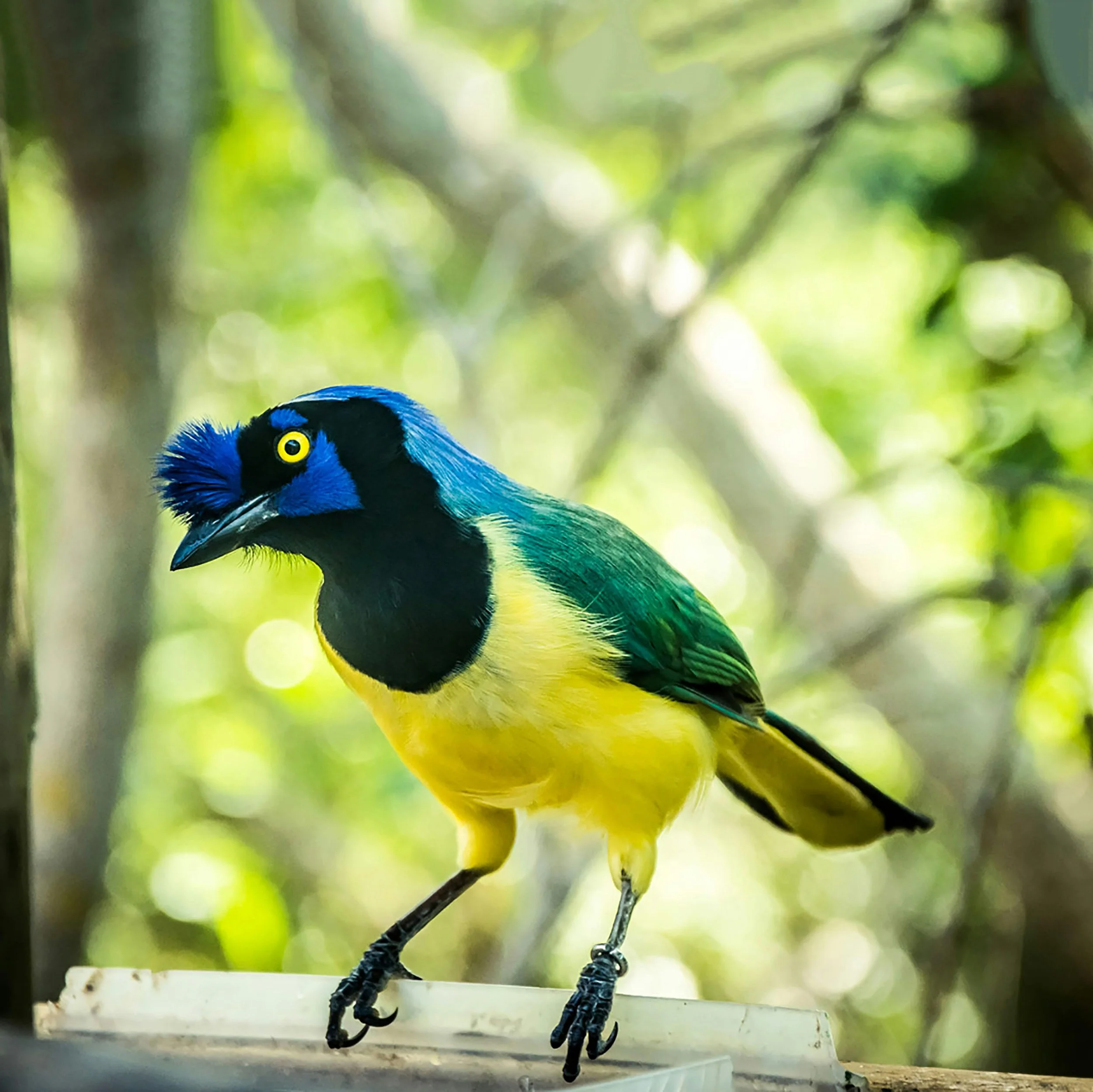
If you’ve ever watched a jay long enough, you start to realize they’re not just “pretty birds.” Jays are characters—bold, clever, noisy, opinionated… and somehow always acting like they own the place.
Now take that jay energy and paint it in lime green, sunshine yellow, and electric blue, then drop it into thorny brushlands and subtropical woodlands where everything feels a little wilder. That’s the Green Jay—a bird that looks like it wandered north from a rainforest party and decided to stay.
For U.S. birders, the Green Jay is one of those “you’ll never forget your first one” species. It’s tropical, loud, and social—often traveling with family members like a roaming neighborhood crew. And when you see one, you don’t just identify it… you kind of meet it.
Let’s dig into where Green Jays live, what they eat, how they behave, and where you can go to see them in real life.
Quick ID vibe (because you’ll want to be ready)
Green Jays are unmistakably colorful: green back and wings, yellowish underparts, and a blue-and-black head pattern that looks like it was designed by a graphic artist with no fear. In the U.S., you’ll almost always see the northern form that tends to look more greenish below than the brighter yellow birds farther south.
But the bigger “tell” isn’t even the color.
It’s the attitude.
Green Jays move with purpose, call constantly, and show up in groups more often than many people expect from a “songbird.”
Distribution: where Green Jays live (and where they barely don’t)
The Green Jay’s range is mostly tropical—from Mexico through parts of Central America—but it just barely pushes into the U.S. in extreme southern Texas.
In Texas, breeding is concentrated almost entirely in the Lower Rio Grande Valley region, with breeding records extending north only a little beyond the Valley (historically documented into counties like Kleberg and Jim Wells, with other records considered more marginal).
That “barely stretches into Texas” reality is part of what makes the bird feel so special: you’re seeing a tropical corvid living right at the edge of its U.S. foothold.
What this means for you:
If you want a reliable U.S. Green Jay, you plan a trip to South Texas, not “Texas-ish.” The farther you are from the Lower Rio Grande Valley, the faster your odds drop.
Habitat: thorny, tangled, and surprisingly neighborhood-friendly
Green Jays like places that feel “brushy” and alive:
Native woodlands and thornscrub
Thickets
Mesquite brush
Parks and developed areas if they still have strong native tree/shrub structure
Even orchards and park-like landscapes in parts of their range.
In the Lower Rio Grande Valley, this often means the classic Tamaulipan thornscrub vibe—dense, spiky, and tangled. It’s not manicured “pretty forest.” It’s living habitat with teeth.
And that’s part of the magic: the Green Jay isn’t just a bird of pristine wilderness. In the right places, it adapts—showing up around picnic areas, feeding stations, and visitor centers, sometimes getting bold enough to investigate human activity (and snacks).
Diet: the definition of “opportunistic”
Green Jays are omnivores with a very flexible menu. Think: “If it moves, grows, or can be pried loose, it’s worth investigating.”
They commonly eat:
Insects and other invertebrates (beetles, grasshoppers, crickets, wasps, etc.)
Spiders and other small creepy-crawlies
Fruit, berries, seeds, nuts
Small vertebrates (yes—sometimes tiny lizards/rodents)
Eggs or nestlings opportunistically, like many jays
The occasional scrap if they can get it
Cornell’s description is perfect: they’re versatile foragers—comfortable picking, pouncing, gleaning, and even flycatching insects.
A note for backyard birders (and feeder watchers)
If you bird in South Texas where Green Jays occur, feeding stations can be wildly productive. They often come in with a squad mentality, and once a family flock learns a reliable food spot, it can become part of their daily route. (You don’t “own” the feeder—the Green Jays do.)
Social habits: family flocks, constant conversation, and year-round swagger
This is where Green Jays really shine.
They’re often seen traveling in conspicuous family flocks, roving through brushlands and woodlands together while keeping contact with lots of calls.
Audubon notes they live in pairs or social groups in all seasons, with a big repertoire of calls—sometimes bizarre, sometimes hilarious, always very “jay.”
They’re also:
Territorial year-round (they don’t suddenly become polite in winter)
Known to drive off rival Green Jays
Likely to mob predators (owls, snakes, etc.)
The deeper “why it matters” piece
Watching a Green Jay flock is a reminder that birding isn’t only about “checking the box.” It’s about noticing how life organizes itself.
A family group moving through thornscrub—calling to each other, coordinating, reacting to danger, sharing information—feels like a living example of community. It’s survival, yes, but it’s also relationship. It’s connection. It’s the kind of thing that quietly resets your nervous system when you’ve been staring at screens and deadlines too long.
Birding teaches us that attention is a form of respect. And few birds reward your attention like a Green Jay.
Where to see Green Jays: “go where the Valley specialties live”
If you’re planning a trip specifically to see Green Jays in the U.S., focus on Lower Rio Grande Valley sites—especially those connected to the World Birding Center network (a partnership of sites along a historic river road).
Here are reliable, well-known places where birders commonly connect with them:
1) Bentsen-Rio Grande Valley State Park (World Birding Center HQ)
This is one of the most classic South Texas birding stops—and Texas Parks & Wildlife Department specifically highlights Green Jay at the park.
2) Santa Ana National Wildlife Refuge
A legendary birding refuge in the Valley and a widely cited place for “tropical edge” species—including Green Jays.
3) Estero Llano Grande State Park
A prime World Birding Center site; TPW Magazine notes Green Jays can often be found in specific zones/blinds there.
4) Resaca de la Palma State Park
A Lower Rio Grande Valley gem (and Texas’s southernmost state park). Recent coverage highlights birding there including Green Jays.
5) Quinta Mazatlán (McAllen)
A very accessible option (urban sanctuary vibes) and their birding info specifically calls out Green Jay as a favorite.
Bonus: More South Texas hotspots
Watch for the RBB upcoming post on TEXAS HOTSPOTS as well as our plans for our spring migration GRAND TOUR OF TEXAS Birding Trip.
How to actually find them (not just visit the right place)
Even in the right habitat, Green Jays can be surprisingly easy to miss if you bird like you’re shopping—fast, distracted, always moving on to the next aisle.
Try this instead:
Listen first. Green Jays are talkers. If you hear a busy mix of jay-like notes in brushy woodland, slow down. And you will probably also hear the clucking of the brown, chicken-like Chachalacas that frequent the same habitat.
Watch for movement at mid-level. Family groups often move through the vegetation together, not just one bird hopping around.
Check feeding stations and picnic areas (where appropriate). Some sites have birds that are bold around people, especially in popular parks and refuges.
Give it time. The “magic” birds show up when you stop trying to force it.
What we can do to help (and why this is bigger than one species)
In the U.S., Green Jays persist in a narrow slice of habitat. That habitat has been pressured for a long time—development, fragmentation, and the loss of native thornscrub ecosystems.
So the help is simple and powerful:
Support native habitat conservation in the Lower Rio Grande Valley (refuges, parks, land trusts, wildlife corridors).
Plant native trees/shrubs where you live in their range—especially thornscrub-associated plants that support insects and produce fruit.
Bird ethically: stay on trails, keep playback minimal (or skip it), and respect wildlife space—especially in sensitive refuge habitat.
Contribute sightings to platforms like eBird so data continues to guide conservation priorities.
Because when a tropical species can still thrive at the edge of its range, it’s a signal that the ecosystem still has breath in it.
And birders? We’re not just observers. We’re witnesses. We’re record-keepers. We’re the people who notice what’s changing—and what’s worth protecting.
Need to catch up on the other Jay posts?
Read:
