

Native Flowers
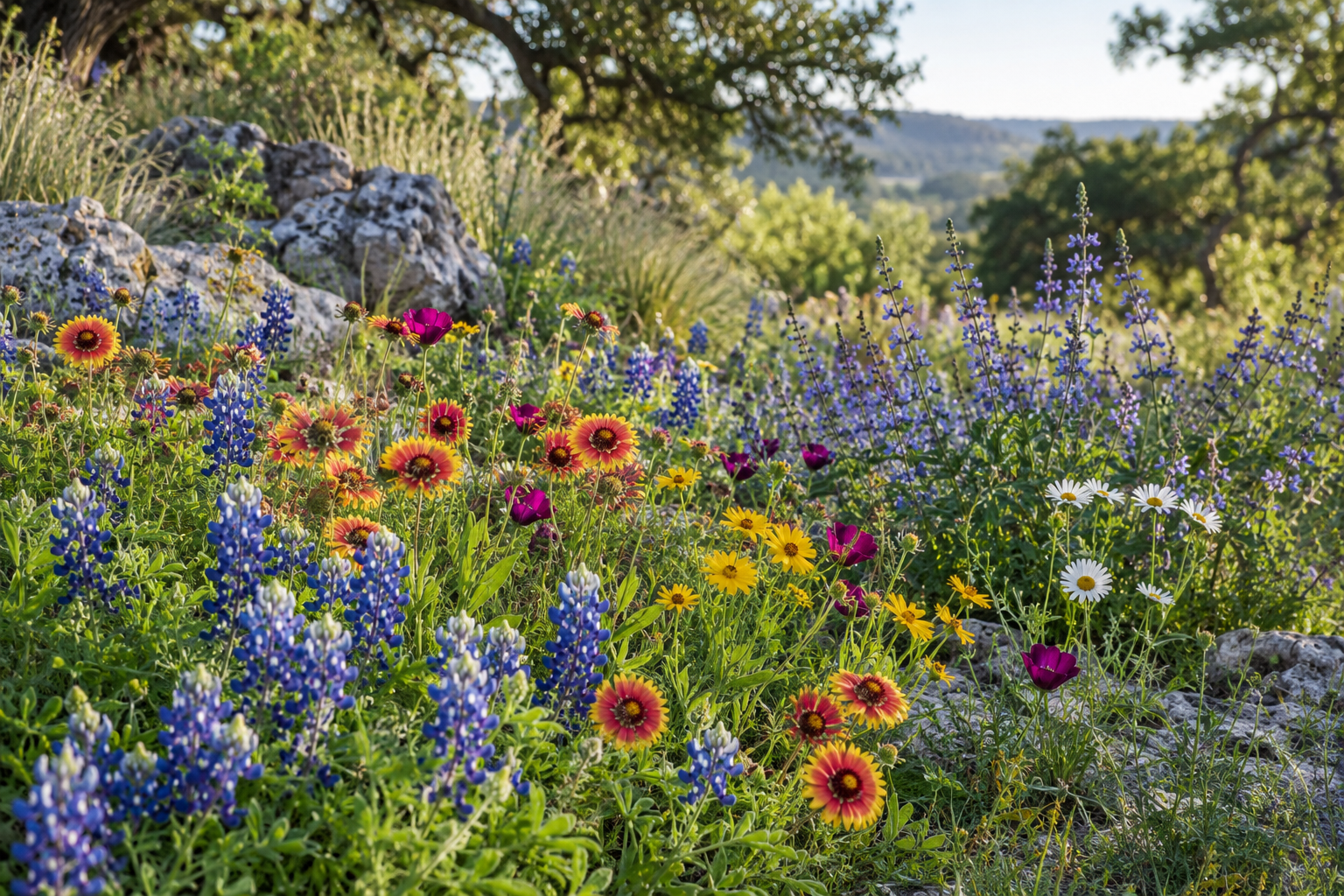
The Living Heart of a Backyard Bird Sanctuary
A native flower garden may look peaceful from the porch, but step closer and you will discover a surprisingly busy place.
Bees move from blossom to blossom. Caterpillars nibble leaves. A hummingbird pauses at a tubular flower. Goldfinches cling to ripening seed heads, while a sparrow searches the ground for seeds that have fallen below. Somewhere inside the stems and foliage, insects are hiding—and a watchful bird is looking for them.
Native flowers do much more than add color to a backyard bird sanctuary. They help provide food, shelter, nesting material and safe places to forage. They support the insects that birds need, produce nectar for hummingbirds and eventually offer seeds for finches, sparrows and other seed-eating birds.
They can also make life easier and more interesting for the gardener.
The important word, however, is native. A flower that is native somewhere in North America is not necessarily native where you live. The best choices are plants that evolved in your region—and, whenever possible, in your part of that region.
When we choose those plants and give them the conditions they need, a flower bed becomes more than decoration. It becomes working habitat.
Native Flowers Feed Birds in More Ways Than One
When people think about flowers and birds, they often picture a hummingbird drinking nectar. That is certainly part of the story, but it is only one part.
Native flowers support birds through several different food pathways.
Native flowers support insects
The biggest contribution may be the one gardeners do not always see.
Native flowers provide leaves, stems, nectar and pollen used by native insects. Some insects feed on many types of plants, but others depend on particular plant families—or even a single group of native plants—to complete their life cycles.
Those insects become bird food.
Adult birds may visit a feeder for sunflower seeds, suet or mealworms, but many species need insects when they are raising young. Caterpillars, beetles, spiders and other small invertebrates provide the protein and moisture growing nestlings require.
Even birds we think of as seed eaters may feed insects to their young.
A patch of native flowers can therefore function as a natural bird-feeding station. Unlike a traditional feeder, it produces food at several levels. Flowers feed pollinators. Leaves feed caterpillars. Insects feed birds. Later, the seeds feed another group of birds.
That is an impressive return from one garden bed.
The National Audubon Society notes that locally native plants provide birds with insects, seeds, fruit, nectar and refuge. Its Native Plants for Birds database can help gardeners search by ZIP code.
Flowers provide nectar
Hummingbirds are especially attracted to tubular flowers, but they do not make selections according to a simple “red flowers only” rule. Flower shape, nectar supply and location all matter.
Depending on the region, native columbines, penstemons, cardinal flowers, beardtongues, coral honeysuckle and native salvias may provide valuable nectar. Bloom times vary, so several species are better than one.
A garden with overlapping flowering periods gives hummingbirds more dependable food during spring migration, nesting season and fall migration.
Native flowers also feed bees, butterflies, moths, flies and beetles. These pollinators help keep the garden reproducing—and some become food for birds themselves. The Xerces Society’s regional plant lists are useful for planning a succession of flowers suited to different parts of the country.
Seed heads become natural bird feeders
Once the petals fade, the value of a native flower is not finished.
Coneflowers, sunflowers, asters, coreopsis, black-eyed Susans, blazing stars and many other native flowers produce seeds that may attract American Goldfinches, Pine Siskins, native sparrows, juncos and other birds.
This is where gardeners can make one of the easiest—and most meaningful—changes in a bird sanctuary: do not deadhead everything.
Leave at least some seed heads standing through fall and winter. Birds will perch directly on sturdy stalks or search the ground underneath them. The dried plants also catch frost and snow, adding structure and beauty to a winter garden.
A perfectly cleaned flower bed may satisfy our sense of order, but it removes food and hiding places just when wildlife needs them most.
Native Flowers Offer Cover, Too
Flowers are not a replacement for native shrubs and trees, but a dense planting can create valuable low-level cover.
Ground-feeding birds may retreat beneath flower stems when startled. Young birds can move through the foliage while learning to forage. Sparrows and juncos scratch among fallen leaves and seeds. Insects overwinter inside standing stems or beneath plant litter, providing another food source when birds search the garden in colder months.
A mixture of flowers, native grasses and low-growing groundcovers is especially useful. Instead of one flat layer of mulch surrounding isolated plants, the garden begins to resemble the layered vegetation birds encounter in natural habitat.
That does not mean every yard needs to become a tall, untamed meadow. Native flowers can be used in a formal border, cottage garden, rain garden, container grouping or narrow strip beside a fence.
The objective is not a particular garden style. It is greater biological function.
Native Flowers Benefit the Gardener
A bird-friendly garden should not require the gardener to struggle constantly to keep it alive.
Native plants are adapted to particular combinations of rainfall, temperature, soil and seasonal change. When they are planted in appropriate conditions, many can thrive with less supplemental water, fertilizer and ongoing intervention after they become established.
That does not mean native plants are maintenance-free. New plants still need water. Seeded areas require careful preparation and weed control. Some native flowers spread enthusiastically, while others are slow to establish.
“Native” also does not automatically mean drought-tolerant. A plant native to a wet meadow or stream bank will not be happy in a dry, sunbaked flower bed.
The real advantage comes from matching the plant to the place.
A dry-site native planted in a sunny, well-drained bed may require much less attention than a thirsty ornamental forced to grow there. A woodland flower placed beneath deciduous trees may succeed where a sun-loving garden flower struggles.
According to the Xerces Society, established native pollinator plantings can often thrive without the added water, nutrients and pesticides commonly required by conventional lawns and ornamental landscapes. That can mean:
Less watering after establishment
Less fertilizer
Fewer pesticide applications
Better performance during normal local weather
Less need to replace struggling plants
More seasonal interest
More birds, butterflies and other wildlife to observe
There is another benefit that is harder to measure: native flowers make a garden feel alive.
The gardener begins to notice when the first bees appear, which flowers hummingbirds prefer, when goldfinches begin examining seed heads and which insects attract warblers during migration. The garden becomes a place for observation rather than simply another area to maintain.
Choose Flowers for Your Region and Your Yard
Before buying seed, determine whether a species is genuinely native to your area. Common names can be misleading, and a package labeled “American wildflowers” or “regional wildflower mix” may include plants from distant parts of the country—or species that are not native to North America at all.
The Lady Bird Johnson Wildflower Center Native Plant Database allows gardeners to search by state, sunlight, soil moisture, plant height and bloom time. State native plant societies, university extension programs and local Audubon or Wild Ones chapters can provide additional guidance.
Then consider the conditions in your yard:
How many hours of sun does the site receive?
Does water drain quickly or remain after rain?
Is the soil sandy, rocky, clay-based or rich in organic matter?
How much space can the plants occupy?
Are shorter plants needed along a walkway?
Would taller flowers work better against a fence?
Are deer or rabbits likely to browse the planting?
Choose a collection of species instead of relying on a single “perfect” flower. Aim for blooms from early spring through fall, with several species flowering during each season.
Planting several of the same flower together also makes it easier for pollinators and hummingbirds to find them. A garden does not need one of everything. Repeated drifts of a smaller number of well-chosen species often look more intentional and provide better foraging opportunities.
Regional Native Flower Ideas
These are starting points, not universal recommendations. Species ranges vary, so confirm that each plant is native to your state or ecoregion.
Northeast and Mid-Atlantic: New England aster, smooth blue aster, wild bergamot, cardinal flower, blue-stemmed goldenrod, woodland sunflower and eastern columbine.
Southeast: Coreopsis species, black-eyed Susan, blazing star, scarlet sage, partridge pea, native phlox, narrowleaf sunflower and native milkweeds.
Midwest and Great Plains: Purple prairie clover, prairie blazing star, butterfly milkweed, wild bergamot, cup plant, compass plant, prairie coneflower and native sunflowers.
Texas and the Southern Plains: Winecup, standing cypress, mealy blue sage, lemon beebalm, plains coreopsis, gayfeather, Texas bluebonnet and Maximilian sunflower.
Southwest and Intermountain West: Desert marigold, globemallow, firecracker penstemon, Rocky Mountain penstemon, blanketflower, native lupines and desert bluebells.
California: California poppy, tidy tips, farewell-to-spring, California aster, native clarkias, native lupines and seaside daisy.
Pacific Northwest: Oregon sunshine, Douglas aster, farewell-to-spring, large-leaved lupine, western columbine, native yarrow and native camas.
Avoid treating these lists as shopping lists. A flower native to western Oregon may not belong in eastern Washington. A Texas Hill Country species may be poorly suited to the Gulf Coast. The closer you can match a plant to your local ecology and growing conditions, the better.
Buying Native Flower Seed
For a small garden, individual seed packets or plugs give you the most control. For a larger meadow, a carefully designed regional mix may be more practical.
Before ordering, look for:
Scientific names for every species
A complete ingredient list for seed mixes
Information about the seed’s geographic origin
Pure live seed or germination information
Site requirements
Planting and pretreatment instructions
No invasive or unidentified filler species
When available, locally collected or regionally grown seed is an excellent choice. Local ecotypes are populations that developed under the climate and ecological conditions of a particular area.
Do not worry if you cannot obtain a perfect local ecotype for every backyard flower. Begin with reputable, regionally appropriate species and improve the planting over time. A modest bed of suitable native flowers is more useful than a grand plan that never gets planted.
Also remember that many native perennial seeds do not behave like vegetable seeds. Some require a period of cold, moist conditions before they will germinate. Others may appear slowly or spend their first season developing roots rather than producing abundant flowers.
Read the supplier’s germination directions before planting.
Native Seed Sources Around the United States
The following companies and organizations provide native flower seed or help gardeners locate regional suppliers. Availability, shipping policies and inventories can change, so check each source before ordering.
Wild Seed Project — Maine-based nonprofit focused on seed-grown native plants of New England.
Ernst Conservation Seeds — Pennsylvania supplier with an extensive selection for the Northeast, Mid-Atlantic and eastern United States. Check mixes carefully because the company also sells naturalized species.
Prairie Moon Nursery — Minnesota source offering hundreds of native species, particularly useful for the Midwest, Great Lakes and prairie regions.
Ohio Prairie Nursery — Native flower, grass and pollinator mixes for the Midwest and eastern United States.
Roundstone Native Seed — Kentucky grower specializing in regionally produced native seed for the Southeast and eastern United States.
Native American Seed — Texas source specializing in native wildflowers and prairie grasses from the Texas–Oklahoma–Louisiana region.
Florida Wildflower Growers Cooperative — A source recommended by the Florida Wildflower Foundation for Florida-native wildflower seed.
Plants of the Southwest — New Mexico nursery and seed source specializing in native and desert-adapted plants of the Southwest.
Great Basin Seed — Utah-based supplier with seeds for the Great Basin, Intermountain West and Southwestern landscapes.
Larner Seeds — Specialist in California native flowers, grasses and other native plant seeds.
Northwest Meadowscapes — Regional native wildflower and grass seed for Oregon, Washington and the Pacific Northwest.
For more local options, search the Lady Bird Johnson Wildflower Center’s National Suppliers Directory. Native plant societies and seasonal native-plant sales may also offer species or ecotypes that large mail-order companies do not carry.
This list is not an endorsement of every seed or mix sold by any supplier. Always read the species list and confirm that the plants are appropriate for your location.
Let the Garden Finish Its Work
Once your native flowers are growing, resist the temptation to manage every stage of their lives.
Let a caterpillar chew a few leaves. Allow birds to pick through aging blossoms. Leave seed heads standing. Keep some stems and fallen leaves through winter. Avoid broad-spectrum pesticides that can eliminate the insects the garden was created to support.
You do not have to redesign the entire yard at once. Begin with one sunny corner, a narrow border or several containers. Replace a small section of lawn. Add three native flower species with different bloom times. Watch what visits.
A feeder invites birds to stop for a meal. Native flowers invite them into a living community.
When we plant flowers that belong to the place where we live, we give birds more than nectar or seeds. We give them insects, shelter, seasonal food and another safe place to move through the neighborhood.
And we give ourselves something, too: a garden filled with color, movement, discovery and a reason to step outside and look more closely.
