

Native Trees: The Backbone of a Backyard Bird Sanctuary
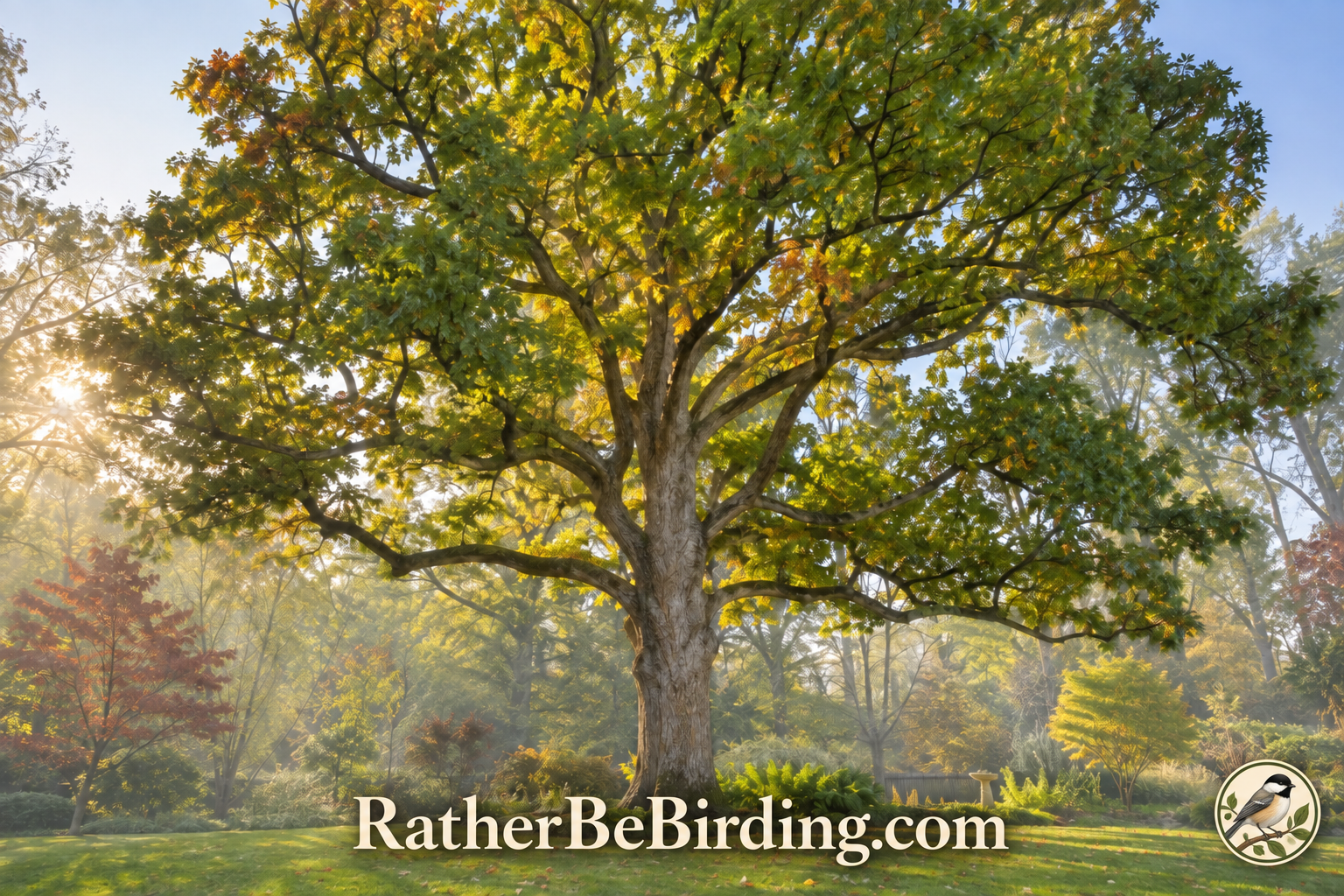
When we begin planning a backyard bird sanctuary, it is easy to focus on the features closest to eye level. We picture berry-covered shrubs, colorful flowers, bubbling water, and feeders filled with sunflower seed.
All of those things matter. But look a little higher.
Trees form the backbone of a bird-friendly landscape. They create the structure that holds the sanctuary together, connecting the ground, shrub, understory, and canopy layers into one living habitat.
A mature tree may offer birds food, nesting sites, shade, protection from weather, singing perches, lookout posts, and safe pathways across the yard. Its leaves may host caterpillars. Its flowers may attract insects. Its fruit or seeds may feed birds later in the season. Even its bark, branches, cavities, and fallen leaves contribute something.
But not every tree provides these benefits equally.
If your goal is to help birds, the best tree is usually one that belongs in your region—one that has developed relationships with the insects, birds, soil, and weather of that place over thousands of years.
Why Native Trees Matter to Birds
Birds do not use trees simply as attractive places to sit. A tree is part of a much larger food web.
Native insects recognize native trees as food and shelter. Caterpillars feed on their leaves. Beetles hide beneath their bark. Pollinators visit their flowers. Spiders build webs among their branches.
Birds, in turn, feed on all those creatures.
This relationship becomes especially important during nesting season. Adult birds may eat seeds or visit your suet feeder, but most North American songbirds need insects to raise their young. Caterpillars are particularly valuable because they are soft, nutritious, and easier for nestlings to digest than hard seeds.
A nonnative ornamental tree may look green and healthy to us while providing remarkably little food for local insects. Without insects, the tree becomes little more than outdoor furniture for birds—a perch, perhaps, but not a complete habitat.
Research highlighted by the National Audubon Society found that yards dominated by nonnative plants can function like “food deserts” for insect-eating birds. Native plants, including trees, support the insect abundance birds need to reproduce successfully. Audubon explains the research here.
That does not mean every nonnative tree in your yard must be removed. A large established tree may still offer shade, shelter, nesting structure, or a valuable cavity. The better approach is usually to protect useful existing trees while adding more native choices whenever space becomes available.
A sanctuary does not have to be perfect to be helpful.
Trees Provide More Than One Kind of Food
When people think of trees feeding birds, they often picture berries or fruit. Those foods are important, but they are only part of the story.
A native tree may provide:
Caterpillars, beetles, spiders, and other small invertebrates
Nectar and pollen that attract hummingbirds and insects
Fleshy fruit for thrushes, waxwings, orioles, catbirds, and mockingbirds
Seeds for finches, chickadees, nuthatches, and sparrows
Nuts and acorns for jays, woodpeckers, turkeys, and other wildlife
Sap used by sapsuckers and by birds attracted to the insects gathering nearby
The timing matters, too.
Spring insects help nesting birds. Summer fruit may support resident species and early migrants. Fall berries and nuts help birds build energy for migration or prepare for colder weather. Some fruit remains on the tree into winter, becoming especially important when other foods are scarce.
A good sanctuary does not offer one enormous meal on one day. It provides a changing sequence of foods across the seasons.
Trees Build the Vertical Layers Birds Need
A lawn with one isolated tree is better than a lawn with no trees, but it does not function like a complete habitat.
Birds divide the landscape vertically. Some feed primarily on the ground. Others remain in low shrubs. Certain warblers search among small outer branches, while woodpeckers and nuthatches examine trunks and heavier limbs. Flycatchers watch for insects from open perches. Hawks may use the highest branches as observation posts.
Trees make those different zones possible.
A tall canopy tree placed above smaller understory trees, shrubs, flowers, grasses, and leaf litter gives birds far more usable space than a collection of disconnected plants. It also gives them protected routes through the yard.
Think of your sanctuary as a building with several floors. The more useful floors you provide, the more kinds of birds can find a place to feed, rest, or nest.
Trees Offer Shelter and Safe Passage
Birds need places where they can disappear.
Dense branches help birds escape predators and find shelter from wind, rain, cold, and intense summer sun. Evergreens can be especially valuable during winter because their foliage continues to provide cover after deciduous trees have lost their leaves.
Trees also help connect habitat.
A bird may hesitate to cross a wide, exposed lawn. A line of trees and shrubs creates a safer travel corridor between a feeder, water source, nesting area, and neighboring habitat. These connected pathways are especially useful for young birds that are still learning to fly and for shy species that avoid open spaces.
If possible, avoid planting a single tree in the middle of an otherwise empty yard. Connect it visually and physically to shrubs, smaller trees, or a garden bed. The result will feel more natural—and birds are more likely to use it.
Trees Create Nesting Opportunities
Trees offer many different kinds of nest sites.
Orioles may suspend a woven nest near the tip of a drooping branch. Cardinals and mockingbirds may nest in dense foliage. Hummingbirds often place their tiny nests on sheltered horizontal branches. Hawks, crows, doves, and herons need stronger supporting limbs.
Older trees may develop cavities used by chickadees, titmice, nuthatches, owls, and woodpeckers. Dead branches can provide hunting and singing perches. Loose bark may shelter insects and, in some regions, roosting bats.
This is one reason an old tree should not be removed simply because it looks imperfect. If a certified arborist determines that the tree does not pose a danger, a dead limb—or even part of a dead tree—can be tremendously useful to wildlife.
A perfectly groomed tree may be visually tidy. A tree with a few holes, rough patches, and weathered branches may be a neighborhood full of life.
A Special Case for Oak Trees
If you can plant only one large native tree, an oak deserves serious consideration.
Native oaks are often described as keystone plants because so many other living things depend on them. The National Wildlife Federation reports that a native oak can support the caterpillars of more than 500 species of butterflies and moths. Those caterpillars become essential food for chickadees, warblers, vireos, tanagers, and many other birds. The NWF Native Plant Finder can help identify highly valuable plants by ZIP code.
In spring and early summer, birds search oak foliage for caterpillars and other insects. During migration, the spreading canopy can become a busy feeding station for warblers and other small songbirds.
Later in the year, acorns feed Blue Jays, Wild Turkeys, woodpeckers, grackles, ducks, and many other animals. The USDA Forest Service notes the importance of acorns as food for birds and wildlife across North American oak habitats. See the USDA’s field guide to native eastern oaks.
Oaks also provide:
Broad canopies for shade and shelter
Strong branches for nesting and perching
Deeply textured bark where insects can hide
Cavities as the tree ages
Leaf litter that protects overwintering insects and feeds the soil
Long lives, allowing one tree to benefit generations of birds and people
Not every oak grows into a massive tree, and not every species tolerates the same conditions. There are oaks adapted to dry slopes, moist bottomlands, coastal areas, clay soils, sandy soils, intense heat, and cold winters.
The important step is choosing an oak native to your particular area.
Oak Trees for Different Regions
Depending on your location and site conditions, native possibilities may include:
Northeast and Mid-Atlantic: white oak, northern red oak, black oak, pin oak, and swamp white oak
Southeast: southern live oak, willow oak, southern red oak, overcup oak, and Shumard oak
Midwest and Great Plains: bur oak, chinkapin oak, northern red oak, and swamp white oak
Texas and the southern Plains: escarpment live oak, bur oak, chinkapin oak, Shumard oak, and Texas red oak
Southwest: Emory oak, Arizona white oak, silverleaf oak, and Gambel oak in appropriate elevations
California: coast live oak, valley oak, blue oak, canyon live oak, and California black oak
Pacific Northwest: Oregon white oak, also called Garry oak, where naturally appropriate
This is only a starting point. Native ranges can change within a single state, and soil, drainage, elevation, rainfall, and available space all affect which oak will thrive.
Before buying, check with your state native plant society, county extension office, local Audubon chapter, or a reputable native plant nursery. Ask not only whether the tree is native to the state, but whether it is native and suitable for your part of the state.
Choosing Native Trees for Your Region
There is no single “best bird tree” for every backyard. The desert Southwest, the humid Southeast, the Great Plains, and the Pacific Northwest support very different natural plant communities.
The following examples can help you begin your search.
RegionNative trees to investigate:
Northeast and Mid-Atlantic - Native oaks, black cherry, serviceberry, river birch, American holly, eastern red cedar
Southeast - Native oaks, blackgum or tupelo, bald cypress, native magnolias, American holly, pines
Midwest and Great Plains - Bur oak, hackberry, serviceberry, eastern red cedar, native plum, cottonwood where space permits
Texas and Southern Plains - Escarpment live oak, bur oak, chinkapin oak, cedar elm, netleaf hackberry, Texas persimmon,
Desert Southwest - Desert willow, velvet mesquite, netleaf hackberry, native oaks, native junipers, Arizona sycamore in suitable sites
Mountain West - Gambel oak, quaking aspen, Rocky Mountain juniper, pinyon pine, ponderosa pine
California - Native oaks, California sycamore, toyon, Pacific madrone, native elderberry
Pacific Northwest - Oregon white oak, bigleaf maple, red alder, Pacific madrone, western red cedar, Douglas-fir
These are regional possibilities, not universal planting instructions. For example, a tree native to wet coastal Washington may struggle east of the Cascades. A Texas tree suited to deep East Texas soil may fail in thin soil over Hill Country limestone.
“Native to my state” is helpful. “Native to my local ecosystem” is better.
Match the Tree to the Yard
A tree that is ecologically valuable but planted in the wrong location may become a costly problem.
Before planting, consider:
Mature height and canopy width
Distance from your house, roof, driveway, and utility lines
Root space
Soil type and drainage
Sun exposure
Average rainfall and irrigation needs
Cold hardiness and summer heat tolerance
Whether the tree drops large fruit, nuts, cones, or branches
Whether deer or other animals may damage a young tree
Do not choose a tree based only on how it looks in a nursery container. That small plant may eventually become 60 feet tall and nearly as wide.
Large native trees provide tremendous habitat, but smaller yards can still support useful understory trees. Serviceberries, native dogwoods, desert willow, redbuds, native hawthorns, and some smaller oaks can fit where a huge canopy tree cannot.
A small, well-chosen native tree is more valuable than an inappropriate large tree that must be removed ten years later.
Plant More Than One Kind of Tree
If space allows, combine several tree types rather than planting a row of the same species.
A layered mix might include:
A large deciduous canopy tree
A smaller flowering or fruiting understory tree
A native evergreen for year-round cover
Shrubs beneath and around the trees
Native flowers and grasses at ground level
Diversity makes the sanctuary more resilient. If one tree species is affected by a pest, disease, drought, or storm, the entire habitat is not lost. Different trees also provide food at different times and attract different insects.
Try to create overlapping canopies and layers without overcrowding the plants. Your goal is not to fill every inch immediately. It is to imagine how the sanctuary will develop over years.
Protect the Trees You Already Have
Planting a young native tree is an investment in the future. Protecting an established tree may produce immediate results.
Before removing a mature tree, ask:
Is it native?
Is it healthy enough to remain?
Are birds already nesting or feeding in it?
Does it connect two areas of cover?
Could selective pruning solve the problem?
Could a safe portion of the trunk remain as a wildlife snag?
Have questionable trees evaluated by a qualified arborist. Safety comes first, especially near homes and walking areas, but a tree does not have to look flawless to be useful.
Also protect the ground beneath your trees. Repeated mowing, soil compaction, and damage from string trimmers can weaken roots and trunks. A broad bed of leaf litter, native groundcover, or mulch can protect the root zone while extending the habitat downward.
Avoid piling mulch against the trunk. Trees do not need mulch volcanoes. Give the trunk room to breathe and the roots room to spread.
Leave Some of the Leaves
A tree’s usefulness does not end when its leaves fall.
Leaf litter shelters caterpillar pupae, beetles, spiders, and other small creatures. Ground-feeding birds such as towhees, sparrows, thrashers, and wrens search through those leaves for food.
Leaves also return nutrients to the soil and help conserve moisture around tree roots.
You do not have to leave every leaf on every walkway. Move leaves from patios, sidewalks, and heavily used lawn areas into garden beds and beneath trees and shrubs. There they become part of the sanctuary instead of part of the waste stream.
This small change can turn the space beneath a tree into an active feeding area.
Give a Young Tree Time
Trees ask us to think beyond the current season.
A shrub may produce berries within a year or two. A feeder can attract birds this afternoon. A tree works on a different schedule.
It may take several years before a young tree develops a substantial canopy. It may take much longer before it produces a large crop of acorns, forms cavities, or provides sturdy nesting branches.
But the tree begins contributing sooner than we sometimes realize. Insects may find its leaves. Birds may use it as a perch. Its roots begin improving the soil, and its shade begins changing the tiny climate beneath it.
Planting a native tree is an act of patience—and of optimism. Someone may sit beneath its full canopy many years from now. Birds may nest in branches that have not grown yet.
Start With One Good Tree
You do not need an acre of land to make a meaningful difference.
Start by looking at what your yard is missing. Does it need summer shade? Winter shelter? Spring insects? Fall fruit? A connection between two isolated garden beds?
Then choose one native tree capable of filling several of those needs.
If you have room for an oak, consider planting one. If you already have mature oaks, protect them and build layers of native shrubs and plants beneath them. If an oak is too large for your space, choose a smaller native tree that fits the yard you actually have.
The best backyard bird sanctuary is not the one with the longest plant list. It is the one where each plant contributes to a living, connected habitat.
Feeders may bring birds close enough for us to enjoy. Native trees give them reasons to stay.
Plant the tree that belongs where you live, care for it well, and give it time. Long after the first leaves unfold, it will continue providing food, shelter, and possibility—one branch, one caterpillar, and one new generation of birds at a time.
Read about other layers that create a successful backyard bird sanctuary. The shrub layer or berry plants.
