

Why Habitat Helps You Identify Birds
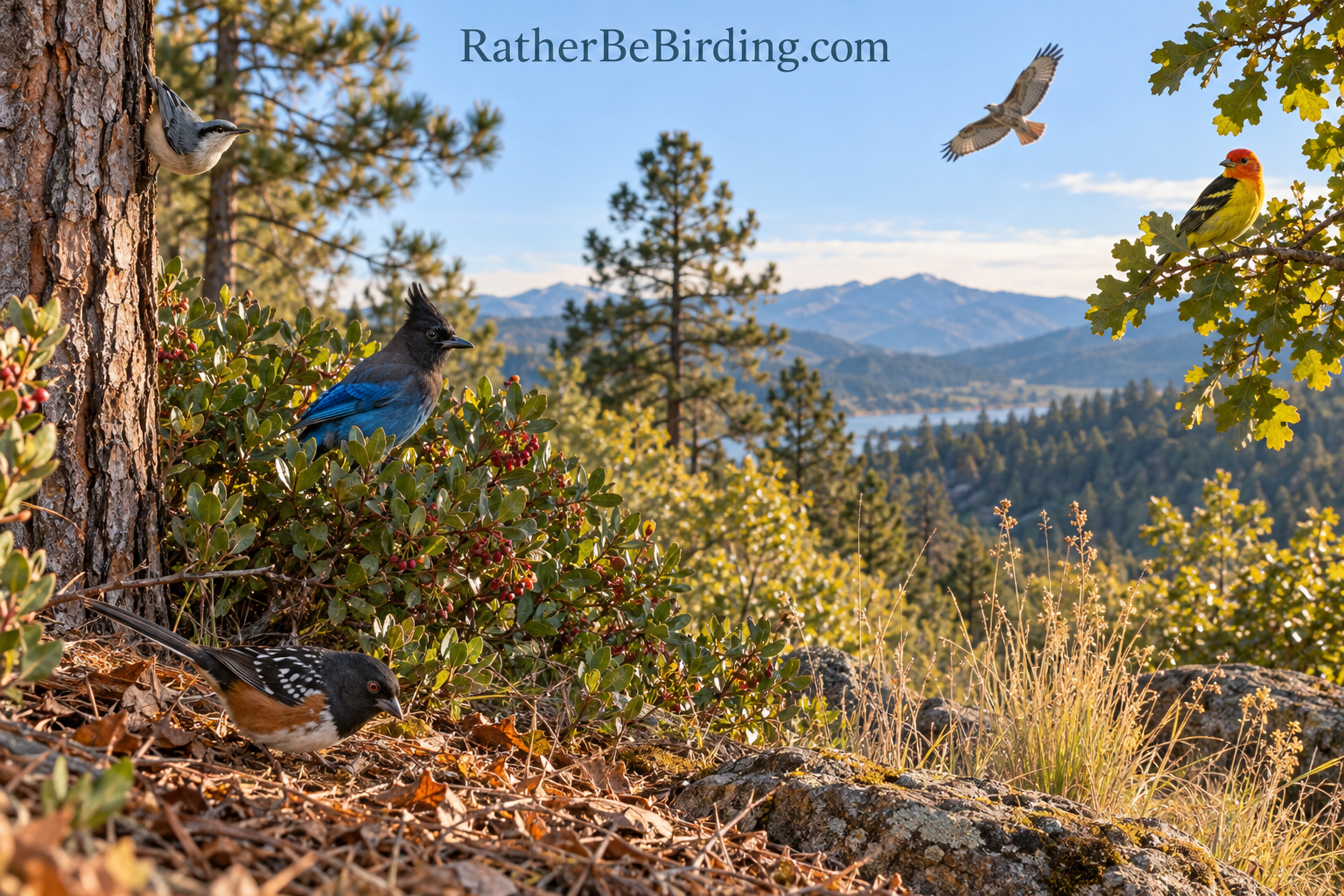
When you are learning to identify birds, it is tempting to concentrate on color. You see a flash of yellow, a rusty breast, or a black cap and immediately begin searching your field guide for a bird with the same markings.
Sometimes that works. Often, it does not.
Light changes color. Feathers fade and wear. Males, females, and young birds may look different. A bird may also be partly hidden, facing away, or moving too quickly for a clear view.
Habitat gives you another way into the identification—and it is one of the most helpful skills a beginning birder can learn.
Before you ask, “What color was that bird?” ask, “Where was it?”
Was it high in the leafy canopy, clinging to a tree trunk, moving through dense shrubs, or walking across open ground? Was it beside freshwater, on a rocky shoreline, in a marsh, or over a wide-open field?
Those details can shrink a long list of possibilities into a much more manageable group.
Habitat will not always tell you exactly which species you found, but it helps you know where to begin.
What Do Birders Mean by Habitat?
Habitat is more than a place on a map. It is the complete living environment a bird uses to find food, water, shelter, and nesting space.
A city park, for example, may contain several habitats within a surprisingly small area. Its open lawn may attract robins, grackles, and geese. Mature trees may hold woodpeckers, chickadees, and nuthatches. A brushy edge may shelter sparrows, wrens, and towhees. A pond may bring in swallows, herons, kingfishers, and ducks.
All of those birds are “in the park,” but they are not using it in the same way.
Look at habitat on more than one scale:
The larger landscape, such as forest, grassland, desert, wetland, coastline, or neighborhood
The smaller habitat within it, such as a reed bed, muddy edge, flowering tree, or brush pile
The vertical layer a bird occupies, from the ground to the treetops and open sky
The particular feature it is using, such as bark, seed heads, shallow water, or exposed perches
Learning to notice those layers turns a general location into a collection of useful clues.
Habitat Narrows the Possibilities
Imagine that you catch sight of a small brown bird. “Small and brown” describes a great many species, so color alone does not take you far.
Now add habitat.
If the bird is creeping headfirst down the trunk of a mature tree, you have a strong clue pointing toward a nuthatch. If it is climbing upward while using its stiff tail for support, think about a Brown Creeper. If it is kicking through dry leaves beneath a shrub, a sparrow or towhee becomes more likely. If it is perched on a cattail over marsh water, you should consider an entirely different group of birds.
The bird is still brown, but its surroundings and position have transformed the identification problem.
This is especially useful when birds look similar. Many warblers are small, active, and yellowish. Yet one foraging near the ground in dense cover creates a different shortlist from one moving through tall conifers.
Shorebirds can also be challenging, but probing mud, picking along sand, or wading in shallow water reveals feeding style and narrows the choices.
Instead of comparing your mystery bird with every bird in the book, habitat helps you compare it with the birds most likely to be there.
Learn to Read the Vertical Layers
One of the easiest ways to use habitat is to divide what you see into vertical layers.
Ground level
Look for birds walking, hopping, or scratching. Depending on your location and the season, you may find doves, sparrows, juncos, towhees, thrushes, or robins.
Notice whether the surface is mud, short grass, leaf litter, rock, sand, or shallow water. Each one provides different kinds of food.
Shrub layer
Densely branched shrubs give birds food and cover. Wrens, sparrows, cardinals, towhees, and some warblers may spend much of their time here.
Because birds in this layer can be difficult to see, pay attention to movement, calls, and the height at which the bird appears.
Trunks and large branches
Tree bark is its own feeding zone. Woodpeckers, nuthatches, and creepers search it differently.
A woodpecker may brace against the trunk and hammer or probe. A creeper commonly works upward in a spiral. A nuthatch can travel downward headfirst.
Even without a clear look at the bird’s plumage, the way it moves on a tree trunk can provide a valuable identification clue.
Midstory and canopy
The middle and upper branches may hold vireos, warblers, tanagers, orioles, and other foliage-gleaning birds. Some favor outer twigs; others stay closer to the trunk.
Even when leaves block your view, the bird’s height and movement can point you toward the right family.
Open air
Do not forget the open sky. Swifts, swallows, gulls, vultures, and raptors may spend much of their visible time in flight.
Wing shape, flight style, height, and the landscape below all become part of the identification.
These habitat associations are patterns, not unbreakable laws. Birds wander, migrate, and surprise us. Habitat helps you form a good first hypothesis, but it should never persuade you to ignore clear evidence pointing somewhere else.
Look for the Bird’s Food
Birds choose places that help them survive, and food is one of the strongest reasons a bird appears where it does.
Seed-eating birds may gather in weedy fields, beneath feeders, or around grasses and flowers left standing through winter. Insect-eating birds may inspect bark, hover beneath leaves, dart from exposed perches, or follow emerging insects along the water.
Fruit-eating birds may suddenly fill berry-producing trees and shrubs. Wading birds search shallow water for fish and aquatic animals, while shorebirds probe or pick food from mud, sand, and rocky edges.
Ask yourself two questions:
What food might this habitat provide?
How is the bird trying to collect it?
A bird repeatedly flying from a fence to snatch an insect in midair suggests a flycatching strategy. A bird hanging upside down at the ends of fine twigs is built for another kind of search. A bird turning over leaves with both feet has revealed something about its identity even if you have not seen its face.
Habitat and behavior work together. The place tells you what opportunities are available; the bird’s actions tell you which opportunity it is using.
Edges Are Especially Productive
An “edge” is where two habitats meet: woodland and meadow, marsh and open water, brush and trail, or a landscaped yard and a wilder fence line.
These transition zones offer resources from both neighboring habitats. Birds may feed in the open but retreat to shrubs for safety. Forest birds may visit sunlit foliage where insects are active. A pond edge gives wading birds shallow feeding water and nearby perches.
Edges can also make birds easier to see. Watch the outer branches of a wooded border or the boundary between open water and marsh vegetation.
Whenever you arrive at a new birding location, identify its edges. Then slow down and watch them.
Season Changes the Meaning of Habitat
The same place can hold a very different bird community from one season to the next.
A leafy summer nesting tree may become a fruiting stop for autumn migrants. A flooded field may briefly provide ideal feeding conditions for shorebirds. A winter thicket may shelter sparrows that nest far to the north. In spring, even a small patch of trees can give traveling songbirds food and a place to rest.
The question is not simply, “What birds use this habitat?” It is, “What birds might use this habitat right now?”
Migration also produces exceptions. A bird may appear outside its familiar breeding habitat because it is traveling, resting after a long flight, or using whatever food and shelter it can find.
When you encounter an unexpected bird, observe carefully rather than dismissing it. Unusual does not mean impossible.
Knowing the season still makes your habitat clues much stronger. Your field guide’s range maps, seasonal notes, and habitat descriptions can help you decide which possibilities make sense.
Use Habitat Without Letting It Fool You
Habitat is powerful, but it is not proof.
If you decide that a certain bird “must” be in a shrub, you may bend every glimpse and sound to fit that answer. Expectations help us find birds, but they can also cause identification mistakes.
Treat habitat as one part of the evidence. Check it against:
Overall size and shape
Bill length and form
Wing and tail proportions
Posture and movement
Feeding behavior
Plumage pattern
Voice
Range and season
The strongest identifications come from several clues agreeing with one another. If the habitat suggests one bird but its shape, behavior, and voice suggest another, pause and investigate.
It is perfectly good birding to leave a bird unidentified.
“Small songbird in low marsh vegetation” is an honest and useful observation. Every time you record what you truly saw, you strengthen the skills you will use on the next bird.
A Simple Habitat-First Identification Routine
When you see an unfamiliar bird, resist the urge to reach immediately for your field guide or phone. Watch for a few moments and collect the clues that may disappear.
Try this order:
Name the broad habitat. Are you in woodland, grassland, desert, wetland, shoreline, or a developed area?
Find the bird’s layer. Is it on the ground, in shrubs, on a trunk, in the canopy, over water, or in open air?
Notice the exact feature. Is it using mud, reeds, flowers, berries, bark, a dead snag, or an exposed perch?
Watch what it does. Does it climb, scratch, hover, probe, dive, soar, or make short flights after insects?
Estimate size and shape. Compare it with a familiar bird rather than trying to guess inches.
Add visible field marks and sounds. Notice patterns before concentrating on fine shades of color.
Check range, season, and habitat together. Use your guide to test a shortlist, not to search every page at random.
With practice, this sequence becomes quick and natural. You begin to predict which birds might appear before you see them.
Practice by Choosing One Habitat
Choose one small area you can visit regularly: a backyard, neighborhood pond, wooded trail, creek crossing, or corner of a local park.
Spend ten minutes watching only one habitat layer. On one visit, study the ground. On another, watch the shrubs or tree trunks. Record where each bird first appeared and what it was doing.
You might write:
Sparrow-sized bird feeding beneath tall grasses
Small bird moving downward along the trunk
Robin-sized bird making repeated trips between a berry shrub and a tree
Long-winged bird circling above the open field
Try to make these notes before naming the species. This separates observation from assumption and teaches you to see details that are easy to miss.
Over time, familiar places become outdoor classrooms. You learn which branches flycatchers favor, where sparrows retreat when startled, and when fruiting trees attract visitors.
You are not merely memorizing a list. You are learning how birds live.
Habitat Helps You See More Birds
Reading habitat does more than improve identification. It changes the way you search.
Instead of scanning everywhere at once, you begin to focus on places where birds are likely to feed, rest, or hide. You notice a sheltered pocket out of the wind, an active patch of berries, a muddy margin, or one dead tree full of holes.
You start looking for what does not quite fit: the shape that interrupts a branch, the “leaf” that remains upright, or the small movement deep in otherwise still cover.
This is one reason experienced birders can seem to find birds so quickly. They may not have better eyesight. They have learned where to look.
The next time a bird appears, do not begin with color alone. Take in the whole scene. Notice the landscape, the habitat layer, the available food, and the bird’s behavior.
Habitat may not hand you the name immediately, but it will point you in the right direction.
The more you understand where birds live, the easier it becomes to recognize who is living there.
Now check out our complete series on Beginning Birders by reading Simple Gear next.
