

Nest Box Facts Every Backyard Birder Should Know
Placement, hole size, predators, and how to be a responsible “bird landlord”
There’s something deeply satisfying about watching a bird disappear into a wooden box you hung with your own hands.
A flash of blue.
A beak full of grass.
A chick peeking out of a tiny round doorway.
And in a few short weeks, a bevy of fledgling birds join mom and dad at the feeders fluttering their wings to get their parents to feed them one more time. You’ll watch them learn to trust their wings while they get use to their new world - your backyard.
Nest boxes turn birding from passive observation into partnership.
For many cavity-nesting birds, safe nesting spaces are getting harder to find. Old trees with natural hollows are removed. Dead snags get cut down. Development tidies up the messy corners of nature where birds once raised their young.
And that’s where we come in.
A thoughtfully placed nest box can mean the difference between a failed season and a successful family.
But here’s the catch: not all boxes are created equal.
Size matters.
Placement matters.
Hole size really matters.
And predator protection matters most of all.
Let’s walk through what actually works — and how to become the kind of landlord birds would happily rent from year after year.
First things first: what is a cavity nester?
Cavity nesters are birds that raise their young inside holes — either natural tree cavities or woodpecker-excavated spaces.
Some common North American cavity nesters include:
Bluebirds
Chickadees
Wrens
Tree Swallows
Purple Martins
Wood Ducks
Screech Owls (and others)
Kestrels
Because natural cavities are limited, these species readily accept well-designed nest boxes.
But they’re picky… for good reason.
The entrance hole is everything
If you remember only one thing from this post, remember this:
The entrance hole size determines who lives there.
Birds evolved to fit specific openings that protect them from larger competitors and predators. When the hole is too big, you unintentionally invite trouble.
Why “too big” is dangerous
Oversized holes can allow:
European Starlings to take over
House Sparrows to invade
Predators (raccoons, snakes, cats) to reach inside
Larger birds to evict smaller species
Eggs and chicks to be pulled out
It can turn a safe nursery into an all-you-can-eat buffet.
Common hole sizes
1 1/8" — Chickadees, titmice
1 1/4" — Wrens
1 1/2" — Bluebirds, Tree Swallows
2 1/2–3" — Wood Ducks
Martins — open compartments or gourds
Even an extra quarter inch can change who shows up.
So measure carefully. Don’t “round up.”
Precision here protects lives. Metal plates are available (see products below) that can make an entrance smaller and will keep squirrels from gnawing an opening wider and destroying the box.
Wood Duck nest boxes: bigger, higher, wetter
Wood Ducks are one of the great conservation success stories — and nest boxes played a huge role.
They naturally nest in tree cavities near water, but those old hollow trees are disappearing.
Wood Duck box basics
Entrance hole: about 3 inches oval
Interior floor: ~10 x 10 inches
Height: 20–24 inches tall
Fill with wood shavings (not sawdust)
Place 6–20 feet high
Mount near water or wetlands (or in the water if the pole can be secured)
They prefer quiet backwaters, ponds, marsh edges, and wooded creeks.
And here’s a cool fact: ducklings jump from the box within 24 hours of hatching. That’s why boxes are often placed above water or soft ground.
It looks terrifying. It works every time.
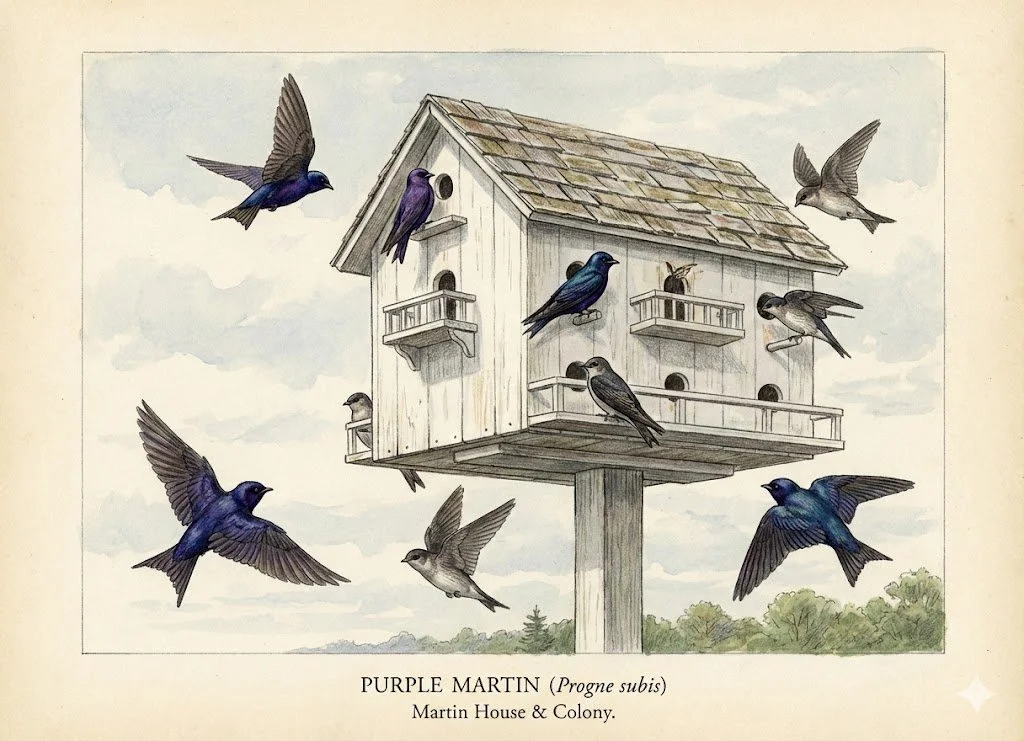
Purple Martins: houses vs. gourds (and why gourds often win)
Martins are special.
East of the Rockies, they depend almost entirely on human-provided housing.
No boxes? No martins.
Historically, people used hollow gourds. Today we see aluminum houses, plastic systems, and modern gourds.
So what’s best?
Many experienced landlords prefer gourds
Why?
Better ventilation
More shade (cooler in summer)
Fewer parasite issues
Natural shape martins like
Easier to manage individually
Less crowding
Houses look charming, but gourds often produce higher fledging success.
If you’re serious about martins, a pole system with multiple artificial gourds and predator guards is often the gold standard.
Predator protection is non-negotiable
Martins are extremely vulnerable to:
Raccoons
Snakes
Hawks
Owls
Use:
Pole baffles
Snake guards
Regular monitoring
Starling-resistant entrances
Being a martin landlord means active management, not “set it and forget it.”
House Wrens: the quirky exception
House Wrens are tiny, feisty, and full of opinions.
One of those opinions?
They sometimes prefer a free-hanging, swinging box.
Why?
Movement may deter predators and competitors. A swinging box is harder for larger birds to land on.
If you have wrens nearby, try:
Hanging a small box from a branch
Or, even better, suspending it under a porch or eave
They’ll often move in fast — sometimes stuffing the box with sticks within hours.
Classic wren behavior.
Placement matters more than you think
It’s not just what you hang. It’s where.
General guidelines
Face away from prevailing winds
Provide partial shade in hot climates
Avoid heavy foot traffic
Mount on poles rather than trees or fence posts when possible for better predator protection
Space boxes appropriately (some birds are territorial, like species pairs are happier if their boxes are not in direct line of sight - martins are the exception.)
For example:
Bluebirds: open fields, fence lines
Chickadees: woodland edges
Wrens: shrubs and gardens
Wood Ducks: near water
Martins: wide open space (minimum 30’ from any building or tree and no bushes around the base of the pole)
If you wouldn’t want to raise kids there, neither do birds.
The predator problem (and your role as landlord)
This is the part many people skip… but it’s the most important.
Putting up a nest box without protection can accidentally make things worse.
Boxes concentrate birds and make them predictable.
Predators learn quickly.
Common threats
Raccoons reach inside
Snakes climb poles
Cats wait below
Hawks ambush fledglings
Owls raid at night
How to help
Use:
Pole baffles
Snake guards
Metal predator guards around holes
Proper mounting height
Regular monitoring
No plants or tall grass around the base of the poles
Remove any spherical, messy nest of the house sparrow and recheck the entrance hole size & correct if needed. (Well-formed, bowl nests should stay.)
And clean boxes annually to reduce parasites and disease.
Being a landlord means responsibility.
It’s not just offering housing — it’s providing safety.
When done right, your box becomes a refuge.
When done wrong, it becomes a trap.
That sounds dramatic… but it’s true.
Thankfully, small tweaks make a huge difference.
Why nest boxes matter more than ever
Natural cavities are disappearing fast.
Dead trees (snags) used to be everywhere. Now they’re removed for “tidiness” or safety.
Without cavities:
Bluebird numbers drop
Martins struggle
Ducks lose nesting sites
Owls compete harder
Nest boxes fill that gap.
And the payoff is incredible.
There’s nothing like watching:
Bluebirds feeding chicks
Ducklings leaping to water
Martins swirling overhead
Chickadees prepping for their first flight
It turns your backyard into a living story.
Final thought: you’re not just hanging a box
You’re creating possibility.
You’re restoring habitat.
You’re helping birds do what they’ve done for thousands of years.
And honestly? It’s one of the most rewarding things you can do as a birder.
Because one day you’ll glance outside, coffee in hand, and see a tiny face looking back at you from that round wooden doorway…
…and you’ll know you helped make that moment happen.
That’s birding that matters.
Read more about the Nesting Box Species in North America.
