

Health Benefits of Birding
A Joyful Way to Age Well
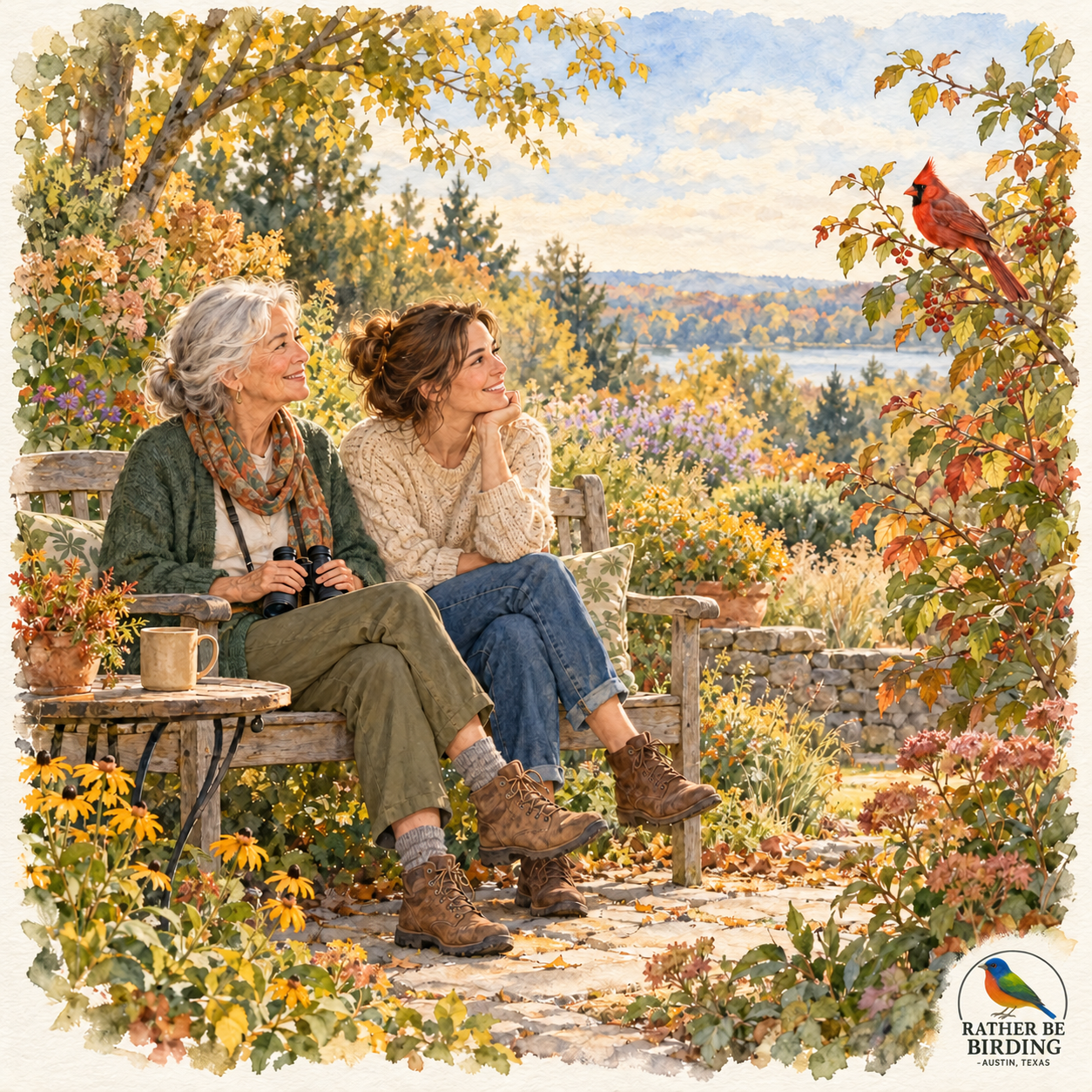
A cardinal lands outside your window. You stop stirring your coffee. For a few moments, you watch it turn a seed in its bill, glance toward the shrubs, and disappear into the leaves.
Nothing dramatic has happened. Yet you have paused, noticed something beautiful, and connected with a world beyond your to-do list.
The health benefits of birding can begin with moments like this. Birdwatching offers opportunities for mental engagement, gentle movement, companionship, and enjoyment of nature. For seniors, it is an especially adaptable hobby—one that can grow with your interests and change with your abilities.
You do not need to hike miles, own expensive binoculars, or identify every bird. A window, porch, neighborhood park, or comfortable bench can be your starting place.
And while this article focuses on birding for seniors, these pleasures belong to every age. Children, busy parents, working adults, and retirees can all find reasons to look up.
1. Birdwatching May Support Mental Well-Being
One of the most encouraging areas of research concerns the relationship between birds and how we feel.
A 2022 study published in Scientific Reports followed 1,292 participants using smartphone assessments of their everyday experiences. Seeing or hearing birds was associated with better mental well-being, with an association still evident at the next assessment. Researchers also observed this pattern among participants who reported a diagnosis of depression.
The study was observational, so it could not prove that birds caused the improvement. Still, it offers evidence that ordinary encounters with birdlife may contribute to emotional well-being. [1]
That word ordinary matters. You do not have to travel to a famous birding destination to have a worthwhile experience.
Watching a wren investigate your flowerpots or noticing a hawk circling above the grocery store can become a welcome interruption in the day.
Birding will not remove grief, worry, or illness, and it does not replace mental health care. It can, however, become one enjoyable part of a life that supports your well-being.
2. Birding Creates Space for Mindful Attention
Birdwatching gives your attention somewhere specific to rest.
Instead of trying to empty your mind, you can follow a bird's movements. Where did it land? Is it searching beneath leaves? Does it pause before returning to the feeder?
This is a practical way to practice mindfulness: noticing what is happening now.
You might spend five minutes watching a mockingbird from the porch and realize that, for those minutes, you were absorbed in something other than tomorrow's appointment or yesterday's frustration.
There is no need to turn the experience into another assignment. Some days you may want to identify every visitor. Other days, watching feathers lift in the breeze is enough.
For beginners, this is permission to enjoy birds before knowing their names. For experienced birders, it is an invitation to rediscover familiar birds without rushing past them.
You do not need to know every bird to enjoy the bird in front of you.
3. Birding Can Make Physical Activity More Appealing
“Go exercise” and “let's see whether the ducks are back” can lead to the same park. One invitation may simply sound more appealing.
The physical benefits of birdwatching come partly from the movement it can encourage. Walking to a viewing area, taking a neighborhood loop, or moving between park benches adds activity to an outing.
For seniors who enjoy walking, birds provide a reason to return regularly. A familiar route changes as migrants arrive, leaves fall, and resident birds shift their routines.
The CDC recommends that adults 65 and older aim for at least 150 minutes of moderate-intensity aerobic activity weekly, muscle-strengthening activities on at least two days, and activities that improve balance. People unable to meet those recommendations should be as active as their abilities and conditions allow. [2]
A slow birding stroll with frequent stops may not count as moderate-intensity exercise. Birding also does not replace strength and balance work. But it can help make movement a more appealing part of your week.
If comfortable for you, combine a walking segment with a seated observation stop. Let the birds provide motivation while your abilities guide the pace.
4. Identifying Birds Gives Your Mind Something Interesting to Do
A bird appears on a branch. Before opening a field guide, you begin making comparisons.
Is it sparrow-sized or robin-sized? Is the bill thin or heavy? Does it cling to the trunk or sit upright? Have you seen that tail movement before?
Bird identification involves attention, memory, observation, and problem-solving. You collect clues, compare possibilities, and revise your first impression.
The National Institute on Aging identifies mentally stimulating activities and social engagement as areas relevant to cognitive health, while emphasizing that evidence about lasting cognitive benefits continues to develop. We should not translate that into a promise that birdwatching prevents dementia. [3]
What we can say is that birding offers a rich, enjoyable learning activity.
Start with three familiar birds. Learn their shapes and behaviors before adding more. At Rather Be Birding, a useful principle is:
Focus on Family. Then Species.
Recognizing “woodpecker” or “wren” is progress, even when the exact species remains uncertain. Curiosity matters more than speed, and forgetting a name does not erase what you noticed.
5. Birdwatching Offers Natural Opportunities for Connection
Some people enjoy birding alone. Others discover that birds make conversation easier.
“Did you see where that heron landed?” is a simple beginning. You already have something to share.
For older adults whose routines have changed through retirement, relocation, or the loss of a partner, a recurring birding activity can create an opportunity to spend time with others. It does not have to involve a large group or an ambitious field trip.
Try a weekly porch visit with a neighbor, a short outing with a friend, or a beginner-friendly bird walk. Ask organizers about pace, seating, surfaces, and restroom access before choosing a group.
Birding also works across generations. A grandchild might spot movement first while you notice the bird's behavior. Neither person needs to be the expert.
Consider making the invitation specific: “Would you like to watch the feeder with me over coffee on Friday?”
A shared interest gives the visit a focus—and leaves plenty of room for conversation.
6. Birds Can Bring Purpose and Anticipation to Everyday Life
There is something satisfying about having a reason to check the window.
Have the winter sparrows returned? Is the bluebird pair still visiting? Will the hummingbird use the flowers today?
Birding creates small things to anticipate. You can follow the changing seasons, keep a notebook, or learn which birds use different parts of your neighborhood.
For some people, that interest grows into caring for habitat. Planting an appropriate native shrub, maintaining clean water, or making windows safer gives you practical ways to help the birds you enjoy.
You might also explore a bird count or another citizen-science project, choosing one whose requirements suit your skills and energy.
The value is not measured by how much you accomplish. A single observation can be worth recording. One useful habitat improvement can be worth making.
Birds invite us to pay attention to lives beyond our own—and sometimes that is exactly the invitation we need.
7. Birding Can Adapt to Changing Mobility, Vision, and Hearing
An important strength of birding for seniors is its flexibility.
A long trail may suit you one year; a shaded bench may suit you the next. Both offer real opportunities to observe birds.
If walking is uncomfortable, consider window birdwatching, a patio chair, an accessible viewing platform, or a designated wildlife drive. Check actual conditions rather than assuming that a location described as “easy” meets your needs.
If holding binoculars is tiring, try supporting your elbows or watching closer birds without magnification. A larger field-guide image may be more useful than struggling with small print.
If hearing changes make certain songs difficult to detect, concentrate on movement, shape, and behavior. If fine visual details are challenging, accessible audio descriptions or a companion's observations may add to the experience.
Adaptations are part of making the hobby yours.
Birding does not have to be a hike. It does not have to look like anyone else's outing.
How to Start Birdwatching for Your Well-Being
Choose a place you can visit easily. Convenience makes returning simpler than an ambitious plan that requires perfect weather and a free afternoon.
Begin with ten minutes at a window, on a porch, or beside a nearby patch of trees. Ten minutes is a manageable starting point, not a scientifically established “dose” of birding.
Keep your first goal small: notice one bird and follow what it does.
Binoculars are useful, but they are optional. A notebook can hold a few observations, and a field guide can help when you want to investigate further. Resist the urge to buy everything before discovering what you enjoy.
For outdoor outings, plan around comfort: suitable footwear, water, weather protection, seating, and a manageable route. Stop walking before raising binoculars. If a health condition affects exercise, ask your clinician what level of activity fits your situation.
Then give yourself permission to return to the same place. Familiarity is not boring when you begin noticing what changes.
Frequently Asked Questions About the Health Benefits of Birding
Is birdwatching good for seniors?
Birdwatching can be a rewarding hobby for seniors because it combines opportunities for learning, nature enjoyment, social connection, and optional physical activity. It can be adapted to different interests and abilities, including watching from home.
Can I enjoy the benefits without walking?
Yes. Seated birding still offers observation, curiosity, and enjoyment. You can also share it with others. The exercise component depends on movement, but walking is not a requirement for participating in birdwatching.
Do I need to identify birds correctly?
No. Identification can add interest, but it is not an admission requirement. Watching a bird bathe or search for food is worthwhile even if you never learn its name. Let learning support your enjoyment rather than become a test.
Skill Builders: Try a Ten-Minute Birding Pause
Choose one comfortable place and try this simple exercise three times this week.
Settle in. Notice how you feel before you begin, without expecting any particular result.
Find one bird. Watch with your eyes or binoculars, or listen if that suits you.
Collect three clues. Notice its size, where it spends time, and what it is doing.
Stay with the experience. Wait a little before reaching for an identification tool. What else can the bird show you?
Write one sentence. Record something you noticed and, if useful, how you felt afterward.
You might write: “The little bird returned to the same branch after every feeder visit.”
If no birds appear, notice the habitat and try again another time. This is practice in paying attention, not a challenge to produce a sighting.
Let Curiosity Lead You Outside—or to the Window
The health benefits of birding are an encouraging reason to begin. The pleasure of birds may be what keeps you coming back.
There will always be another behavior to notice, another seasonal change to follow, and another familiar bird worth watching a little longer.
Start where you are, with the energy and time you have today.
Visit Rather Be Birding for more beginner birding tips, ideas for birding for seniors, and ways to create a backyard bird sanctuary. Then choose one comfortable spot and see who shows up.


A cardinal outside the window can be the beginning of something good. Explore how birding offers opportunities for mental well-being, gentle movement, learning, and connection - with practical ideas for seniors and bird lovers of every age.