

How to Use a Bird Field Guide
And Why It Will Make You a Better Birder
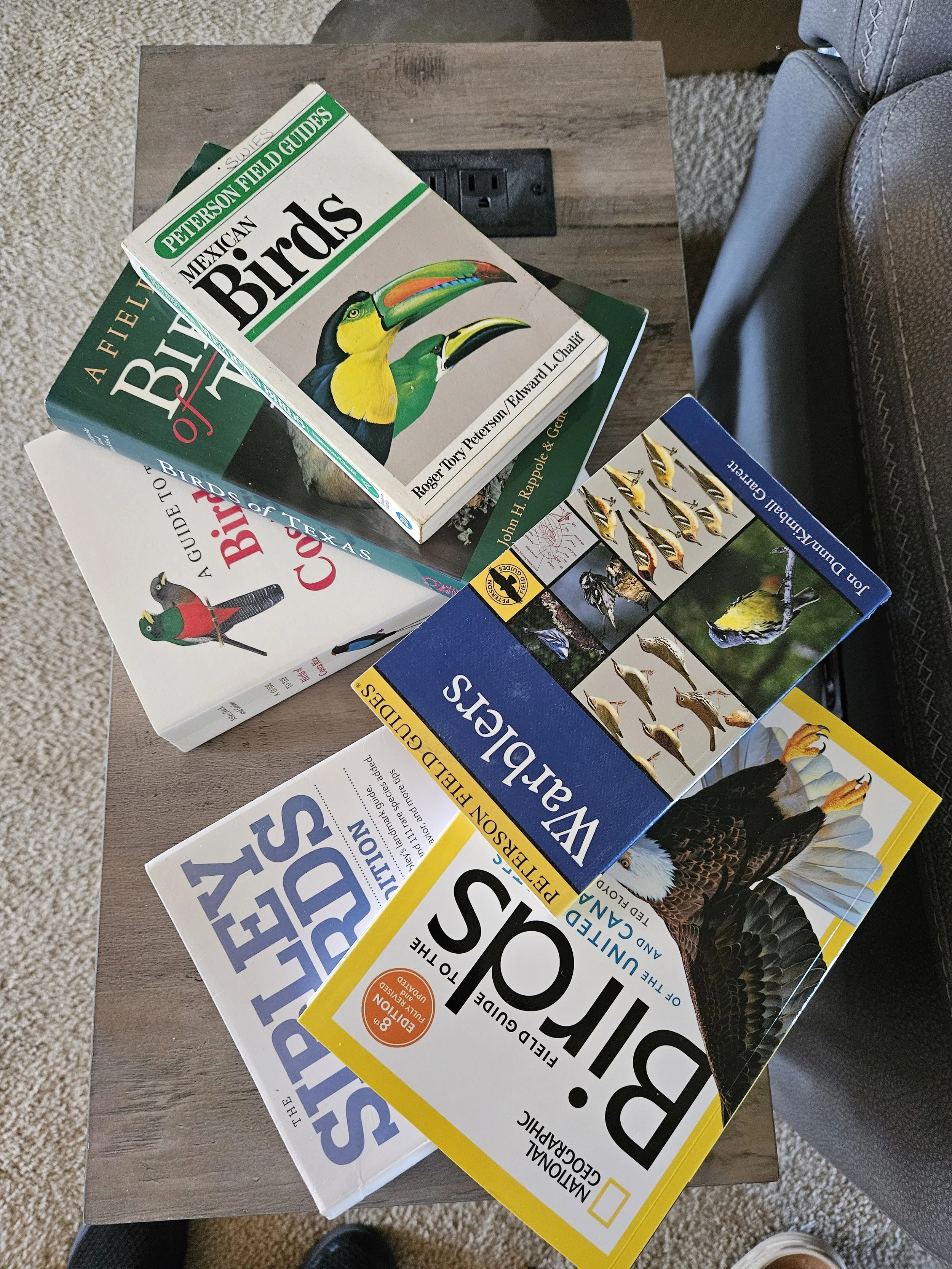
If you spend any time around experienced birders, you’ll notice something interesting. Many of them carry a field guide that looks… well… loved.
The cover might be bent.
There might be sticky notes poking out from the edges.
A few pages may even have pencil notes in the margins.
That’s not neglect. That’s evidence of a birder learning their craft.
A good bird field guide is more than just a reference book. It’s a training tool. Used well, it can accelerate your birding skills faster than almost anything else.
Many new birders treat a field guide like a dictionary—only opening it when they need to identify a bird. But the secret many experienced birders know is this:
The best birders study their field guide even when they aren’t birding.
Let’s walk through how to use a field guide the right way—from coffee table study sessions to understanding the logic behind bird families—and how this simple habit can dramatically improve your birding skills.
Your Field Guide Is a Training Manual
A bird field guide is not just a book you grab when you’re stuck.
It’s a learning system.
Every time you spend a few minutes flipping through the pages, your brain is quietly building connections between:
Bird families
Size comparisons
Shapes and silhouettes
Field marks
Habitat clues
Geographic ranges
The more often you expose yourself to those patterns, the faster you’ll recognize birds in the field.
Think of it like immersion learning.
The more you surround yourself with the material, the faster it sticks.
The Coffee Table Method (One of the Best Birding Habits)
One of the simplest ways to improve your birding knowledge is to leave your field guide somewhere visible.
A coffee table.
A nightstand.
Next to your favorite reading chair.
Then spend five or ten minutes flipping through it each day.
You don’t need a formal study plan. Just browse. Or pick birds depending on your locale or season. Any system you use is fine.
Look at:
A few pages of sparrows
A couple of warblers
Some shorebirds
A family you don’t know well
Over time you’ll start noticing patterns:
Warblers are tiny and energetic
Hawks share similar body shapes
Sparrows often have similar streaking patterns
Ducks have distinctive bill shapes or the difference between diving and dabbling ducks
These mental snapshots build a visual memory bank, which is exactly what birders rely on in the field.
When a bird pops into view for three seconds and disappears, you’ll still have enough stored knowledge to make a good identification.
Yes—You Can Write in Your Field Guide
Some birders hesitate to write in their guide. After all, it’s a book.
But here’s the truth:
A field guide works best when it becomes personal.
Many experienced birders jot notes in the margins like:
“Seen at local park April 2024”
“Often near river trail”
“Look for white eyebrow stripe”
“Song sounds like squeaky wheel”
“Tail is longer than I expected”
“Much darker gray than the Loggerhead.”
These notes turn your field guide into a custom birding notebook.
You’ll also remember birds more easily because the note ties the species to a personal experience.
That’s powerful learning.
Should You Use Sticky Notes or Tabs?
Many birders use small sticky notes or index tabs to mark sections of their field guide.
It can make flipping through the book much faster in the field. Yes there is an index - some even have a Quick Reference Index in front and a traditional index in the back of the guide but sometimes it’s just faster to put a sticky so they can find the pipits fast.
Common tab sections include:
Ducks
Hawks
Shorebirds
Gulls
Warblers
Sparrows
If you bird in a specific region, you might also mark pages for:
Your most common backyard birds
Seasonal migrants
Species you’re hoping to find
Some birders also use small sticky flags to mark lifers or birds they want to study later.
Just be careful not to overdo it.
Too many tabs can make the book harder to use instead of easier.
A handful of well-placed markers is usually perfect.
Highlighters and Color Coding
Instead of sticky notes, some birders highlight key information in their guide.
For example:
Yellow highlight might mark:
Common birds in your region
Blue highlight might mark:
Lifer birds you've personally seen
Green highlight might mark:
Birds you hope to find on that Arizona trip
This isn’t necessary, but it can make quick reference easier when you’re scanning pages outdoors.
If you try this approach, use a light color highlighter over the name of the bird or a tic mark next to the name so the illustrations and text remain clear.
Why Birds Appear in a “Strange” Order in Field Guides
New birders often notice something confusing.
Birds in a field guide are not listed alphabetically.
Nor are they arranged by color.
Instead, they follow a sequence that may seem strange at first.
Ducks appear near loons and grebes.
Hawks are grouped with falcons and vultures.
Warblers appear near tanagers and sparrows.
Why?
Because the order reflects scientific relationships between birds.
Field guides follow a taxonomic order developed by ornithologists to show how birds evolved and relate to one another.
In other words:
Birds that appear near each other in a field guide are often evolutionary cousins.
Understanding Bird Families
Once you understand the concept of bird families, field guides start making much more sense.
Each family shares certain characteristics.
For example:
Woodpeckers
Cling to tree trunks
Strong chisel bills
Stiff tail feathers for support
Hawks
Broad wings
Powerful talons
Soaring flight style
Warblers
Small
Active
Often brightly colored
Sparrows
Small brown birds
Thick conical bills
Often streaked plumage
Learning families dramatically simplifies bird identification.
Instead of choosing between 900 species, you may only need to choose between 10 species in a single family.
That’s a huge advantage.
A Field Guide Teaches Bird Relationships
The order of birds in a field guide also teaches birders something subtle but powerful.
You begin to see how species relate to one another.
For example:
Blue Jays appear near other corvids like:
Crows
Ravens
Magpies
Because they share intelligence, behavior patterns, and evolutionary history.
Similarly, many ducks appear grouped together because they share body shape, feeding style, and habitat.
The field guide is quietly teaching you bird biology and evolution while helping you identify species.
The Power of Relative Size
Field guides also help birders learn one of the most important identification tools:
relative size.
Many guides include small silhouettes comparing birds to common species like:
Robin
Crow
Goose
This helps birders instantly narrow down possibilities.
If a bird is clearly smaller than a robin but larger than a sparrow, that immediately eliminates dozens of species.
Over time, these size comparisons become second nature. Even the tiny Chipping Sparrow will stand out when it’s feeding near it’s larger cousin the White-crowned Sparrow.
Your brain automatically begins sorting birds by size categories before you even open the guide.
Study the Range Maps
One of the most underused tools in a field guide is the range map.
These tiny maps show where birds occur during:
Breeding season
Migration
Winter
Before identifying a bird, always check the range map.
If the species doesn’t occur in your region during that season, you can eliminate it - at least for the moment. Birding is usually a process of percentages. In most parts of the country, when you see a hawk on a telephone pole, there is a presumption that it’s a Red-tailed Hawk (our most common hawk). Then you try to prove or disprove it through relative size and field marks. [Never assume it’s a Red-tailed and not give it a second look to prove it - you might have just missed the incredibly beautiful Ferruginous Hawk without an ID.]
This simple step saves birders from many identification mistakes.
Use the Field Guide Even After You Identify the Bird
Once you identify a bird, don’t close the book immediately.
Take a moment to read a little more about the species.
Look for:
Behavior notes
Habitat preferences
Unique traits
For example, you might discover:
The bird prefers wetlands
It migrates thousands of miles
It feeds in a particular way
These details make the bird more memorable the next time you see it.
Paper Field Guides vs Birding Apps
Modern birding apps have become incredibly powerful tools.
Apps like Merlin allow birders to:
Search by color
Identify birds by sound
Filter species by location
Carry thousands of species in their pocket
They are amazing tools.
But paper field guides still offer some unique advantages.
Advantages of Paper Field Guides
Paper guides encourage deeper learning.
Because you flip through pages, you naturally see many related birds along the way.
This builds broader knowledge of:
Families
Similar species
Visual patterns
You also avoid the temptation to jump directly to the answer.
Instead, you study the birds and compare options, which strengthens your identification skills. It’s also easier to look through a large family of birds to find a bird unknown to you. If you don’t suspect that bird is a Grasshopper Sparrow, you’ll have a difficult time toggling back and forth through the very large sparrow family.
Many birders feel that paper guides train the brain better even though it’s extra weight to carry on a bird walk.
Advantages of Birding Apps
Apps shine in several areas.
They can:
Instantly play bird songs
Use location filters to narrow species lists
Identify birds by sound recordings
Provide updated range maps
For beginners, apps can dramatically speed up learning.
They are also excellent tools for confirming an identification you made using a field guide.
The Best Approach: Use Both
Most experienced birders use both tools together.
A typical approach might look like this:
Observe the bird carefully
Estimate size and shape
Flip through the field guide to narrow options
Check the range map
Confirm with an app if needed
This method combines the learning depth of a field guide with the technology advantages of apps.
The Secret Benefit of Studying a Field Guide
Here’s something interesting.
The more time you spend studying your field guide at home, the less you will need it in the field. This is soooo true!
Why?
Because your brain begins recognizing birds instantly.
Shape.
Movement.
Relative size.
Color patterns.
These clues start jumping out at you automatically.
Birders sometimes call this developing a sense for GISS — General Impression of Size and Shape.
It’s the moment when you glance at a bird and think:
“That looks like a warbler.”
“That’s definitely a hawk. Wow - Broad-winged!”
“That bird moves like a nuthatch.”
That kind of instinct comes from exposure—and field guides provide that exposure.
Your Field Guide Will Become a Personal Record
Over time your guide may collect:
Notes in the margins
Tabs marking favorite sections
Dog-eared pages
Memories of trips and lifers
Park passes stuffed between the pages
It becomes something more than a reference book.
It becomes a journal of your birding journey.
Every mark in the margins tells a story.
A Final Thought
Birding is a skill built slowly, one observation at a time.
A field guide is one of the most powerful tools you can use along that path.
Keep it nearby.
Flip through it often.
Write in it.
Study the families.
Learn the patterns.
Before long you’ll notice something remarkable.
The birds around you will start revealing their identities more quickly.
And that simple book on your coffee table will have helped open the door to a whole new way of seeing the natural world.
Just starting your birding journey? Jump to our Beginning Birding Post to help you get started and…
Let’s go Birding!
