

Hummingbirds in the United States
Distribution, Migration, and How Backyard Feeders Help
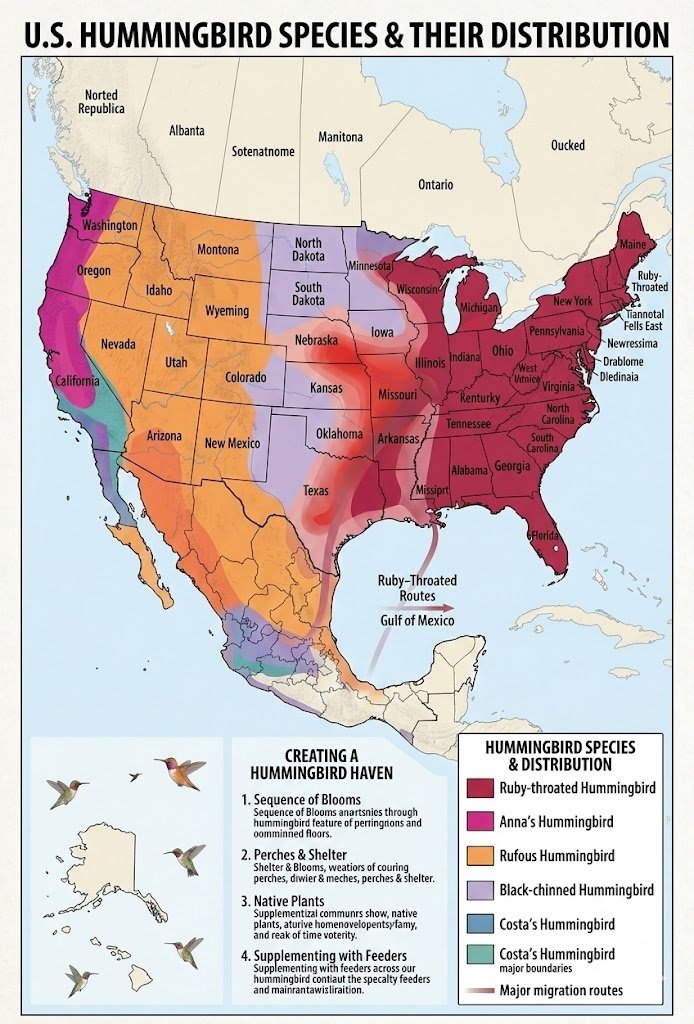
If there is a bird that captures the imagination of nearly every backyard birder, it’s the hummingbird.
Tiny, fast, and dazzlingly beautiful, hummingbirds are among the most fascinating birds in North America. Watching one hover at a flower or feeder feels almost magical. But behind that beauty lies one of the most remarkable migration stories in the bird world.
Every year, millions of hummingbirds travel thousands of miles between their wintering grounds in Mexico and Central America and their breeding territories across the United States and Canada. Some of these journeys include one of the most astonishing feats in bird migration: a nonstop flight across the Gulf of Mexico.
For backyard birders, understanding where hummingbirds live, where they travel, and how they move across the country can make the experience of seeing them even more meaningful. And it highlights something important—our backyards can play a real role in helping hummingbirds complete their incredible journey.
Let’s take a closer look at hummingbirds across the United States, their migration patterns, and how providing clean feeders can help them along the way.
Hummingbirds Across the United States
There are more than 300 species of hummingbirds in the Americas, but only about two dozen have been recorded in the United States, and far fewer occur regularly.
The distribution of hummingbirds in the U.S. follows a simple pattern:
Eastern U.S.: dominated by one species, the Ruby-throated Hummingbird
Western U.S.: home to several species
Southwestern deserts and mountains: the highest diversity of species
This geographic split makes hummingbird watching very different depending on where you live.
Eastern United States
If you live east of the Great Plains, your hummingbird is almost certainly the Ruby-throated Hummingbird.
These birds breed across most of the eastern United States and southern Canada, from Florida to Maine and westward toward the central plains.
Despite this enormous breeding range, they spend winter mostly in:
Mexico
Central America
the Caribbean
A few remain along the Gulf Coast or southern Atlantic coast during winter, but most migrate south every fall.
For eastern birders, the arrival of Ruby-throats is one of the classic signs of spring.
Western United States
Out west, hummingbird diversity increases dramatically.
Depending on the region, you may encounter species such as:
Anna’s Hummingbird
Rufous Hummingbird
Calliope Hummingbird
Black-chinned Hummingbird
Broad-tailed Hummingbird
Costa’s Hummingbird
Unlike eastern hummingbirds, several western species remain in the United States year-round, particularly in coastal California where mild climates and winter flowers provide food.
The Southwest: A Hummingbird Paradise
The greatest hummingbird diversity in the U.S. occurs in the desert mountains of Arizona and New Mexico.
In southeastern Arizona especially, birders may see 10–15 species of hummingbirds during the year, making it one of the best hummingbird destinations in North America.
This is why southeastern Arizona has become famous among birders for hummingbird watching.
Hummingbird Hotspots in the United States
If hummingbirds spark your curiosity, a few places stand out as truly special.
Southeastern Arizona
For hummingbird enthusiasts, southeastern Arizona is legendary.
The region’s unique combination of desert valleys, mountain “sky islands,” and proximity to Mexico creates ideal habitat for many species. Birders visiting places like:
Madera Canyon
Ramsey Canyon
Patagonia
Cave Creek Canyon
can encounter species rarely seen elsewhere in the United States.
Broad-billed, Violet-crowned, Berylline, and Lucifer hummingbirds are all possible in this region.
Many lodges and nature centers even maintain large hummingbird feeding stations where multiple species can be seen at once—sometimes dozens of birds buzzing around feeders at the same time.
For a birder, it’s unforgettable.
The Rio Grande Valley of South Texas
Another hummingbird hotspot sits along the lower Rio Grande Valley in south Texas.
Because Texas lies along major migration flyways, multiple hummingbird species pass through the state every year.
In fact, birders in Texas can see:
Ruby-throated Hummingbirds
Black-chinned Hummingbirds
Buff-bellied Hummingbirds
Rufous Hummingbirds
and occasional rarities
South Texas also serves as an important migration staging area, where hummingbirds pause to feed and build energy reserves before continuing their journeys.
One of the Most Amazing Migrations in the Bird World
Despite their tiny size, hummingbirds are among the most impressive long-distance migrants on the planet.
The Ruby-throated Hummingbird alone may travel 2,000 miles or more between breeding and wintering grounds.
And some of that migration involves a feat that almost seems impossible.
Crossing the Gulf of Mexico
Each fall, many Ruby-throated Hummingbirds leave the southern United States and head toward Mexico and Central America.
Instead of hugging the coastline, many birds fly directly across the Gulf of Mexico, a journey of roughly 500 miles over open water.
Even more remarkable:
The flight can take 18–20 hours nonstop.
Birds must complete it without landing or feeding.
They rely entirely on fat reserves built before departure.
To prepare for this journey, hummingbirds may increase their body weight by 25–40% before migration.
Imagine a bird weighing less than a nickel flying hundreds of miles across open ocean.
That’s the scale of the hummingbird migration story.
Spring Migration: The Return of the Hummers
In late winter and early spring, hummingbirds begin the journey north again.
The first Ruby-throated Hummingbirds usually appear along the Gulf Coast in late February or early March, spreading northward through the eastern United States during March and April.
Male hummingbirds typically arrive first, quickly establishing feeding territories before females follow.
As temperatures warm and flowers begin to bloom, hummingbirds continue their flight northward until they reach breeding territories that stretch into southern Canada.
For many birders, seeing that first hummingbird of the season is one of the most exciting moments of spring.
Why Backyard Feeders Matter During Migration
Migration is an incredibly demanding process.
Hummingbirds burn enormous amounts of energy during flight. Their wings may beat 15–80 times per second, and their metabolism runs at one of the highest rates in the animal kingdom.
To keep going, they must constantly refuel.
In the wild, hummingbirds rely on:
nectar-producing flowers
tiny insects for protein
tree sap and other natural food sources
But along migration routes, backyard feeders can become important refueling stations.

Research and conservation groups note that feeders can help support hummingbirds by supplementing natural nectar sources, particularly where habitat has been lost.
Think of feeders as roadside rest stops for migrating birds.
A hummingbird may visit several yards in a neighborhood while fueling up before continuing its journey.
Why Spring Feeders Are So Important
Many birders wonder:
Should I put my feeders out early in spring?
The answer is yes.
Hummingbirds arriving from migration often reach the southern United States before many flowers are in full bloom. This makes backyard feeders especially helpful early in the season.
Providing nectar during this time gives hummingbirds a reliable food source after a long journey.
And don’t worry—feeders do not stop hummingbirds from migrating.

Migration is controlled by daylight length and biological instinct, not food availability.
Instead, feeders simply help the birds stay energized during their travels.
Don’t Forget Fall Migration
Spring gets most of the attention, but feeders are just as important in fall.
In late summer and early fall, hummingbirds begin preparing for their southbound migration.
During this time they:
feed almost constantly
build fat reserves
increase body weight dramatically
Keeping feeders up in September and October allows hummingbirds to refuel before their long journeys south.
Some birds will linger surprisingly late in the season.
And occasionally, you might even host a rare western hummingbird passing through.
Keeping Feeders Safe and Clean
If feeders are going to help hummingbirds, they must be maintained properly.
A poorly maintained feeder can do more harm than good.
A few simple guidelines make a big difference:
Nectar recipe
The standard hummingbird nectar recipe is simple:
1 part white sugar
4 parts water
Boil briefly, allow to cool, and fill your feeder.
Never use:
honey
artificial sweeteners
red dye
Clean feeders frequently
Warm weather can cause nectar to spoil quickly.
A good rule of thumb:
every 3–4 days in warm weather
once a week in cooler temperatures
Wash feeders with hot water and a bottle brush.
Use multiple feeders
Hummingbirds can be territorial.
Placing two or three feeders spaced apart can reduce aggressive behavior and allow more birds to feed.
Your Backyard Can Help a Migrating Hummingbird
It’s easy to think of migration as something happening far away—across oceans, forests, and distant landscapes.
But the truth is much simpler.
For a migrating hummingbird, your backyard might be a crucial stop on its journey.
The feeder hanging outside your kitchen window might help a bird:
recover from a long overnight flight
build energy for the next leg of migration
survive a cold front or storm
It’s a small act with a meaningful impact.
A Final Thought for Backyard Birders
Hummingbirds remind us how extraordinary birds can be.
A creature weighing less than a nickel can:
fly hundreds of miles across open ocean
migrate thousands of miles each year
navigate continents alone
And yet it might pause for just a moment at a feeder in your backyard.
So as spring approaches, take a few minutes to:
clean your feeders
mix a fresh batch of nectar
hang them where you can enjoy the view
Because somewhere out there, a hummingbird is on its way north.
And it may be looking for exactly what you’ve provided.
