

Shorebird Migration
Why “Fall” Begins in the Middle of Summer
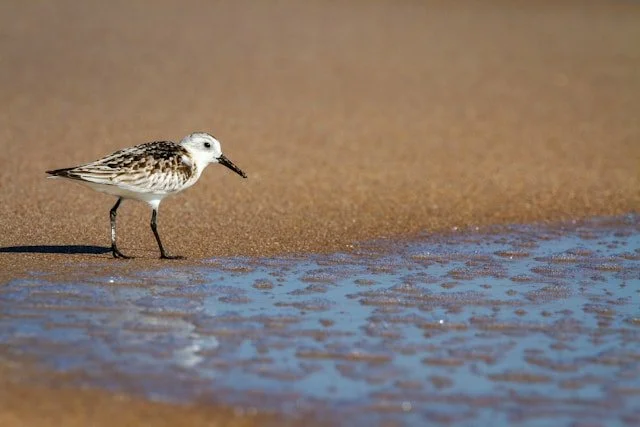
For many birders, fall migration brings to mind crisp mornings, changing leaves, skeins of geese overhead, and warblers slipping quietly through September trees.
But shorebirds have apparently never received that calendar.
While much of North America is still in the middle of summer—when gardens are blooming, cicadas are buzzing, and young songbirds are following their parents around the yard—shorebirds are already heading south.
By late June and early July, adult sandpipers, plovers, yellowlegs, dowitchers, godwits, and other shorebirds begin appearing at coastal mudflats, prairie wetlands, reservoirs, flooded fields, and sewage ponds across the continent. Southbound migration can begin in July and continue through September or even later because different species, adults, and juveniles leave their breeding grounds at different times.
It may seem impossibly early.
Didn’t these birds just arrive on their breeding grounds?
In many cases, they did.
Shorebird migration is one of the most impressive—and humbling—events in the bird world. These birds may weigh only a few ounces, yet some travel from the Arctic to the southern tip of South America. Others cross oceans without stopping. Juveniles that have never migrated before may leave after their parents and somehow find wintering grounds thousands of miles away.
And lucky for us, shorebird migration creates some of the best birding opportunities of late summer.
Where Have the Shorebirds Been?
Many of the shorebirds passing through the United States and southern Canada have spent their brief breeding season much farther north.
A large percentage breed in Alaska, northern Canada, and the Arctic tundra. Some nest near shallow tundra ponds, wet sedge meadows, coastal plains, river deltas, bogs, and muskeg. Alaska alone provides breeding habitat for dozens of shorebird species.
Imagine arriving on the tundra during the short Arctic summer.
The snow has only recently melted. For several weeks, daylight lasts nearly around the clock. Wetlands open, plants grow quickly, and enormous numbers of insects emerge. The abundance of insects provides a temporary but exceptionally rich food supply for adult shorebirds and their rapidly growing chicks.
This is no leisurely summer vacation, however.
Shorebirds must arrive, establish territories, court, lay eggs, incubate them, hatch their young, and prepare for another migration—all during a remarkably compressed season.
Not every North American shorebird travels to the Arctic. Killdeer nest across much of the continent. Spotted Sandpipers raise young along lakes and rivers over a broad range. Upland Sandpipers use grasslands, while American Avocets, Black-necked Stilts, Willets, and several other species breed in temperate wetlands and prairie regions.
Still, many of the small sandpipers we see during migration—the birds affectionately and sometimes desperately called “peeps”—have come from northern breeding grounds most of us will never visit.
Why Do Shorebirds Begin Migrating So Soon?
The simplest explanation is that Arctic summer is short.
Once a shorebird has finished its part in the nesting cycle, there is little advantage in remaining on the breeding grounds. The birds must begin moving toward places where food will continue to be available as northern temperatures fall and wetlands begin to freeze.
Some of the first southbound shorebirds may be adults whose nests failed. If eggs or chicks are lost to predators, severe weather, flooding, or other causes, those adults may leave the breeding grounds by late June. Arctic-breeding Least Sandpipers and other shorebirds can begin appearing in the Lower 48 before June is over.
Successful adults may depart as soon as their parental responsibilities are complete. In some species, males and females leave at different times because they do not share nesting duties equally. In others, adults leave while the young remain behind to grow, feed, and prepare for migration.
As a general pattern, adult shorebirds migrate before juveniles. The youngest birds often appear several weeks later, after they have finished growing their flight feathers and stored enough fat to begin the journey.
This creates a long, layered migration.
The first shorebirds you see in July may be worn adult birds. Later in summer, fresher-looking juveniles begin joining the movement. By August and September, a single wetland may hold adults in nonbreeding plumage, juveniles in their first feathers, and several very similar species feeding together.
No wonder shorebird identification can become a little spicy.
Adults and Young Birds Do Not Always Travel Together
One of the most astonishing parts of shorebird migration is that many juveniles make their first journey without their parents.
Adult American Golden-Plovers leave the Arctic before their young. Later, juvenile plovers set off for South America on their own, guided by instincts they were born with rather than by experienced adults leading the way.
Think about that for a moment.
A bird only a few months old leaves the tundra, navigates across an enormous continent, finds suitable places to rest and feed, avoids storms and predators, and eventually reaches wintering habitat it has never seen.
Young Red Knots also migrate after adults have left. Many first-year birds do not immediately complete the full adult cycle back to Arctic breeding grounds the following spring, but the southbound journey is still an extraordinary undertaking.
The routes are not random. Shorebirds inherit powerful directional instincts, but they also respond to weather, wind, coastlines, river valleys, wetlands, food availability, and conditions encountered along the way.
Migration is not simply a straight line drawn between two points on a map. It is a series of decisions made by a very small bird moving through a very large world.
Some of the Longest Journeys in the Bird World
It is easy to underestimate a sandpiper.
Many look delicate. Some are no larger than a sparrow. They spend much of their time quietly probing mud, picking tiny prey from the surface, or running along the water’s edge.
But shorebirds are among the greatest endurance athletes on Earth.
Bar-tailed Godwit
Bar-tailed Godwits breeding in Alaska can fly across the Pacific to New Zealand and Australia. These birds routinely make nonstop flights of more than 7,000 miles.
One tagged juvenile flew approximately 8,435 miles from Alaska to Tasmania in 2022 without landing, completing the journey in about 11 days.
No rest stop. No meal break. No handy island conveniently placed halfway across the ocean.
Before departing, godwits transform their bodies into migration machines. They store enormous fat reserves, and their bodies prioritize the organs and muscles most necessary for sustained flight.
Hudsonian Godwit
Hudsonian Godwits breed in Alaska and northern Canada, then travel to southern South America. Their migration may approach 10,000 miles in one direction, carrying them from northern bogs and tundra wetlands to coastal and wetland habitats near the bottom of the continent.
Red Knot
Some Red Knots travel between Arctic Canada and wintering grounds as far south as Tierra del Fuego. Their yearly round trip may total nearly 19,000 miles. Along the way, they depend on a chain of traditional staging and feeding areas where they can rapidly replace the energy used during long flights.
White-rumped Sandpiper
The White-rumped Sandpiper also travels from Arctic Canada to southern South America. Southbound birds may move over the Atlantic, continue along the coast, and eventually cross the Amazon Basin. The journey can take about a month.
Pectoral Sandpiper
Pectoral Sandpipers nest across northern Russia, Alaska, and Canada. Most winter in southern South America, creating a yearly round trip that can approach 19,000 miles.
These birds are doing much more than “flying south for the winter.” They are linking ecosystems separated by oceans, countries, climates, and hemispheres.
Shorebirds Need Places to Stop and Refuel
Even species capable of very long flights cannot complete migration without food.
A productive mudflat may look empty or unattractive to us, but to a migrating shorebird, it can be a well-stocked dining room. Mud, sand, shallow water, exposed lake edges, salt marshes, flooded agricultural fields, estuaries, and temporary rain pools can hold insects, worms, crustaceans, mollusks, and other small prey.
At important stopover sites, shorebirds may feed nearly continuously for several days, storing fat for the next part of the journey. Semipalmated Sandpipers, for example, gather at traditional coastal mudflats and inland wetlands to fatten before continuing south.
That means a flooded field that exists for only two weeks may be tremendously important. A shallow edge exposed by falling reservoir levels can become a temporary migration hotspot. A sewage pond, sod farm, or overlooked corner of a wildlife refuge may host an unexpected variety of birds.
Storms can also produce exciting shorebird days. Heavy weather may force migrating birds to land, sometimes placing coastal species on inland ponds, flooded fields, or short-grass areas where birders do not normally expect to find them.
It always pays to check the mud.
Why Fall Shorebirds Are So Difficult to Identify
Shorebirds are challenging even under ideal conditions.
During southbound migration, ideal conditions are apparently considered optional.
The birds may be hundreds of feet away. Heat waves rise from the mud. Their legs are partly hidden by water. Every bird is moving. The flock contains several species. The sun is behind them. And the one bird you most need to study has placed its bill underneath a wing and gone to sleep.
Then there is plumage.
Breeding shorebirds can be surprisingly colorful. Red Knots become warm terracotta below. Dunlin develop black belly patches. American Golden-Plovers wear bold black-and-white faces and underparts. Several sandpipers show rusty, chestnut, gold, or reddish markings.
During late summer, adults begin losing those dramatic breeding colors and replacing them with quieter gray, brown, and white nonbreeding plumage. A migrating adult may be halfway between the two, with scattered breeding feathers remaining among newly grown gray ones.
It may look exactly like the field-guide illustration—or like none of them.
Feather wear adds another complication. Adults arriving from the breeding grounds may have worn, faded feathers with softer or less distinct markings.
Juveniles often look fresher. Their newly grown back and wing feathers frequently have neat pale, buff, or rusty edges, producing a crisp scalloped or “scaly” appearance. Juvenile Western and Semipalmated Sandpipers, for example, may both show patterned backs, but the amount and location of rusty coloring can help separate them.
Those markings are beautiful at close range.
At 150 yards across a mudflat, they can be less cooperative.
Stop Looking Only at Color
When plumage becomes confusing, return to the basics.
Look at the bird’s overall size, body shape, posture, bill length, bill shape, leg length, and feeding style.
Compare it directly with nearby birds. Is it smaller than the Least Sandpiper beside it? Longer-bodied? More upright? Does its bill extend well beyond the length of its head? Is the bill straight, drooping, or slightly upturned?
Then watch what the bird does.
Plovers commonly run, pause, look, and peck. Dowitchers probe rapidly with an up-and-down motion that resembles a sewing machine. Sanderlings race after retreating waves and hurry back when the next wave arrives. Spotted Sandpipers teeter almost constantly. Solitary Sandpipers often bob or tremble the rear of the body while feeding alone around smaller freshwater wetlands.
Behavior will not solve every identification, but it can reduce a flock of confusing possibilities to a much smaller group.
This is exactly the approach I discuss in Birding by Behavior: How It Can Help You Identify More Birds. Before trying to identify every feather, ask what the bird is doing, where it is feeding, how it moves, and whether it is alone or part of a flock.
Shorebirds are perfect birds for practicing this skill because their feeding behaviors are often easier to see than their tiny plumage details.
A Better Way to Work Through a Shorebird Flock
Do not begin with the hardest bird in the flock.
Start with the obvious ones.
Identify the largest and smallest birds. Find the yellowlegs, plovers, avocets, stilts, or dowitchers first. Use those known birds as size references for everything around them.
Next, sort the smaller sandpipers into rough groups.
Are they tiny peeps, medium-sized sandpipers, or larger long-billed birds? Are their legs dark, yellow, or greenish? Are they feeding in shallow water, working the edge of the mud, or picking prey from a drier surface?
Watch one individual for several minutes instead of jumping from bird to bird. Notice its posture and feeding rhythm. Look at the bill when the bird turns sideways. Is the bill longish or short (that gives clues about it’s feeding habits). Does the bill turn up at the tip or is it decurved (tips downward).
Wait for it to stretch a wing or briefly take flight. A tail pattern, wing stripe, white rump, or flash of color may suddenly become visible.
Photographs can be enormously helpful, even imperfect ones. A slightly blurry picture may still capture leg color, bill proportions, wing length, or the shape of the eyebrow. It also gives you something to study later when the flock is no longer moving at the speed of a tiny feathered pinball machine.
And sometimes the best identification is simply:
“Small sandpiper—probably one of two species.”
That is not failure. That is careful birding.
The Juveniles Are Coming
As summer progresses, begin looking for those beautifully patterned young birds.
Juveniles often appear crisp and tidy compared with worn adults. Pale feather edges may create rows of scallops across the back. Some show warm buff or rusty tones, distinct eyebrow stripes, or neatly patterned wing coverts.
Studying juveniles is one of the best ways to improve your shorebird skills because it forces you to move beyond one perfect adult breeding-plumage picture.
Instead of memorizing a single appearance, you begin to understand the structure of the bird.
You recognize the shape of a plover.
You notice the long wings of a White-rumped Sandpiper extending beyond its tail.
You learn the compact, short-billed look of a Semipalmated Sandpiper compared with the longer, often slightly drooping bill of a Western Sandpiper.
You see the bird rather than just the plumage.
Summer Is One of the Best Times to Look for Shorebirds
You do not need to live beside the ocean.
Check wildlife refuges, reservoirs, prairie potholes, shallow lakes, river edges, flooded farm fields, sod farms, wastewater treatment ponds, salt marshes, and even temporary pools created by heavy rain.
Look for exposed mud and shallow water.
Visit early in the morning when temperatures are cooler and light is less harsh. At coastal sites, learn how the tide affects the birds. High tide may push them into concentrated roosts, while a falling tide exposes fresh feeding areas.
Bring binoculars, but use a spotting scope whenever possible. Shorebirds often remain frustratingly far away, and the extra magnification can turn a vague gray shape into a bird with a visible bill, leg color, and personality.
Most importantly, give yourself permission not to identify everything.
A mixed flock of molting adults and newly arrived juveniles can challenge even experienced birders. Shorebird identification is not a test you pass or fail. It is a skill built through repeated observation.
Each flock teaches you something.
Fall Migration Has Already Begun
When the first shorebirds appear in July, summer does not feel as though it should be ending.
And for us, it isn’t.
But somewhere in the Arctic, the brief breeding season is already closing. Adult sandpipers are leaving the tundra. Young plovers are growing their flight feathers. Godwits are storing fat for ocean crossings, and tiny birds weighing only a few ounces are preparing to connect the top of the world with the bottom.
Their arrival is our reminder that migration is not confined to September and October.
It is already happening.
So check the mudflat.
Scan the edge of the reservoir.
Stop beside that flooded field.
The little gray bird in the distance may have just arrived from the Arctic—and it may still have thousands of miles to go.
New to Birding? Begin with the Basics by reading Birding for Beginners. Considering new equipment to increase your enjoyment of this upcoming migration? Check out the endless possibilities at our Rather Be Birding Essentials Amazon Store
