

Using Relative Size to Become a Better Birder
A Simple Skill that Dramatically Improves Bird Identification
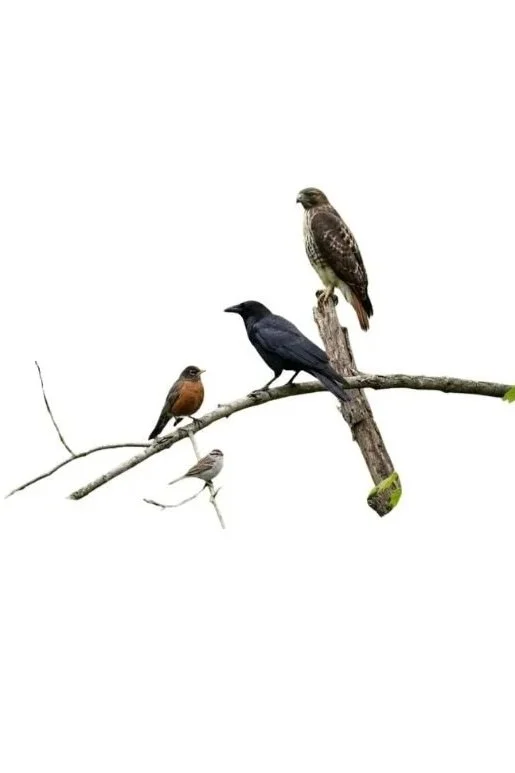
Showing relative size of some “common” North American birds (Chipping Sparrow, American Robin, American Crow, Red-tailed Hawk)
Relative Size
One of the most powerful skills a birder can develop has nothing to do with owning better binoculars or memorizing hundreds of species. It’s much simpler than that.
It’s learning to judge relative size.
At first glance this may sound obvious. Of course birds have different sizes. But the real trick—and the skill that strong birders develop—is learning to compare birds to other birds you already know AND seeing the size difference when you only have 1 bird in sight.
When you begin birding, the world can feel overwhelming. There are hundreds of species, dozens of bird families, and an endless combination of field marks, songs, habitats, and seasonal movements.
But experienced birders rarely begin with the field marks.
They begin with elimination. They don’t do it consciously but when they see the relative size they automatically eliminate hundreds of the 1100 species of birds in North America.
And relative size is often the first clue that starts the entire identification process.
The Bird Detective Process
Think of bird identification as solving a mystery.
When you see a bird, your brain should start working through a series of clues:
Relative size
Shape and posture (often called GISS – General Impression, Size, and Shape)
Habitat and time of year
Behavior and movement
Field marks
By the time you reach the field mark stage, a skilled birder has often narrowed the possibilities down to one or two bird families, sometimes even just a couple possible species.
Relative size is often the very first step in that process.
Why Relative Size Matters So Much
When beginning birders try to identify birds, they often start by looking for colors or markings.
That’s understandable. Field guides emphasize those details.
But color can be deceiving.
Lighting conditions change how colors appear. Birds may be in shadow. Juveniles often look different from adults. And sometimes birds simply refuse to sit still long enough to study every stripe and patch.
Relative size, however, is usually instantly visible.
Your brain can register size differences much faster than it can process detailed field marks.
For example, you may notice immediately that a bird is:
Tiny (warbler-sized)
Small (sparrow-sized)
Medium (robin-sized)
Large (crow-sized)
Very large (hawk-sized)
Those categories alone can eliminate dozens of species immediately.
Your “Reference Birds”
The easiest way to judge relative size is by comparing birds to a few common reference species.
Many birders use familiar backyard birds as their measuring sticks.
A few helpful reference birds include:
House Sparrow~6 inches
American Robin~10 inches
American Crow~17 inches
Red-tailed Hawk~22 inches
With practice, you start to mentally sort birds into categories like these. You’ll be surprised how quickly you start automatically use this skill when birding. This quick mental comparison instantly narrows your possibilities.
Relative Size in Action
Let’s walk through a real birding scenario.
You’re watching a mixed flock of birds feeding in a winter hedgerow.
There are several birds moving through the brush:
Some sparrows
A few juncos
Maybe a couple finches
Then you notice something.
One bird is noticeably smaller than the others.
It’s quick, nervous, and darting among the stems.
That size difference becomes your first clue.
The Chipping Sparrow Example
Consider the difference between two common winter sparrows:
Chipping Sparrow – about 5.5 inches
White-crowned Sparrow – about 7 inches
That may not sound like a dramatic difference on paper.
But in birding terms, it’s huge.
A White-crowned Sparrow is nearly 20% larger than a Chipping Sparrow.
In a mixed flock, that size difference becomes obvious once you train your eye to see it.
The tiny bird weaving through the group is likely the Chipping Sparrow. Now you check the field marks, open your field guide and confirm your ID.
Once size has narrowed your focus, you can confirm with field marks:
Chipping Sparrow:
Smaller body
Thin bill
Plain gray breast
Rusty crown in breeding plumage
Black eye-line with a white “eyebrow” in breeding plumage
But the key is that size started the process.
Relative Size Helps Eliminate Entire Bird Families
This skill becomes even more powerful when birds are less familiar.
Imagine spotting a bird perched on a fence post.
You notice immediately that it is:
Robin-sized
That single observation instantly eliminates many possibilities.
It is probably not:
A warbler
A sparrow
A kinglet
A chickadee
Instead, you might consider families like:
Thrushes
Blackbirds
Mockingbirds
Some woodpeckers
Just like that, your field guide search becomes much easier.
Habitat and Season Refine the Clues
After relative size, your next clue is usually habitat and time of year.
This is where a little background knowledge really helps.
Birds appear in places that match their lifestyle - usually.
Ask yourself:
Is the bird in water, woods, grassland, or backyard habitat?
What season is it?
What birds are expected in this region right now? (Research, apps, checklists, field guide maps can provide lots of help here)
For example:
If you see a robin-sized bird in a wetland in winter, you might consider:
Red-winged Blackbird
Rusty Blackbird
Brewer’s Blackbird
But you probably would not consider a thrush, which would likely be farther south during winter.
Relative size gives you the starting point.
Habitat and season narrow things even further.
Shape Matters Too
Size alone is powerful, but birders usually combine it with shape.
This is the famous birding concept known as GISS:
General Impression, Size, and Shape
Experienced birders often identify birds using GISS before they even notice field marks.
For example:
A crow-sized bird with a long tail and upright posture might suggest a:
Magpie
Small raptors
A robin-sized bird with a chunky body and upright stance might suggest a:
Thrush
Robin
Shape and size together become incredibly effective.
Practicing Relative Size
Like every birding skill, judging relative size improves with practice.
Here are a few exercises that help build the skill.
Exercise 1: Backyard Size Comparison
Spend a few minutes watching birds at your feeder or in a nearby park.
Ask yourself simple questions:
Which birds are smaller than a sparrow?
Which birds are about robin-sized?
Which birds are bigger than a crow?
Try sorting birds into size categories.
You’ll quickly start recognizing patterns.
Exercise 2: Mixed Flock Observations
Mixed flocks are fantastic learning opportunities.
Watch closely and ask:
Which birds are the smallest?
Which birds are the largest?
Which birds share a similar size?
This helps you notice birds that might otherwise be overlooked.
Exercise 3: Field Guide Immersion
A paperback field guide can be a powerful learning tool.
Spend a few minutes each day flipping through the pages.
Pay attention to the size information listed for each species.
Over time, you’ll begin to develop a mental library of bird sizes.
When you see a bird in the field, your brain will start making connections automatically.
This kind of daily immersion is one of the fastest ways to grow your birding knowledge.
Why Beginners Should Start With Size
Beginning birders often feel overwhelmed because they try to memorize everything at once.
Relative size offers a much simpler starting point.
Instead of asking:
“What bird is this?”
Try asking:
“What size bird is this?”
That single question immediately simplifies the puzzle.
Birding becomes less about memorization and more about observation and reasoning.
The Confidence Boost
Learning to judge relative size does something else important.
It builds confidence.
When you start eliminating possibilities and narrowing down bird families, you realize that bird identification is not random guessing.
It’s a logical process.
Every clue matters.
Size. Shape. Habitat. Behavior. Field marks. Time of Year.
Piece by piece, the puzzle comes together.
And once you experience that process a few times, birding becomes much more rewarding.
Birding Is a Skill That Grows
No one becomes an expert birder overnight.
But each time you practice a skill like judging relative size, your observation abilities improve.
Soon you’ll begin noticing things you once overlooked:
The tiny bird in a flock
The slightly larger sparrow
The robin-sized bird perched above them
These small observations lead to better identifications and a deeper understanding of the birds around you.
Practice With a Friend
Birding skills also grow faster when you share them.
If you haven’t already, consider inviting a friend to join you on a bird walk.
Two sets of eyes often notice things one person might miss.
You might spot the tiny sparrow, while your friend notices the larger bird perched nearby.
Birding together turns every outing into a learning experience.
If you’d like ideas on how to start, take a look at our 1 minute read on inviting a friend to go birding.
It’s one of the best ways to deepen both your birding skills and your enjoyment of the hobby.
Birders Love Helping Beginners
Another wonderful aspect of birding is the community.
Most birders remember what it was like to be new.
They are usually more than happy to help someone who is learning.
Local bird clubs, nature centers, and wildlife refuges often host guided field trips.
These outings can accelerate your learning dramatically.
Experienced birders will often point out things beginners might miss:
subtle size differences
posture and behavior
habitat clues
And before long, you’ll start seeing those clues yourself.
One Simple Skill, Big Results
Relative size may seem like a small detail.
But it’s one of the most useful tools a birder can develop.
By noticing whether a bird is sparrow-sized, robin-sized, or crow-sized, you immediately narrow the identification possibilities.
Combine that with habitat knowledge, seasonal awareness, and field marks, and you’ve suddenly become a much more effective bird detective.
Keep Building Your Birding Skills
This post is part of our Be a Better Birder series, where we focus on practical skills that make bird identification easier and more enjoyable.
If you’re just getting started, you might also want to revisit our Beginning Birding series for foundational skills like:
raising binoculars quickly
noticing field marks
birding by ear
using a field guide
The more these skills work together, the stronger your birding becomes.
And remember…
The best way to improve is simply to get outside and practice.
Watch the birds around you.
Notice their size.
Compare them with the birds you already know.
Before long, your eyes will start spotting clues automatically.
And that’s when birding really becomes fun.
Closing Thoughts
You don’t have to know the bird’s name to enjoy watching them but most birders do. And once you know the name, the fun really begins. Watch that Chipping Sparrow (or typically a small flock of them) and notice that even though the are quite small - they have a BIG attitude and are so wonderful to watch.
I know when to expect the chippers to arrive in early winter in my backyard and I know to enjoy them before the migrant north in the spring. My yard feels lonely without them but I’m happy to know I may have helped a few survive another winter in a safe backyard before they start that arduous journey north.
