

Why Birding is Good for Your Mental Health
At Any Age
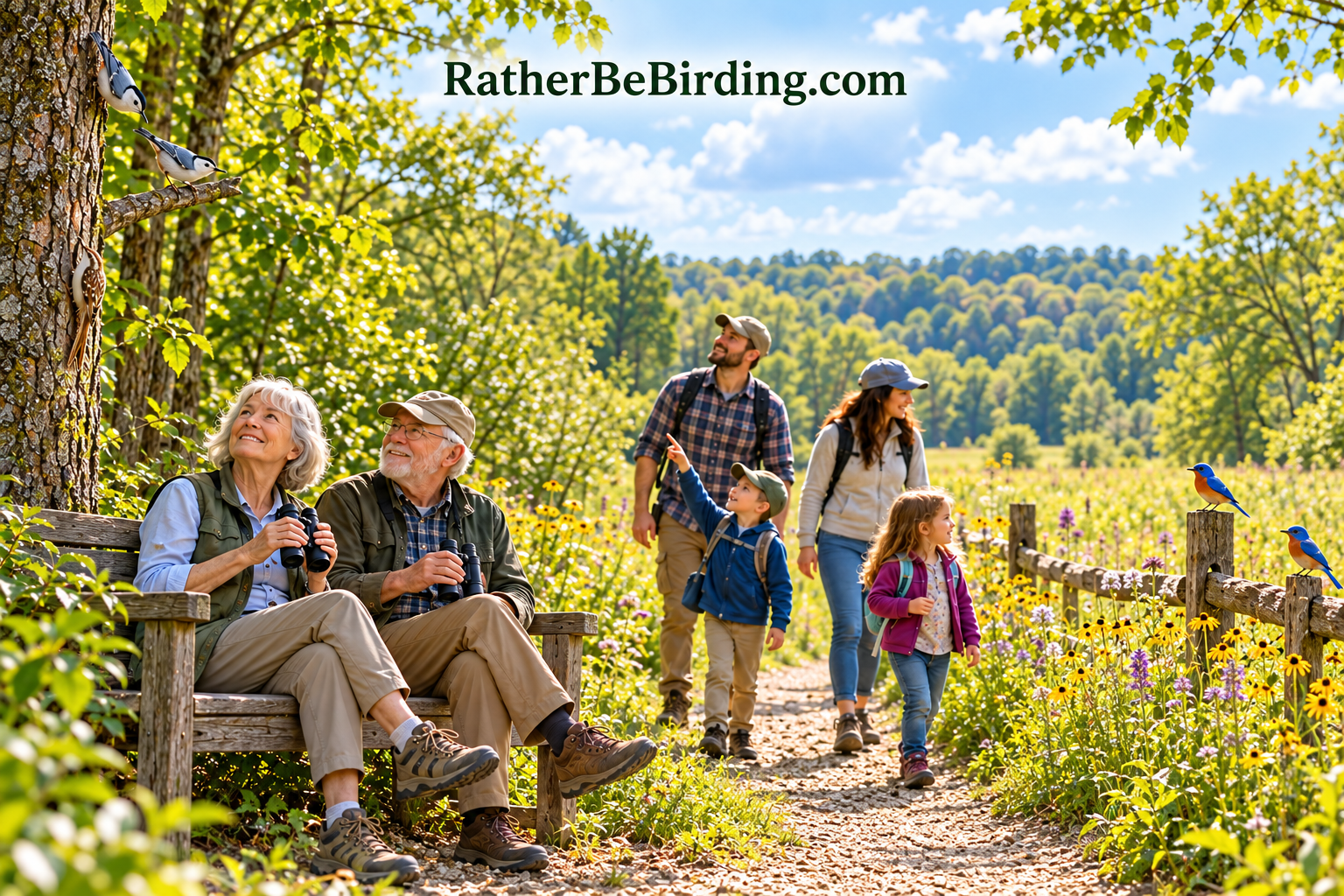
A cardinal lands outside the kitchen window. A wren sings from somewhere inside a shrub. You pause, look up, and listen. For a moment, your attention belongs to something other than the worries running through your head.
That small shift is one reason birding can become such a meaningful part of everyday life.
The mental health benefits of birding include opportunities to unwind, practice mindful attention, connect with other people, and find pleasure in ordinary surroundings. Research increasingly supports a relationship between encounters with birds, time in nature, and better psychological wellbeing.
For beginning birders, this is an encouraging place to start. You do not need to identify every bird to enjoy watching them. For older adults, birding offers something equally valuable: an interest that can adapt to changing energy, mobility, memory and circumstances.
Whether you watch from a window or explore a wooded trail, connecting with nature can give your day a welcome breathing space.
What Research Says About Birding and Mental Health
In a 2022 study published in Scientific Reports, researchers used the Urban Mind smartphone app to collect real-time reports from 1,292 participants. Seeing or hearing birds was associated with better mental wellbeing, including among participants who reported a diagnosis of depression. The association also appeared at the next assessment, suggesting benefits could extend beyond the immediate encounter.
This was an observational study. It shows a relationship, rather than proving that birds caused the improvement or that everyone will experience the same effect. Scientific Reports
A 2024 pilot study involving 112 participants on a college campus added experimental evidence. Researchers examined birdwatching sessions and nature walks relative to a control condition. Results supported improvements in wellbeing and reductions in psychological distress, with particularly promising findings for birdwatching. Larger, more diverse studies are still needed. NC State News
Together, these findings offer a good reason to take everyday nature experiences seriously. They do not establish birding as a treatment for depression or tell us exactly how much birdwatching any individual needs.
The practical invitation is simple: make room for birds, notice how you feel, and let enjoyment guide you.
Birdwatching Gives Your Attention Somewhere Else to Go
Modern life asks us to keep track of a great deal. Messages, appointments, headlines, family concerns, and unfinished tasks can follow us even when we sit down to rest.
A bird offers a different kind of invitation. What is it doing? Where will it go next? Why did it suddenly raise its crest? And maybe the most important - forget all that other stuff for a moment.
Following those questions gives your mind something immediate and interesting to work with. Instead of rehearsing tomorrow’s problems, you might spend a minute watching a chickadee carry away a seed or a woodpecker chip away bark.
Nature research offers a possible explanation for this relief. In a small 2015 experiment, participants who took a 90-minute nature walk reported less rumination afterward; those who took an urban walk did not show the same reduction. Rumination is the repetitive dwelling on distressing thoughts that can make it difficult to move forward. PNAS
That study does not mean you need a 90-minute walk to benefit from birding. It suggests that natural settings may help interrupt an unhelpful pattern of thought.
A backyard birding break is a manageable way to explore that possibility in your own life.
Mindful Birding Helps You Notice the Present
Mindfulness involves paying attention to present experience. Birding gives that idea something concrete to rest on.
You might notice the movement of a tail, the rhythm of a song, or the way sunlight changes the color of a bird’s feathers. You become interested in what is happening right here.
Try watching one bird for a full minute before reaching for a field guide. Notice its shape, posture, movements, and surroundings. If your mind wanders, gently return to the bird.
You can do the same with nature more broadly. Watch a butterfly land. Follow a leaf drifting across water. Listen to wind moving through branches.
You do not have to empty your mind or feel perfectly peaceful. The practice is simply returning your attention to something you can see, hear, or feel.
Read our blog “The Zen of Birding: How Birds Help Us Slow Down, Pay Attention and Reconnect”
Slow birding fits naturally here. Staying in one place gives you time to observe behavior you might miss while hurrying toward the next sighting. A familiar robin can be every bit as absorbing as a new species.
Birdsong Adds Another Way to Connect With Nature
Some birding moments begin before you see anything. A whistle comes through an open window. A woodpecker drums. Geese call overhead.
Listening can make even a familiar place feel more alive.
A 2026 experimental study examined combinations of forest and urban settings with recorded birdsong or traffic sounds. The forest setting paired with birdsong produced the strongest overall improvements in several self-reported measures, including stress and feelings of restoration. The findings support considering both what we see and what we hear in our nature experiences. NC State News
You can begin without knowing which bird is singing. Ask whether the sound is a whistle, buzz, trill, or repeated phrase. Notice whether it comes from high in a tree or low in a shrub.
For people with hearing loss, visual birding remains a rewarding option. Watching feeding behavior, flight, and interactions provides plenty to explore. Connecting with nature can draw on whichever senses work best for you.
Beginning Birding Builds Curiosity and Confidence
Learning a new skill can feel intimidating, especially when other people seem to know every name immediately.
Birding becomes more welcoming when you begin with small, useful questions. Is this bird larger or smaller than a robin? Does it climb a trunk or hop along the ground? Is its bill thick, slender, or hooked?
At Rather Be Birding, a helpful starting principle is: Focus on Family. Then Species.
Read the RBB blog post “Learn Bird Families: One of the Best Shortcuts to Becoming a Better Birder.”
Recognizing a woodpecker as a woodpecker is progress. Noticing that a bird behaves like a wren is progress. Identifying your first familiar neighborhood birds gives you a foundation to build on.
Each discovery offers a modest sense of accomplishment. You learn a call, recognize a silhouette, or notice a behavior you had overlooked.
The mental health value of birding should not depend on getting every identification right, however. Curiosity is enough to begin. An unidentified bird can still give you an enjoyable five minutes.
Keep a notebook of observations if you like. Include questions and memorable moments alongside species names. That makes the journal a record of discovery rather than a scorecard.
Why Birding for Seniors Is Such a Good Fit
Birding for seniors deserves special attention because the hobby can remain meaningful across many different circumstances.
Retirement may change the shape of a day. Health concerns can change how far someone travels. Grief or a move may make familiar routines feel different. Having an absorbing interest close to home can offer continuity while life adjusts.
A morning bird check provides something to anticipate. Returning migrants mark the seasons. A bird’s repeated visits create questions worth following tomorrow.
Birdwatching also involves learning and observation. Comparing shapes, remembering a familiar call, and interpreting behavior give the mind something engaging to do. Those activities make birding an enjoyable learning hobby; they are not evidence that it prevents dementia.
Older adults also bring valuable experience. Patience, knowledge of a neighborhood, and years of noticing seasonal changes all belong in birding. Someone who knows when the local trees flower may notice changes that a visiting birder misses.
Beginning birding later in life does not require catching up with anyone. You can develop an interest at your own pace and choose the parts that suit you.
You Can Enjoy Birding With Limited Mobility
Walking long distances is only one way to bird. You can watch from a porch, an accessible park bench, a wheelchair, or a comfortable chair beside a window.
For seated birding, choose a place with a useful view of vegetation, open sky, or water. Keep binoculars and a field guide within easy reach. A cushion, shade, and a convenient place to rest your arms may make observing more comfortable.
If you go out, check practical details first: surface conditions, distance from parking, seating, restrooms, and whether the route fits your needs. A short visit to a suitable spot can be more enjoyable than an ambitious outing that leaves you exhausted.
On hot days, early outings or indoor window watching may be the better choice. Let comfort help determine the plan. Birds take it easy during the heat of the day too, so bird early or late to see more activity.
If binoculars are difficult to hold, larger nearby birds can be easier to observe without them. Ducks on a pond, doves on a fence, and birds visiting a safely placed water source all provide interesting behavior to watch.
Your birding practice can change with your body and still remain yours.
Birds Can Help People Connect With Each Other
Birding can be wonderfully solitary, but it also creates easy opportunities for conversation.
Have you seen the hawk near the pond? What has been visiting your yard? Did you hear that wren this morning?
A shared subject can make meeting people feel less awkward. You have something to look at together, and conversation can grow from what you notice.
For beginning birders, a welcoming group can provide encouragement and practical help. For seniors, a regular outing or birding companion may become an enjoyable part of the week.
Choose groups that match your pace. Ask about walking distance, terrain, and how often participants stop. A bench beside a pond with one friend may suit you better than a large group covering several miles. Some groups tend to be populated by “expert” birders who may be more interested in the thrill of the “seeking” and in seeing the most birds. It can be hard to keep up with these Olympic birders. I’ve more than once thanked the group before turning around to head back to the parking lot because the pace was just too fast for me.
More likely you will meet field trips leaders dedicated to making sure everyone in group has a chance to see each new species, that you get a turn viewing through the scope if you want it and that you are not being left behind by the pace of the group. Sometimes a good leader will give you a heads up about the trip before you begin. “This is an rough, sometimes rocky, trail and is about a three mile walk with no shade.” That way you know before you go. And always notify the leader if you decide to bow out so they don’t organize a search party later.
You can also share birding across generations. A grandchild might help spot movement while you explain a familiar behavior. A friend can send a photograph of a mystery bird. Connection can grow around a shared question.
My son was two and joined my husband and I for a road trip through the excellent birding habitat in the northern part of Boulder County. Skip and I are watching a Canada Goose pair who had taken over a massive treetop nest that had formerly been a Great-horned Owl nest when the Red-tailed Hawk pair had abandoned it after building the nest 5 years earlier. Our son, from his position in the car seat inside the VW van, starts saying, “Woodpecker, Mommy, woodpecker!” I responded, “no honey, we’re looking at Canada Geese.” He said, “No Mommy - a woodpecker!” So I looked where he pointing and 10 feet in front of us on a tree trunk was a Red-headed Woodpecker - an unusual site in Boulder County. And just like that it became a part of his life too. I still often get texts of his daily sightings. I love that boy!
Backyard Birding Offers Enjoyment and Purpose
Creating a bird-friendly space gives you something to care for and observe over time.
A feeder is only the beginning. Native plants, water, shelter, and suitable nesting opportunities can make a yard more useful to birds while giving you more natural activity to enjoy.
Even a modest change can become an ongoing project. Watch which birds use a shrub. Notice insects around a native flower. Record visitors to a clean, well-maintained birdbath.
Learn how to create a bird sanctuary in your own backyard.
These observations can help you feel connected to the place where you live. Your surroundings become a habitat with relationships and seasonal changes worth understanding.
If you enjoy contributing, citizen science offers another direction. Participating in a bird count or submitting carefully identified observations can give your interest a broader purpose.
Keep the commitment realistic. Caring for one small patch of habitat or recording a few familiar birds may fit your life better than taking on a demanding volunteer role. Meaningful participation can begin close to home.
Keep Birding Enjoyable Instead of Making It Another Obligation
Any hobby can become stressful when comparison takes over. Birding is no exception.
Long species lists, rare-bird alerts, equipment choices, and impressive photographs can create pressure to do more. If that pressure crowds out pleasure, adjust the way you bird.
Choose an outing because the place interests you. Leave some birds unidentified. Put the camera away occasionally. Return to a favorite local spot even when nothing unusual has been reported.
On a difficult day, make the goal small: sit near the window and notice one bird. On an energetic day, explore somewhere new.
Birding and time in nature can support wellbeing alongside other forms of care. They do not replace mental health treatment. Persistent anxiety, depression, or distress deserves attention from a qualified professional, even if watching birds brings moments of relief.
You do not need to feel better every time you go outside. Enjoyment, interest, and connection are worthwhile experiences in their own right.
Start With a Five-Minute Birding Break
Choose somewhere comfortable: a window, balcony, porch, garden, or nearby green space. Put other tasks aside for five minutes.
Look for movement. Listen if you can. Watch one bird and notice what it does. If no bird appears, explore the light, leaves, insects, or clouds instead.
For help with Learning Bird Songs, click here.
Afterward, ask yourself what you noticed and how the pause felt. There is no required result. You are discovering a practice that may fit into your day.
Return when you can. Familiar places become richer as you learn their rhythms, and ordinary birds give you fresh things to notice.
Whether you are beginning birding, returning to an old interest, or adapting your outings as you age, start with what you have. A few minutes of attention can open a door to a more connected relationship with nature.
Your next step: choose one comfortable spot and see what happens there today.



A bird outside your window can give your attention somewhere new to go. Explore what research says about birding and mental health, plus simple ways beginners and seniors can enjoy curiosity, connection, and nature at their own pace.