

Why Birding Is a “Full-Brain Workout”
It might be one of the best things you can do for your brain.
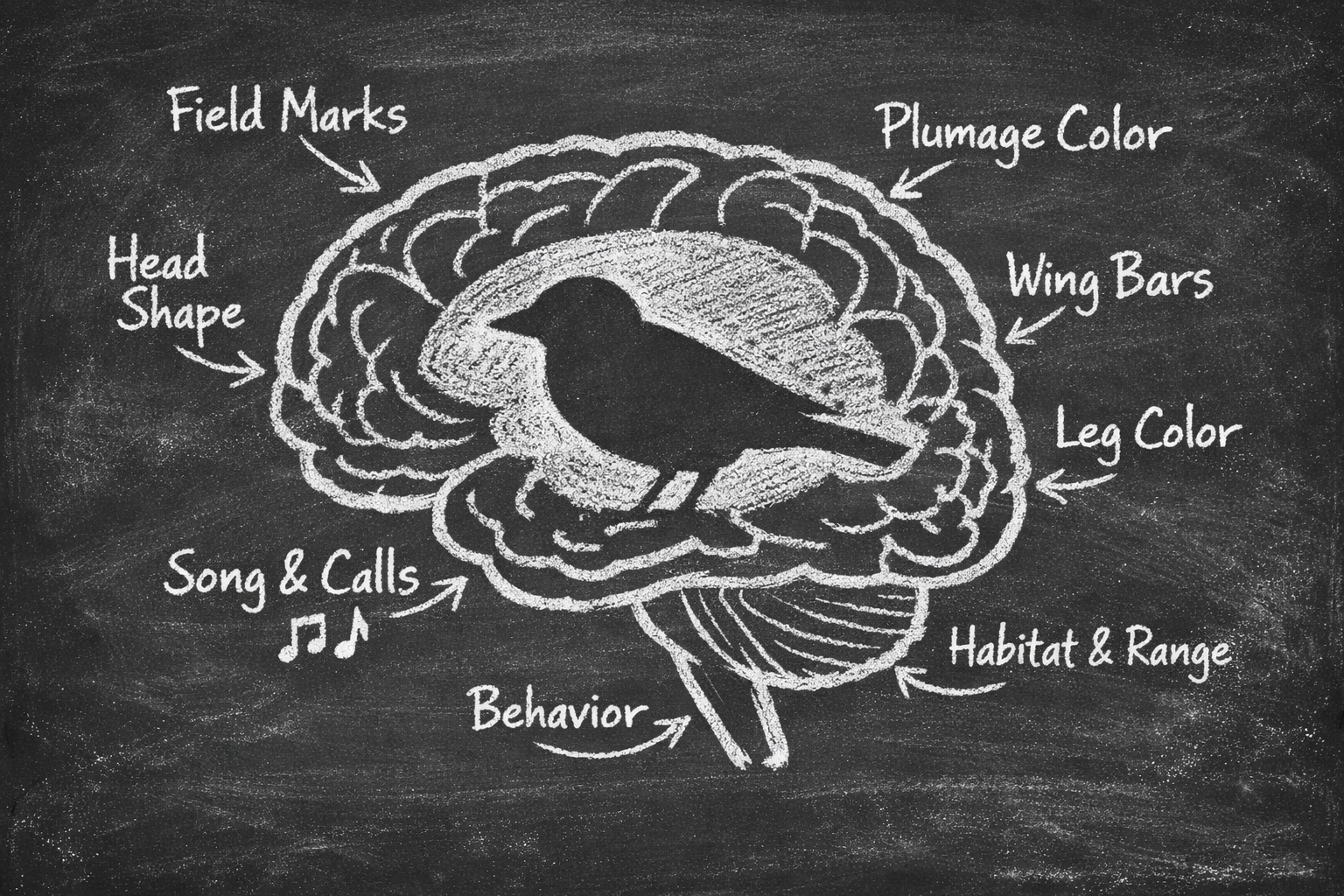
Birding isn’t passive.
It is often peaceful and helps you disconnect from the stress of your working life, but under the surface, your brain is firing on all cylinders - and that’s a good thing.
When you’re birding, you’re constantly using:
Visual processing (field marks, movement, patterns)
Auditory recognition (songs and calls)
Memory recall (species, habitats, seasons)
Decision-making (quick identification under pressure or fleeting sightings)
Pattern recognition (GISS, behavior, flock dynamics)
In fact, scientists now describe birding as a complex cognitive activity that engages multiple brain systems at once.
That combination is incredibly important—because it’s exactly what the brain needs to stay healthy over time.
The Science: Birders May Have “Younger” Brains
A groundbreaking 2026 study published in the Journal of Neuroscience compared expert birders with beginners.
What they found is fascinating:
Expert birders had more compact and efficient brain structures in areas tied to attention and perception
These same brain regions are the ones that typically decline with age
The differences persisted even in older birders
In plain English?
The brains of experienced birders were functioning more like younger brains.
Researchers believe this may help buffer against age-related cognitive decline.
That’s a big deal.
Birding and Dementia: What the Research Suggests
Let’s be clear—birding isn’t a cure for dementia.
But the evidence suggests it may be part of the solution.
Studies have found that people engaged in mentally stimulating, skill-based hobbies (like birding) may have:
Lower risk of Alzheimer’s disease
Better long-term memory
Improved cognitive resilience
In one report, individuals with higher levels of lifelong mental enrichment had up to a 38% lower risk of Alzheimer’s dementia.
And birding fits beautifully into that “mental enrichment” category.
Why?
Because it’s not just learning—it’s continuous learning.
There’s always:
One more species
One more song
One more subtle difference to master
And that ongoing challenge is exactly what builds what scientists call cognitive reserve—your brain’s ability to resist decline.
Think of cognitive reserve like this:
Every time you challenge your brain—learning birds, recalling songs, identifying subtle field marks—you’re making a deposit.
Over time, those deposits add up.
And later in life, when natural decline begins, you’ve got something to draw from.
Birding is uniquely powerful here because it:
Builds deep knowledge networks
Links new information to existing memory
Reinforces learning through repetition and experience
In fact, expert birders in studies showed better memory even for unrelated information when it was linked to their knowledge base.
That’s not just birding skill—that’s whole-brain benefit.
Attention, Focus, and the “Birding Brain”
One of the first things new birders notice is how much their attention improves.
You stop just looking… and start seeing.
Science backs this up.
Birders develop:
Stronger sustained attention
Faster visual processing
Better ability to filter out distractions
These are the same skills that tend to decline with age—yet they remain sharper in experienced birders.
And here’s the interesting part:
These aren’t isolated “birding skills.”
They transfer into everyday life.
Birding as Brain Training (Without Feeling Like Work)
Let’s be honest.
Most “brain training” programs feel like work.
Birding doesn’t.
That’s part of its magic.
It’s:
Enjoyable
Purposeful
Open-ended
Naturally motivating
And because of that, people stick with it for years—even decades.
That long-term engagement is exactly what the brain needs.
The Mental Health Benefits: Calm, Clarity, and Connection
Even before the neuroscience studies, we knew birding made people feel better.
Now we know why.
Research shows:
Seeing or hearing birds improves daily mental well-being
Time in nature reduces negative thoughts and stress
Birding can lower psychological distress and improve mood
There’s something uniquely calming about birds.
Maybe it’s their movement.
Maybe it’s their song.
Maybe it’s the simple act of paying attention.
Whatever the reason, birding naturally encourages:
Mindfulness
Presence
Slowing down
And those are powerful tools for both mental health and brain health.
The Physical Benefits (Yes, Those Count Too)
Birding isn’t just a mental exercise—it gets your body moving.
Depending on how you bird, it can include:
Walking trails
Standing and scanning
Traveling to new locations
Carrying gear
Even gentle activity like this can:
Improve cardiovascular health
Increase circulation to the brain
Reduce inflammation
And for older adults, birding provides low-impact movement that supports both physical and cognitive health.
No gym membership required.
Why Birding Is So Effective (Compared to Other Hobbies)
Not all hobbies are equal when it comes to brain health.
Birding stands out because it combines several key elements:
1. Continuous Learning
There’s no finish line. You’re always building knowledge.
2. Multi-Sensory Engagement
Sight, sound, movement, environment—all working together.
3. Real-Time Decision Making
Birding forces quick thinking and pattern recognition.
4. Nature Exposure
Nature itself improves mental health and cognition.
5. Social Connection
Field trips, birding buddies, and community learning.
Put all that together, and you’ve got a near-perfect recipe for brain health.
It’s Never Too Late to Start
Here’s one of the most encouraging findings from recent research:
The benefits of birding show up even in older adults.
Your brain doesn’t stop adapting.
It doesn’t stop learning.
It doesn’t stop growing.
So whether you’re:
Just starting out
Returning to birding after years away
Or deep into your life list
You’re doing something meaningful for your brain every time you step outside.
A Quiet but Powerful Habit
Birding doesn’t shout.
It doesn’t demand.
It doesn’t compete for your attention like everything else in modern life.
Instead, it quietly asks you to:
Notice
Listen
Focus
Learn
And in doing so, it strengthens the very systems that keep your mind sharp.
Final Thoughts: Birding Changes You (In More Ways Than One)
We often talk about birding as a way to connect with nature.
And it is.
But it’s also a way to reconnect with something else:
Your attention.
Your curiosity.
Your ability to notice the world in detail.
And now we’re learning—it may also help protect your brain for years to come.
So the next time you:
Pause at a feeder
Listen for a distant call
Or puzzle through a tricky ID
Just remember…
You’re not just birding.
You’re building a stronger, healthier mind.
👉 Want to sharpen your birding skills even more?
Check out our guide on Focusing on Field Marks and start building the kind of attention that benefits both your birding—and your brain.
